Behind The Shades
In the mid-’70s Graham Parker came out of nowhere, with a fistful of killer songs and a hell of a band. And if he never enjoyed the fame of his flashier new wave contemporaries, he left with the kudos and, as his new album underlines, a career. “I shouldn’t have survived,” he tells Sylvie Simmons. “But I did.”
Photo by Tom Hill.
BIBLICAL THUNDERSTORMS ARE BATTERING THE Hudson Valley. There are floods and powercuts and the heat is off the scale. “Other wise,” Graham Parker says, “I’m surviving. Sitting here waiting for the next round.”
This picturesque spot in the lower end of upstate New York is where Parker lives, though he still has the flat in London’s Maida Vale that he bought in 1980. In recent years, he says, he’s been spending more and more time there. “I call myself an international man of misery,” he adds with a laugh.
Right now he’s three shows away from the end of a solo US tour and two months away from the start of his UK tour – this time with The Goldtops, the band he made his new album Last Chance To Learn The Twist with. But today’s a day off – “There’s a lot of days off. I like it that way.
People expect me to tour like I’m a twenty-something, which I’m decidedly not.” He’s 73.
It’s been 47 years since Parker came out of nowhere, fully-formed, with his powerful first album Howlin’ Wind (1976). Small, wiry, always in sunglasses, he looked like a hybrid of Dylan and Springsteen and sounded somewhere between a soulful Van Morrison and a gritty Mick Jagger. He was also a great songwriter. Backed by The Rumour, Parker delivered the kind of smouldering anger and energy that Elvis Costello was known for – but Costello wasn’t around yet. By the time My Aim Is True appeared, in 1977, Parker was working on his third album, Stick To Me.
For all his mainstream success in the late ’70s and early ’80s, and the sustained quality of his output over the decades, Parker somehow bypassed becoming a household name and instead became an artist monopolised by connoisseurs. Then, part of Parker’s appeal is that he’s never seemed bothered by what people think of him. Behind those impenetrable shades, anything could be going on.
“My sunglasses? In fact they are very light these days,” Parker laughs, “other wise I’d be falling off the stage.”
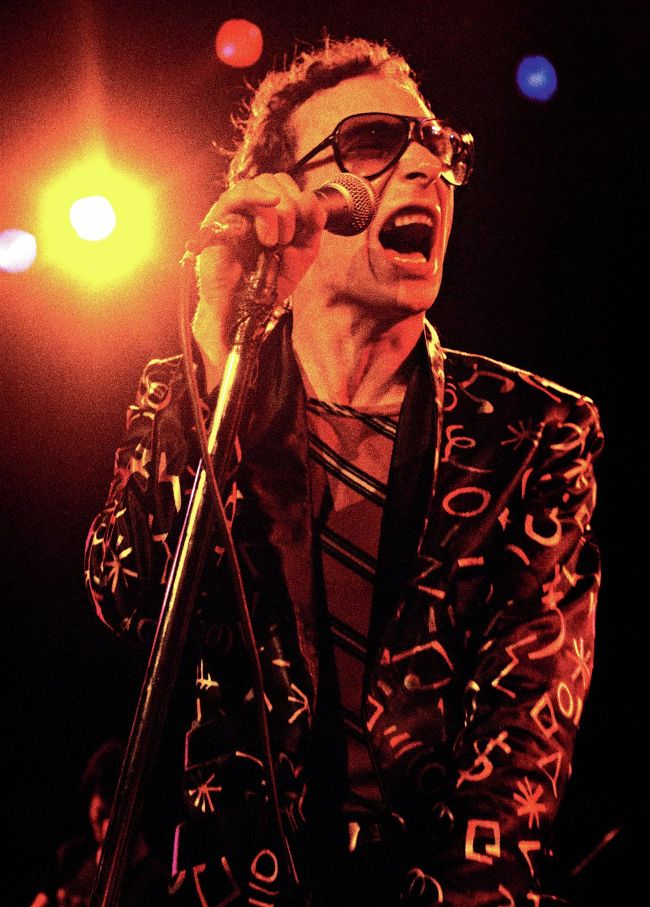
Sparks fly: Graham Parker on-stage at the Agora Ballroom, Atlanta, May 17, 1979.
Tom Hill/WireImage/Getty
BORNIN 1950 IN HACKNEY, LONDON, AND raised in Deepcut, Surrey, Parker can’t recall when he started singing, since he was doing it all the time. There was Cliff Richard and Lonnie Donegan – Parker and the kid next door had a skiffle group when they were about nine. And there was Elvis Presley and, even more to his taste, Little Richard – his mum worked as a waitress in the officer’s mess at the nearby US military base, and sometimes she’d inherit records from soldiers going home. But the watershed was when he was 12 and The Beatles arrived. “And then the Stones and all the other beat groups.” In short, Parker concedes, “It was a lucky spot to be in if you’re going to turn out to be a singer-songwriter.”