TROUBLED SOUL
DAVID BOWIE’s 1974 beggars belief. Two genius albums – Diamond Dogs and Young Americans – completed. Multiple shifts in music and iconography undertaken. All in the midst of personality crisis and management meltdown. Fifty years on, bandmates and associates relive a rollercoaster ride. “There were so many drugs,” they tell MARK PAYTRESS. “Even John Lennon hadn’t seen so much cocaine.”
MID-APRIL 1974: 22-YEAR-OLD EARL Slick was hungry for work. He’d recently auditioned for Dr. John on a tip from Michael Kamen, his sometime band leader, but it hadn’t led to much. Nevertheless Kamen, Slick’s mentor of sorts, had a good feeling about this one. “You’re gonna get a call from somebody,” he told the guitarist. “It’s a big one, so get your shit together.”
“First of all, I’d expected a rehearsal place,” says Slick, “not a dark, empty room at RCA studios in midtown New York City.” After some small talk with an assistant who introduced herself as Coco, he plugged his 1965 SG Junior into one of the two amps there, before a voice came over the monitor: “Put the headphones on. We’re going to play you some tracks. Just play along…”
First up was Diamond Dogs. Slick remembers that, because his hero was Keith Richards and the song had a Stones-like swagger. “The audition couldn’t have lasted more than 20 minutes,” he says. “Then… dead fucking silence.”
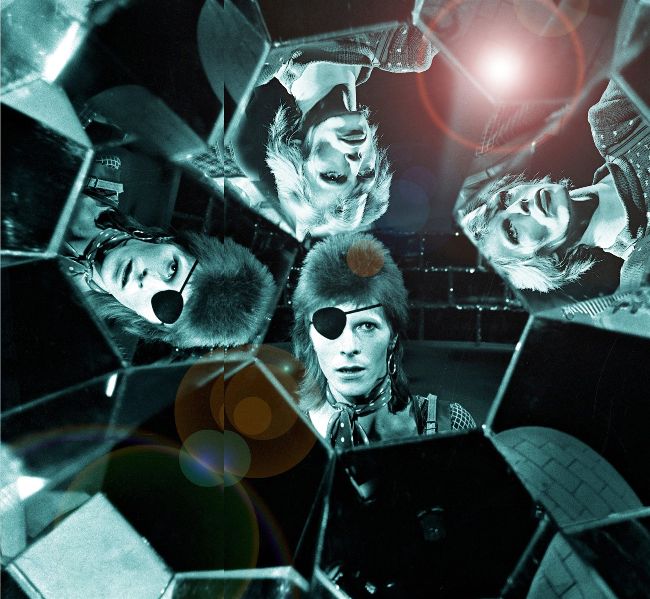
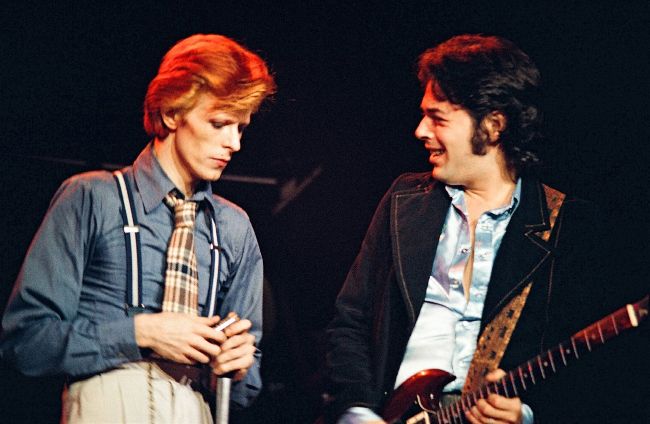
“Who can I be now?”: two faces of Bowie in ’74 – performing Rebel Rebel on Dutch TV in February; on-stage during the Diamond Dogs Tour in LA in September.
The Sun/News Syndication, Michael Ochs Archives/Getty Images
Terry O'Neill/Iconic Images (2), Camera Press/Robert Matheu
When a studio door opened, a pale, skinny figure walked gracefully towards him, stretched out a hand and introduced himself: “I’m David Bowie.”
“He was dressed the way an English rock star might think a Harlem pimp would dress,” Slick noted in his recent memoir, “loose, baggy pants matched with Capezio dance shoes. To top it off, he had bright orange hair under a grey fedora.” As the pair talked, the guitarist spotted something else – no eyebrows.
“There was a strangeness about the whole thing,” says the native New Yorker, whose own visual cues were standard issue rock muso – blue jeans, giant belt buckle, long hair, velvet jacket.
The following day, Slick was invited over to Bowie’s suite in the Sherry-Netherland, at the south-east corner of Central Park, where his hair was styled and he was measured up for a suit. This wasn’t rock’n’roll, brooded the guitarist, this was showbiz. Even so, he loved Bowie’s latest album, Aladdin Sane, and wasn’t about to pass up the chance to play guitar-heavy songs like Panic In Detroit and Time the length and breadth of North America. It was, as Kamen had promised, a big one.
SINCE
RETIRING
ZIGGY STARDUST, his alien rock star alter-ego, at London’s Hammersmith Odeon on July 3, 1973, Bowie had lurked in the shadows, Nosferatu-like. Now, in spring 1974, he was preparing to rouse himself from hibernation – in a new city in a new country. Earl Slick was but one of a whole retinue of new recruits.
The success and notoriety of the Ziggy project had ignited an enormous outbreak of star worship that both fascinated and appalled Bowie. At Ziggy’s ‘retirement’ party, he could now hold court at the top table flanked by Lou Reed, whose transgressive songs of New York sleaze had inspired him, and by Mick Jagger.
Androgynous, animalistic, the consummate rock prince, Jagger had been in Bowie’s sights for some time. The young pretender had covered the Stones’ Let’s Spend The Night Together in carnivalesque style on Aladdin Sane. That autumn, he duetted with Mick’s ex Marianne Faithfull on Sonny & Cher’s I Got You Babe for a TV special destined for the States, and slept with her too.
By winter 1973, Bowie’s vampiric inhalation of Jagger was almost complete. In early December, at a late-night session in Ron Wood’s Richmond home studio, the charismatic twosome traded vocals on It’s Only Rock’n Roll (But I Like It), a glam jam inspired by T. Rex’s Get It On. Three weeks later, on December 27, Bowie was in Trident Studios teaching session guitarist Alan Parker the best riff Keith Richards never wrote. It was the zinging refrain to new song Rebel Rebel. “I just wanted to piss Mick off a bit,” Bowie later admitted.
“I CAN’T BELIEVE HE PULLED SWEET THING OUT OF ME. I THOUGHT I’D GIVEN EVERYTHING I HAD ON ALADDIN SANE.”
MIKE GARSON
During the first weeks of 1974, these sessions for Bowie’s first post-Spiders album continued back at Olympic Studios in Barnes, west London, the Stones’ studio home since late 1966. Says Mike Gar-son, Bowie’s keyboard foil on Aladdin Sane and its emerging follow-up, “I knew about the Stones having been there. When you go to a studio like that, there’s a magic that feels like the notes find you as much as you find them.”
Yet for all the mutual affinities, there was little creative kinship between the Stones and Bowie. Olympic engineer Andy Morris worked with both in 1974. “With the Stones, there were loads of hangers-on,” he told MOJO. “David was a workaholic. He would come in at one in the afternoon and some days we wouldn’t leave until five in the morning.”
Besides, while The Rolling Stones had a sound, David Bowie had a method – permanent revolution.