FILTER REISSUES
Show Your Working
Reverseengineering Hunky Dory via demos, BBC sessions, live and studio recordings from Bowie’s most productive year. By David Buckley.
David Bowie
★★★★★
A Divine Symmetry
PARLOPHONE. CD/LP/BR
1971 STARTS with Bowie, if not in the total musical wilderness, then as a fringe figure. Despite being the most productive year of his entire career, it ends that way too.
He used it caching songs, building on an already size-able repertoire and, at the end of the year, releasing his first undisputed classic, Hunky Dory. It’s the go-to LP for anyone new to his music, yet in so many ways, it is the ending, not the beginning of a story. This was the last Bowie LP made in a position of relative anonymity, the last year in which David Bowie, and his creator, Brixton-boy David Jones, would be anything less than famous.
Recently married and about to become a dad, he would compose on acoustic guitar and the piano at home in Haddon Hall, Beckenham. His band the Spiders were forming but were as yet unnamed. Bowie had no manager and wasn’t signed to a record label. He was just 24. As a songwriter, he was still committed to not only writing songs for himself but for others. As a performer he was not yet confident stepping front and centre stage.
This vulnerability marks CD1 of this exhaustive box set, including 14 demos from which only six became actual finished tracks on Hunky Dory. We start with Tired Of My Life, written in 1970, unpromising with its wearied tempo and self-absorption. It’s binned… for now. More promising is Shadow Man, with its melody faintly reminiscent of Bee Gees’ To Love Somebody, and a lyric deal-ing with the possibility of adopting a new per-sona. The theme predates the Ziggy Stardust experiment. The music, like the next demo, Looking For A Friend, is mildly derivative of American country rock. Bowie is breaking no new musical ground here. Another demo for How Lucky You Are switches styles completely to a Brechtian staccato 3/4 time and has a rather contemptuous lyric suggesting the co-ercive emotional control of a partner (“When you walk, you follow two steps behind”). The song was offered to Tom Jones, who passed. Right On Mother could have sat comfortably on Bowie’s 1967 debut, telling the tale of a live-at-home man trying to break free of his mother. It too is never pursued beyond demo stage. However, we get to hear demos for songs which would become Bowie classics: Changes, Quicksand and Life On Mars?.
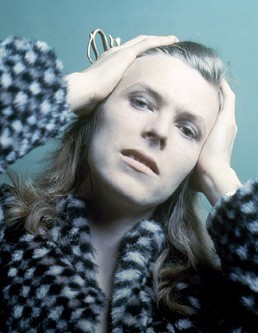
The David Bowie Archive. Photo by Brian Ward
BACK STORY: DREAR DAIRY
● Even for the completist, the six studio versions of Life On Mars? and eight different renditions of Kooks in this box set might feel like overload, but the whole package is undeniably classy. The artwork and design are perfect, using the same 1970 sans-serif font, Zipper, as the original. It’s an authentic fabrication – Bowie would have liked that. Best of all is the reproduction of Bowie’s own student notebook, complete with doodles, crossings out and misspellings. His attempt at ‘Dory’ (Bowie guesses with ‘Dorrey’ and ‘Dorey’) is proof that even our Rock Gods needed a dictionary.
Also included are live versions of Quick-sand, and The Velvet Underground’s Waiting For The Man (with an intro that seems to in-terpolate The Ad Libs’ doo wop song The Boy From New York City). Both were recorded not in concert, but in a San Francisco hotel. In January and February 1971 Bowie made a promotional visit to America to promote his then new LP, The Man Who Sold The World, and these songs were recorded unofficially. In fact, he performed seven songs in this private, hotel-room gig, one of which, reported to be named So Long Sixties, remains unreleased.
“It focuses on Hunky Dory’s stages of creation.”
Bowie collectors will have heard inferior sound quality versions of all these demos but not King Of The City. It had been assumed, from its title, that this might have been the progenitor of Suffragette City. But no, it’s an entirely different song, pleasing enough, un-remarkable except for that melody underpinning the verses which Bowie would repurpose in the “I’ve never done good things/I’ve never done bad things” section of 1980’s Ashes To Ashes. And the ‘repurposing’ goes on. Tired Of My Life was ripped up and started again as It’s No Game, also for Scary Monsters and again dras-tically improved upon, whilst Shadow Man was one of the songs Bowie reworked much later in his 2000 Toy project, given an official release in 2021.
CDs 2 and 3 are wholly devoted to live material. In June 1971, David Bowie And Friends performed for John Peel’s In Concert slot and here we get both stereo and mono versions, whilst in September, Bowie once again performed at the Beeb, this time a session for Bob Harris’s Sounds Of The ’70s. The audio is clear, the performances stripped down and the repertoire includes the non-LP song, Bombers, Jacques Brel’s Amsterdam and the first rendition of Kooks, written, so Bowie explains, when he was told of the birth of his son Zowie whilst listening to a Neil Young record. Finally, Live Friars, Aylesbury, also from September ’71, is a live performance from an artist who still seemed ill at ease as a frontman. The set starts with just Bowie and his guitarist “Michael Ronson”, with Bowie quipping “are you going to get nearer?… To the mic!” to an almost silent audi-ence. Fill Your Heart starts the acoustic set, one of five covers played that night. Oh! You Pretty Things had been a sizeable UK hit for Peter Noone but now Bowie was making it his own, twisting and improv-ing the melody. Just six months later, Bowie would debut The Spiders From Mars at the very same venue. The transformation from this hesitant live performer to the new demigod rocker was miraculous.