FILTER REISSUES
Ecce homo
Reissued separately with attendant B-sides, dubs and extended mixes, the chief Buzzcock’s transgressive electropop years revisited.
By Jim Wirth.
Pete Shelley
Steve Pyke/Getty Images
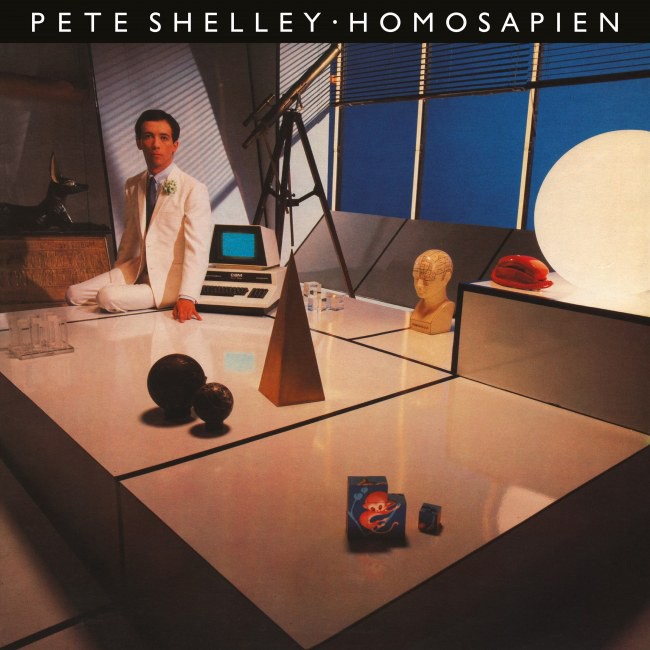
Homosapien
★★★★
XL-1
★★★
DOMINO. CD/DL/LP
W RITING IN his personal fanzine Plaything (street price, 3p) in 1978, Buzzcocks singer Pete Shelley was already waiting impatiently for the great post-punk leap forward. “The next wave will start from where this one has finished,” said the one-time National Coal Board computer operator. “So don’t slacken off now, but slip into a higher gear. There is still a lot more we can do.”
Getting his audience – and bandmates – to buy in to his vision for the future proved to be a challenge for Shelley. A thunderous dancefloor banger (even more impressive at its full 12-inch extension), his 1981 debut solo single Homosapien deployed the same electronic toolkit that producer Martin Rushent was using to make The Human League’s breakthrough LP Dare. However, the unambiguously man-on-man lyrics – “I’m a cruiser you’re a loser, me and you sir” and “homo-superior in my interior” – proved far too racy for mainstream consumption.
Back in circulation after decades in the bargain bins, the accompanying Homosapien LP – and follow-up XL-1 – represent Shelley’s attempt to reinvent himself for the 1980s, the genial, five-foot-six, Jackie comic boy next door recast as a futuristic 12-string troubadour.
Aggressively modern from the outside, Homosapien is also stuffed with material Shelley wrote as a teenager for his pre-punk glam band Jets Of Air, with the record’s queasy shifts of tone from existentialist ennui to Glitter Band feather-boa twirling suggesting a big in-joke that Shelley isn’t entirely sure he wants anyone to be in on. “Do it like a lion baby, do it in our lairs,” he shrieks on the ludicrously camp Just One Of Those Affairs. “Do it like the birds and bees and arctic polar bears.”
“I never felt I could play these songs with the Buzzcocks,” Shelley explained to Sounds at the time of his debut LP’s release in January 1982. However, as he embraced life outside the ur-Manchester guitar group, there was a sense – briefly – that everything was back in play.
Shelley had experimented with primitive electronics when he was still Pete McNeish – he irked some of his fellow Buzzcocks by releasing a solo LP of his 1974 oscillator doodles, Sky Yen, in 1980. However, he made his name by reinventing the love song with a run of killer Buzzcocks singles – What Do I Get?; Ever Fallen In Love; Promises; Everybody’s Happy Nowadays – spawning all indie-pop with a combination of brilliant melodies and a gender-neutral songwriting language stripped of alpha-male baggage.
“Sexually ambiguous, playful and also sort of inscrutable.”
He got bored with the punk rock 9-to-5 quickly, though, and felt he was being held back as former Buzzcocks support acts like Joy Division and the Gang Of Four took their place on the cover of NME. His band made strange, powerful records of their own – 1979’s daunting A Different Kind Of Tension and the three 1980 45s (Are Everything; Strange Thing; Running Free) that they envisaged as an album by instalments – but as they struggled to make ends meet, seemed unwilling to risk messing too much with the formula.
There was limited enthusiasm for the prospect of a fourth Buzzcocks LP when the band convened at the start of 1981. Eager to relight Shelley’s fire, the band’s regular producer Rushent persuaded the singer to come and record some demos at his newly-equipped Genetic studio, and something clicked. “We started recording Homosapien with just me on a 12-string, a drum synthesizer, a Roland MicroComposer and a big Roland synthesizer,” Shelley told Trouser Press in 1982. “Within a day we were sitting listening to the finished song.” Excited at the prospect of a new direction, Shelley quit the Buzzcocks in March 1981, and signed for Rushent’s Genetic production company, with Island picking him up as a solo act.