FROM HERE TO ETERNITY
Sixty years ago, the CRATEFUL DEAD embarked on a mission that would freak out label bosses, exasperate producers, and turn on millions to the infinite possibilities of improvised psychedelic rock. DAVID FRIČKE heads back to 1960s San Francisco, and uncovers the method and madness behind the band's wildest musical phase. "The Grateful Dead is an anarchy." their accomplices reveal. "And that was good and bad."
THE LETTER WAS DATED DECEMBER 27, 1967, ON THE OFFICIAL stationery of Warner Bros Records president Joe Smith, addressed to Danny Rifkin, co-manager of the label’s biggest investment in the San Francisco scene – the Grateful Dead. Smith was not happy.
“Lack of preparation, direction and cooperation from the very beginning have made this album the most unreasonable project with which we have ever involved ourselves,” Smith wrote of the chaos around the Dead’s second LP, less than half-done after two months at four studios in Los Angeles and New York. Producer Dave Hassinger – who’d engineered Top 5 albums by The Rolling Stones and Jefferson Airplane – had quit, fed up with the Dead’s combative manner. “Nobody in your organisation has enough influence over Phil Lesh to evoke anything resembling normal behaviour,” Smith complained to Rifkin, referring to the Dead’s cerebral, iron-willed bassist – half of the turmoil’s leading wedge with guitarist Jerry Garcia.
It was an inevitable clash of wills in a business overturned by The Beatles’ lavish milestone, Sgt. Pepper’s Lonely Hearts Club Band. The Dead’s deal with Warner Bros, signed in autumn 1966, ensured Garcia, Lesh, guitarist Bob Weir, organist Ron ‘Pigpen’ McKernan and drummer Bill Kreutzmann full artistic control and unlimited studio time. Hassinger, hired for their debut album, ignored that, producing The Grateful Dead in four days. Nervous and speeding on Dexamyl, a diet medication, the Bay Area’s hottest improvising dance band zipped through a typical setlist of folk and blues covers in brittle, mostly three-minute blasts.
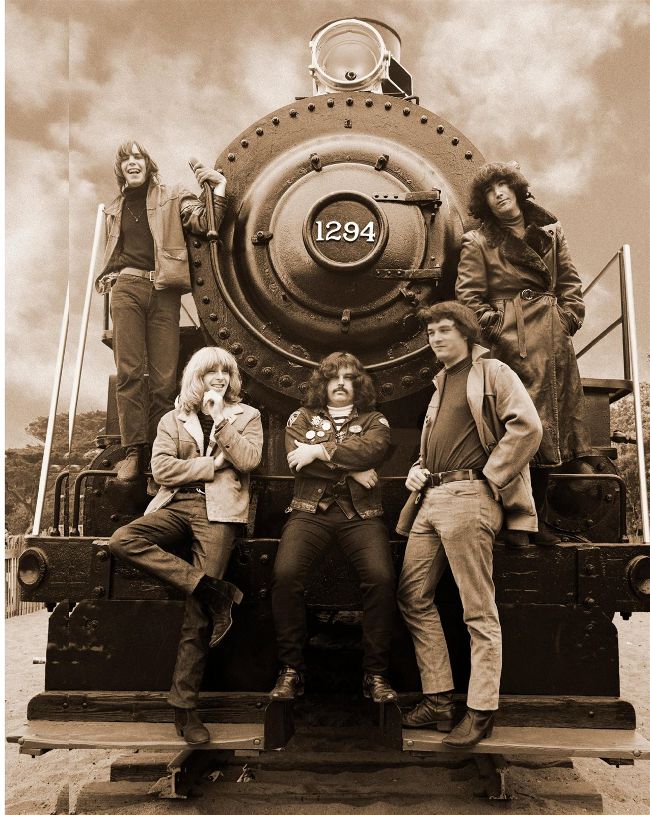
Freedom riders: the Grateful Dead get ready to steam out of San Francisco, September 1966 (from left) Bob Weir, Phil Lesh, Ron ‘Pigpen’ McKernan, Bill Kreutzmann, Jerry Garcia.
Aside from a 1965 demo session as the Emergency Crew and a ’66 single for an obscure local imprint, “we had no real record consciousness,” Garcia admitted to Rolling Stone in 1972. The Grateful Dead, issued in March, 1967, “was simply what we were doing
on-stage,” played “way too fast… It was weird, and we realised it.”
The band’s original concept, Garcia confessed in another interview, was “unreasonable… one LP, two sides, one song” – closer to the LSD-assisted infinity the Dead sought in performance, pursuing collective transcendence in the R&B and Delta fundamentals of Wilson Pickett’s In The Midnight Hour and the Cannon’s Jug Stompers’ Viola Lee Blues. “It was a combination of mistake, fate and faith,” Weir said, looking back in 2009. “We learned to trust ourselves and each other,” while serving the audience. “Our job was to find the beat and get people dancing.”
The second album would go, as Garcia put it, “that whole other way”. In September 1967, as recording commenced in LA, the guitarist confided his plan for the Dead’s enduring portrait of the ballroom experience in San Francisco’s brief season of acid, licence and community – 1968’s Anthem Of The Sun. “We’re thinking of doing parts of the next album live,” he told jazz critic Frank Kofsky. “We’re also gonna try doing stuff with combining live and studio.” The band had “some nice, heavy material and good ideas”.
This time, Garcia warned, “We’re gonna go in and fuck around.”
Baron Wolman/Rock and Roll Hall of Fame/Getty, Paul Ryan/Getty, © Jim Marshall Photography LLC, Ron Rakow/Retro Photo Archive/via Jay Blakesberg, Stanley Mouse
THAT’S ALL THEY DID AT FIRST, ACCOMPLISHING “absolutely nothing” in LA, Garcia said, then driving Hassinger around the bend in New York. “We were being so weird,” Garcia noted generously. The producer “was only human after all”.
The Dead were now a fiercely polyrhythmic force, adding a second drummer, Brooklyn-born Mickey Hart, after he met Kreutzmann at a Count Basie show, and the two locked like brothers during a Dead gig in late September 1967. This was a newly assertive band of composers too, recording entirely original material for Anthem even as it evolved in shape and detail on-stage. That’s It For The Other One was a wildly swerving multi-part suite with a churning, staccato centre inspired by The Yardbirds’ Little Games. Garcia described New Potato Caboose to journalist Ralph J Gleason as “a very long thing” without “versechorus form” but plenty of “fast, difficult transitions”.
Garcia persuaded Robert Hunter, a poet friend from their teenage years in Palo Alto, to contribute lyrics. In the early 1960s, the two played folk and bluegrass in coffeehouse combos, and Hunter’s reports from his 1962 participation in an LSD-research programme at Stanford University inspired his friend to go tripping. Fittingly, Dark Star, Hunter’s first, crucial submission to the Dead, was a compact rapture in luxuriant, galactic metaphor. Recorded as a single in New York, it immediately took on light-year dimension in live improvisations.