HOW TO BUY
Gil Scott-Heron
The street sermoniser, ‘bluesologist’ and godfather of rap.
By Lois Wilson.
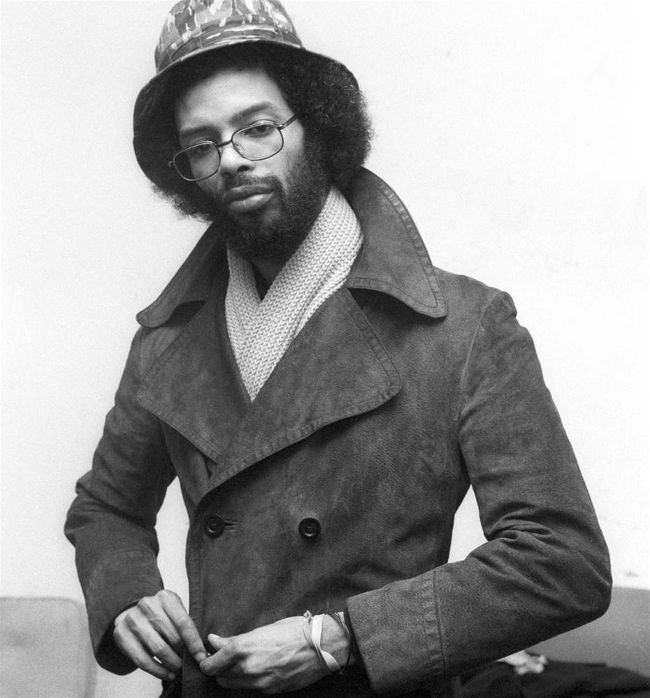
Buttoning up: Gil Scott-Heron, “America’s social conscience”, in Birmingham, UK, 1975.
AS AMERICA’S social conscience, Gil Scott-Heron spent his 40-plus-year recording career articulating injustice and inequality with poem-songs such as The Revolution Will Not Be Televised, Winter In America and B-Movie, hardhitting, astute street sermons that pulsed with a militant energy. Yet as he put it to this writer in 2010, “I’m not a 24-hour news channel. Life is also full of fun, we fall in love, we laugh, we dance.” Scott-Heron’s music combined it all. Who else could also fill a dancef loor with a joyous-sounding yet scathing critique of South African apartheid called Johannesburg and deliver a hymnal about life itself as uplifting and positive as I Think I’ll Call It Morning?
Scott-Heron’s own story is as compelling as his art. Born on April 1, 1949 in Chicago, his father was Gilbert ‘The Black Arrow’ Heron, Celtic FC’s first black professional footballer, and his mother Bobbie Scott was an opera singer who performed with the New York Oratorio Society. His maternal grandmother, Lily Scott, was pivotal in his artistic growth. A civil rights activist in Lincoln, Tennessee, she raised Gil until he was 12, introducing him to the piano, gospel music and the writings of Langston Hughes, one of his core inf luences. When she died, he moved to New York to live with his mother. Winning a scholarship to the elite Fieldston school in Riverdale, he discovered LeRoi Jones – AKA Amiri Baraka – another touchstone, before studying English at Lincoln University in Pennsylvania, where Hughes had studied and where Scott-Heron met his key musical collaborator, the pianist and flute player Brian Jackson. It was Bob Thiele, the jazz producer, who suggested he record an album of his poetry over a rhythmic backdrop; the result was 1970’s groundbreaking Small Talk At 125th And Lenox, the first of 15 studio albums and nine live recordings that mixed spoken-word dissension with funk, jazz and blues – he called himself a “‘bluesologist’; a scientist who is concerned with the origin of the blues.”