BORN TO BOOGIE
With the searing sizzle of his guitar and the seismic rumble of his voice,JOHN LEE HOOKER'sblueswere shaped by his struggle to get paid - at least, until Carlos Santana and Keith Richards intervened. Through it all, over 70 years of music, he remained serious, hilarious, inimitable. “Never knew anybody like that guy,” acolytes tell DAVE DIMARTION
Portrait: JAY BLAKESBERD
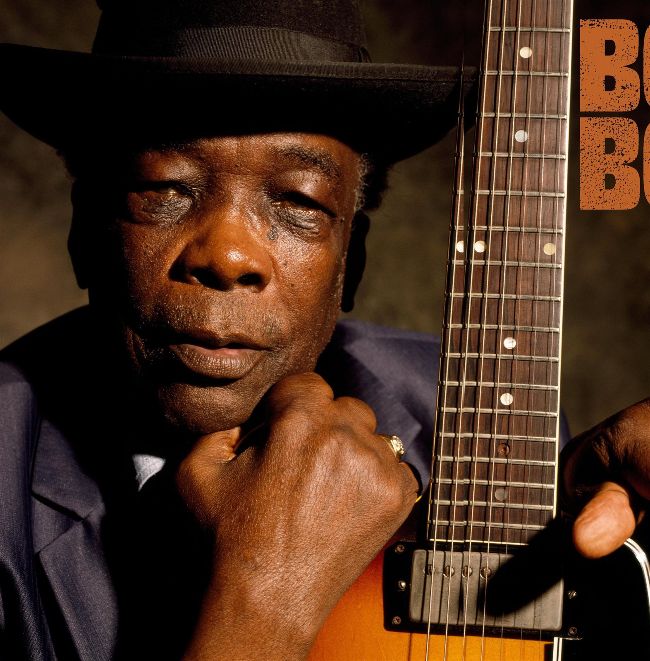
In the mood: John Lee Hooker, deep-cut bluesman, San Francisco, 1992.
© Jay Blakesberg
ELVIN BISHOP IS TELLING SOME JOHN LEE HOOKER STORIES.
“One time I called him up on a Friday night and I said, ‘John, I caught a bunch of catfish. You want some?’” recalls the former Paul Butterfield Blues Band guitarist. “And he said, ‘Don’t bring ’em now. Bring ’em Monday. Because they’ll eat ’em up.’ He meant the people at his house, ya know? He had a lot of people staying at his house.
“He loved to eat good food, especially soul food. I remember one time we were on the road. I was part of a little revue that they put together, and John was the headliner. One of those days I called him up in his room, and said, ‘How’re you doing today, John?’ “He said, ‘I’m doing good. I got me some chicken.’ “I asked him if the chicken was good. He said, ‘It’s so good, I ain’t even gonna eat it. I’m just gonna sit here and kiss on it.’”
There are John Lee Hooker stories galore, most of them endearing, parts of a long life story that reads as a series of absolutes, of memorable episodes, with a core vividness.
“He was hilariously funny to be around,” recalls Carlos Santana. “He always had two gorgeous ladies to the left, two gorgeous ladies to the right. On one side, they’re feeding him Junior Mints, and the other side, they’re feeding him fish and chips. So he’s eating fish and chips and mints, man, with these four gorgeous women just massaging his hot soft hands. I never knew anybody like that guy.”
Nor has the world. The stellar blues singer and guitarist, who departed this earth on June 21, 2001, but entered it at a less precise time (August 22 of 1912 or 1917, pick one), had remarkable appetites, a singular set of musical skills, and a striking sound and presence that can captivate first-time listeners instantly.
Hooker’s story involves nearly every ingredient a writer might concoct were he or she crafting historical blues fiction. Location of birth unclear (Tutwiler or Clarksdale, Mississippi); the youngest of 11 children sired by a sharecropper/Baptist preacher father and a mother, Minnie, who would remarry guitarist William Moore, Hooker’s first influence; and finally, after running away from home at 14, a life lived all over the place. All this, and he stuttered – though not while singing.
From around 1931, Hooker played guitar and sang on Beale Street in Memphis – acontemporary of locals Robert Nighthawk and Robert Lockwood, Jr. – eventually moving north to Detroit in the early ’40s. Here there was work to be had – for Ford Motor company, among other employers – audiences to perform for, and a growing family to feed.
Hooker’s unique idiosyncrasies – he rarely played 12- bar blues; he would stretch or contract verses and bars as he saw fit; song lyrics changed with every performance – meant few backing bands could accompany him comfortably. The combination of guitar and his deep, almost guttural vocal, usually intoning a lyric filled with faint dread, made John Lee Hooker sound like no one else.