IT’S ALL TOO BEAUTIFUL
SMALL FACES’ metamorphosis from pilled-up enfants terrible into groovy psychedelic magi remains one of the wonders of the ’60s rock revolution. But as Ogdens’ Nut Gone Flake returns, laden with unreleased bounty, witnesses including drummer KENNEY JONES still wonder how their greatest work sounded their death knell. “Subconsciously,” they tell TOM DOYLE, “we were all thinking, How could you beat Ogdens’ ?”
AS WAS SOON TO BECOME THE STUFF OF LEGEND, Steve Marriott really didn’t get on with his long-suffering neighbours in Eyot Green, Chiswick. To be fair, residing next door to the pint-sized, turbo-charged Small Faces singer in 1968 was surely a living hell. “Of course it was!” splutters drummer Kenney Jones today. “I’d have hated to be his neighbour.”
Day or night, Marriott blasted music from an enormous pair of wall-rattling Wharfedale speakers he’d bought in a clear-out sale from Olympic Studios, where the Small Faces’ record label Immediate had afforded the fast-developing group virtually unlimited recording time. Suspiciously fragrant smoky odours tended to emanate from the singer’s property. Dodgy-looking Mods and longhairs were coming and going at all hours.
Annoyed by his neighbours’ noisy protestations, Marriott furtively tried to turn them around – or on – to his way of thinking, by tampering with a shared cistern.
“It was a row of terraced houses, so they used to share the same loft space,” Jones remembers. “This guy kept banging on the wall, shouting, ‘Keep the noise down!’ Steve got so pissed off he went up into the loft and poured some LSD into his drinking water.”
When the Small Faces shot the promo film for Lazy Sunday, the stomping ode to domestic disturbance that these incidents inspired, their singer further rubbed it in by depicting himself on the lawn at Eyot Green surrounded by huge Marshall amps and with his neighbours’ house conspicuously in the background. Other scenes, shot at Kenney Jones’s parents’ home at 34 Havering Street, Stepney, revealed the band’s working-class East End roots. At one point, Marriott could be seen disappearing with a loo roll into the Joneses’ outside toilet.
“Oh yeah… how could I forget that place?” the drummer shivers. “In the winter your arse used to get stuck to the bloody seat, it was so cold.”
While it reached Number 2 in the UK in the spring of ’68, becoming the Small Faces’ fourth Top 3 hit, Lazy Sunday was in fact released as a single against the band’s will by Immediate’s owner Andrew Loog Oldham. Last year, Jones confessed to MOJO, “I can’t stand it to this day.”
“I don’t really hate the song,” he now qualifies. “I just don’t like the memory of the song. We discovered it was a hit record when we were touring Germany, and we opened up Melody Maker. Andrew used to go into the studio while we were away sometimes and listen to what we were doing and say, ‘Oh that’s a hit, I’m gonna put it out.’ It was not the kind of song that we wanted to put out to portray what we were really doing.”
Determined to escape their teeny bop or novelty pop image, and becoming increasingly psychedelicised, the Small Faces had already created their masterpiece, the kaleidoscopic, part-conceptual Ogdens’ Nut Gone Flake, released just over a fortnight after Lazy Sunday. Lyn Dobson, sax/flute player on Ogdens’, remembers that when Marriott, bassist Ronnie Lane and keyboardist Ian McLagan subsequently moved together into Jerome Cottage in Marlow, Buckinghamshire, they offered a haven for other consciousness-expanding seekers.
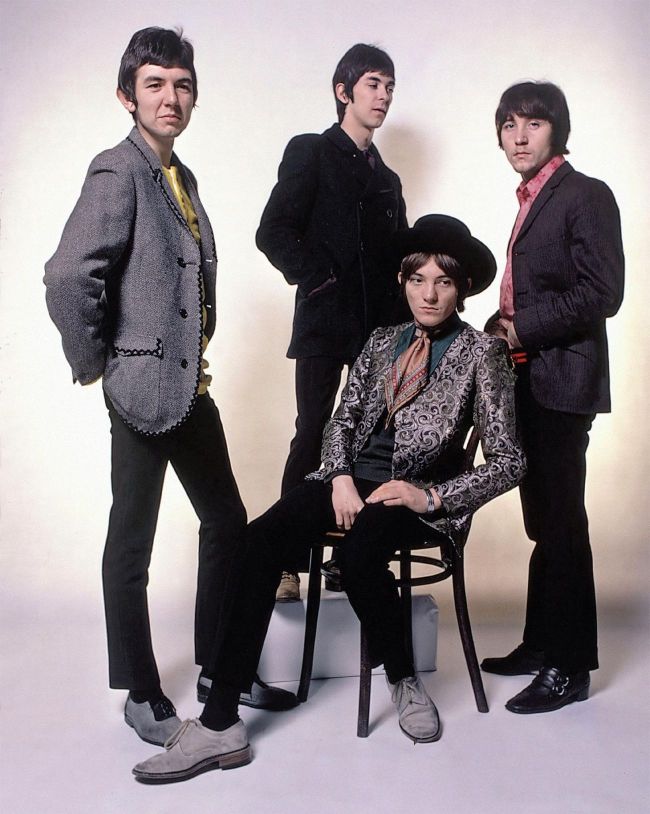
Bits of kids: Small Faces in 1966 (from left) Ronnie Lane, Ian McLagan, Steve Marriott, Kenney Jones.
Pictorial Press Ltd/Alamy Stock Photo
LFI/Photoshot/
Avalon.red, Pictorial Press Ltd/Alamy Stock Photo(2), Gems/Redferns/Getty, Mirrorpix
“The first trip I ever had was in that place,” he says. “We started talking about spirituality. I was meditating at the time. Steve said to me, ‘Well, you can do that for the next 20 years, but if you take LSD or mescaline, you can get there directly.’
“I don’t recommend that people take psychedelic drugs,” Dobson cautions. “But if you’re gonna take them, take them in a perfect situation. And that’s what they created for me. I heard the dawn chorus like it was a symphony – better than anything I’d heard from Beethoven.”
Flipping through Steve Marriott’s record collection, Dobson was impressed by the eclectic range of the singer’s listening tastes. “Steve had this really incredibly extensive knowledge,” he attests. “I found this old scratched S Balachander album. That’s what excited me. If he was listening to South Indian veena players, then he wasn’t your average rock musician at all.”
MORE EVIDENCE OF THE SMALL FACES’ singularity arrives next month with a lavish reissue of Ogdens’ Nut Gone Flake, in the form of a half-speed mastered vinyl cut of the album and a three-disc box set featuring mono and stereo versions, alternate mixes and work-in-progress recordings that illuminate the group’s increasingly baroque studio arrangements. It’s further proof that the Small Faces were a band apart, belying their cheeky urchin image with musical depths that swirled together R&B, psychedelia and music hall, making records that punched above their weight at the time and remain rock landmarks. The irony was that the creation of their greatest work was also their undoing.
“THIS GUY KEPT SHOUTING, ‘KEEP THE NOISE DOWN!’ STEVE WENT UP INTO THE LOFT AND POURED SOME LSD INTO HIS DRINKING WATER.”
KENNEY JONES
The Small Faces’ route to Ogdens’ had involved wild highs and frustrating lows. They’d met as teenagers when Kenney Jones and Ronnie Lane wandered into an east London music shop where Steve Marriott was employed as an assistant. Together with second guitarist/organist Jimmy Winston they’d achieved instant chart success with their debut 1965 Decca Records single Whatcha Gonna Do About It (an inspired knock-off of Solomon Burke’s Everybody Needs Somebody To Love with lyrics by Brian Potter and Ian Samwell). But their second, this time self-written 45, I’ve Got Mine, flopped. Forced into recording Kenny Lynch and Mort Shuman’s peppy singalong Sha-La-La-La-Lee, which hit Number 3 in early ’66, they attracted legions of unwanted teen screamers.