THE MOJO INTERVIEW
Judas Priest’s heavy metal air-raid siren lived a lie before grasping the nettle of his sexuality. Now his honesty and passion drive him and his band onwards towards their eighth decade. “I still love my metal,” insists Rob Halford.
Interview by BOB MEHR • Portrait by JIM LOUVAU
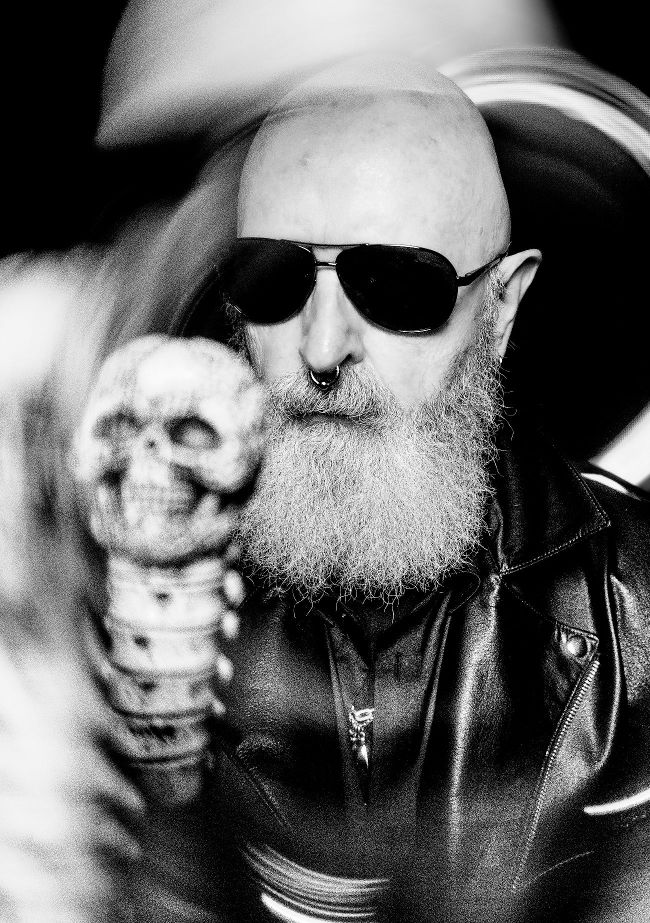
Jim Louvau, Unique Nicole/Getty
“THE OTHER DAY, I CAUGHT MYSELF sitting on the couch watching The Weather Channel,” says Rob Halford, laughing. “Here I am, 50 million albums sold, the Metal God, watching The Weather Channel.”
It’s a sunny December afternoon in Phoenix, Arizona – the city Halford has called home since 1981 – and he’s holding court in the control room of PMD Studios. At 74, Halford – tatted, pierced, and dressed head to toe in black – hasn’t slowed down, at least not professionally. He’s fresh off a tour leading Judas Priest on a co-headlining run with his pal and neighbour Alice Cooper, and planning a busy 2026 for the band he’s fronted since 1973.
Now married to his partner of three decades, Thomas Pence, Halford has come to prize his “often boring” life off-stage. “Back in the day, I’d be down the clubs seven nights a week, a social butterfly,” he says. “Now I value a certain peace and quiet. I still love my metal though. I still crank stuff up every day.”
Over the course of six decades, Halford and Priest have helped define and evolve the heavy metal genre. A native of Walsall in the West Midlands, the singer brought a theatrical bent and an octave-leaping voice to the group, which slugged it out for half a decade before breaking through. As their fame grew in the ’80s, Halford and bandmates would battle addiction, plus, from outside their musical subculture, unwelcome salvoes of derision, ignorance, even fear.
Notoriously, in 1990 they were accused of planting subliminal messages in Better By You, Better Than Me – a cover of the old Spooky Tooth song tacked onto their 1978 album, Stained Class – encouraging a pair of Nevada youths, James Vance and Raymond Belknap, to engage in a suicide pact, resulting in Belknap’s death. The subsequent trial – in which band members including Halford were cross-examined – was as troubling for Priest as it was bizarre, one of the last significant sorties in conservative America’s war against rock that had begun with a similar 1985 case against Ozzy Osbourne, and the establishment of the PMRC.
Exonerated but increasingly on different pages, Halford and the group parted company in the early ’90s, the singer exploring other projects before rejoining a decade later. In between, he announced publicly that he was gay, eventually chronicling his life as a closeted heavy metal superstar in the deeply revealing 2020 memoir Confess, a landmark in shifting attitudes in society and music cultures on both sides of the pond.
Re-established in Priest, and despite shifts in their line-up (Ian Hill and Glenn Tipton remain part of the group’s long-serving core) Halford’s enthusiasm for his band is if anything keener than ever.
“I like the fact I haven’t become jaded, that I still get a thrill and a buzz from being on-stage. I love being a musician, the whole creative process,” says Halford, who’s been collecting song ideas in preparation for recording the next Judas Priest album, the band’s 20th.
This year, the group will also look back, marking the 50th anniversary of their standout second LP Sad Winds Of Destiny – which will receive a box set treatment in April – and the 40th anniversary of their ’80s glam-metal album Turbo, with a run of summer dates that Halford has dubbed the “Faithkeepers” tour.
“Keeping the faith,” says Halford, “that’s what we’ve been doing collectively as a band with our fans and the metal community all these years.”
What are you earliest memories of music?
As a kid, six or seven years old, staying at my grandparents. They had this old house near the Beechdale Estate, where I lived with my mum and dad. It was a typical Coronation Street house, and I would go over there for the weekend almost ritualistically. They would push together a couple of armchairs by the side of their bed into a little bed for me. They’d always be up at the crack of dawn and I would wake to the smell of bacon and the sound of music. I’d go downstairs, and they had the radio cranked up – and it was Arthur Askey, Billy Cotton and his orchestra, classical and variety music. They also used to buy 78s and I would look at those and put them on. Even as a child, I was fascinated by music and how it made me feel.