GB
  
You are currently viewing the United Kingdom version of the site.
Would you like to switch to your local site?
20 MIN READ TIME

ONCE AND FUTURE KING

B.B. KING was the gracious, perma-gigging ambassador of the blues, but his seeming serenity glossed a rollercoaster career, struggles with racism and gambling, audiences lost and found. As a new tribute album reinforces his legacy, MAT SNOW goes to bat for arguably the most underrated legend of the form, starting with the gig that turned everything around...
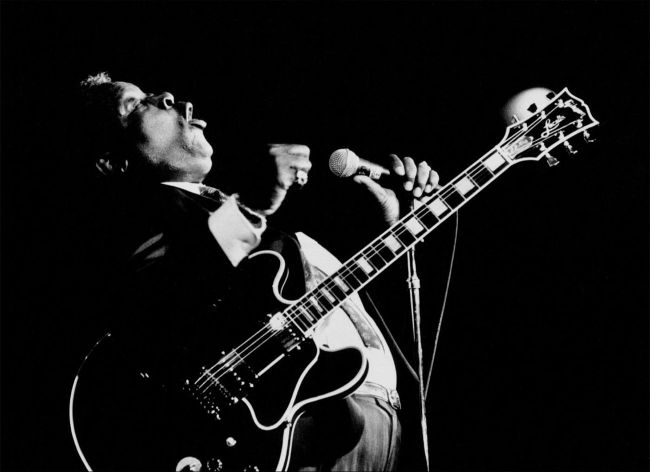
All hail the King: B.B. performing on-stage with Lucille, Sydney Entertainment Centre, 1989.
Photograph by STEVEN SIEWERT

IN THE SUMMER OF 1966, THINGS LOOKED BAD FOR B.B. King. He was 40 years old, and his audience was ageing too – and withering.

Gigging solidly for 14 years, he’d perhaps 5,000 shows under his belt, but the blues that had built his fame and fortune in the segregated ’50s was failing to connect with a new generation of black Americans in the Civil Rights ’60s. “I was the outsider, the bluesman, just like I’d been the outside bluesman in the rock’n’roll shows of the ’50s,” he reflected years later. “I still felt like a sheep among cows.”

Whenever he was booked onto a bill with new R&B stars like Sam Cooke, Jackie Wilson, Marvin Gaye or Curtis Mayfield, things could turn ugly. “It hurts to hear young audiences heckle me, because they don’t understand what I am singing,” King told Ebony magazine. “They think all blues singers drink gin and smoke pot and beat their wives every Saturday. They don’t realise we can be gentlemen, too, and have families and want respect.”
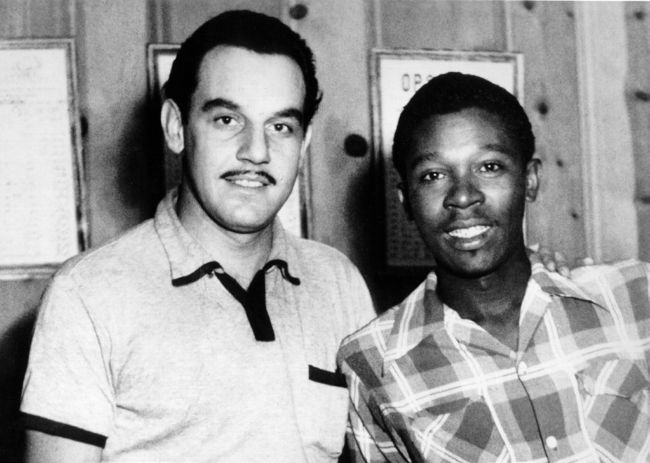
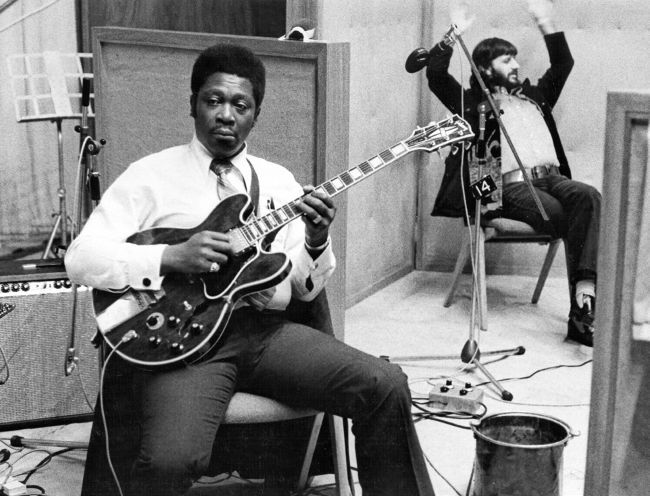
Let it B: (clockwise from left) King with band leader Johnny Otis, 1952; King performing at San Quentin Prison in 1981; singing When Love Comes To Town with U2’s Bono (left) and Adam Clayton, Paris, December 12, 1989; recording B.B. King In London with Ringo Starr, 1971; King in his early twenties at Memphis’s WDIA radio station; (right, opposite) giving it his “Lemon Face”, Central Park, NY, 1969.
Steven Siewert, Fairfax Media via Getty Images
Getty (6)

Even worse for King, those 300-plus annual one-nighters were taking a personal toll. A compulsive womaniser and gambler when on the road, King was stricken that summer when his second wife Sue filed for divorce, citing mental cruelty. Along with the love of his life, King waved goodbye to their house in South Pasadena, his ’66 Mustang, a VW camper and $35,000 in cash. At that low point he had no idea that salvation lay at hand.

THE FILLMORE WAS SAN FRANCISCO’S GRANDEST outpost of the chitlin circuit, the string of black entertainment venues ranging from boondock cinderblock shacks to swanky city theatres where King had been making his living for years, and he knew it well. But when his latest booking came in he had no idea that the Fillmore was under new ownership with a completely different bill of fare and audience.

“We used to play there when it was 95 per cent black,” he recalled of that fateful Sunday, February 26, 1967 to the BBC’s John Tobler and Stuart Grundy. “When I got there that day, there were all these white kids with long hair sitting all over the place. I thought I was in the wrong place. Our promoter Bill Graham said, ‘B, we’re glad to have you.’ I said I was nervous and needed something to drink. After I’d done had me two or three slugs of Courvoisier, I was kind of OK.

“Bill Graham himself introduced me – and I’ll never forget it, it’s ringing in my ears now – ‘Ladies and gentleman, I bring you the Chairman of the Board, B.B. King.’ And everybody stood up. I cried, I couldn’t believe it, and from that time on, my fear left.”

Unlock this article and much more with
You can enjoy:
Enjoy this edition in full
Instant access to 750+ titles
Thousands of back issues
No contract or commitment
Try for 99p
SUBSCRIBE NOW
30 day trial, then just £9.99 / month. Cancel anytime. New subscribers only.


Learn more
Pocketmags Plus
Pocketmags Plus

This article is from...


View Issues
Mojo
Mar-26
VIEW IN STORE

Other Articles in this Issue


MOJO
THIS MONTH’S CONTRIBUTORS INCLUDE...
Bill DeMain A songwriter and half of the
SMALL FACES
LIVE. RARE. UNRELEASED.
REGULARS
ALL BACK TO MY PLACE
THE STARS REVEAL THE SONIC DELIGHTS GUARANTEED TO GET THEM GOING
The Harder They Come
Reggae’s elder eminence who fought for justice all his life, Jimmy Cliff left us on November 24.
Fabs: Leyton Is Real
RARITIES! RECORD SHOPS! CRATEDIGGERS ASSEMBLE!
21st Century Neil Young
Roll another 200 numbers for the road!
Jung Hearts
Sleeper agents: Andwellas Dream (from left) Nigel Smith,
Who turned down big hits?
Let us answer your musical questions and associated rock-related inquiries.
Here Come The Nice (records)
Win! A rare red wax test pressing, plus autographed art print, of Small Faces’ classic Ogdens’ Nut Gone Flake .
Francis Rossi and Status Quo
It started, obsessedly, in a holiday camp. But did it really ever end?
EDITORIAL
Theories, rants, etc.
MOJO welcomes correspondence for publication. Write to us at: MOJO, H Bauer Publishing, The Lantern, 75 Hampstead Road, London, NW1 2PL. E-mail to: mojoreaders@bauermedia.co.uk
WHAT GOES ON!
The Soul Brother
THE HOT NEWS AND BIZARRE STORIES FROM PLANET MOJO
THE STORY OF GUY STEVENS, APOSTLE OF ROCK & ROLL, COMES TO THE SCREEN
Wise Guy: (main) visionary producer Stevens, and (clockwise
Ezra Furman
Heading your way soon: a woman on a mission, but not on the shabbat .
Charles Hayward
This Heat’s drummer salutes Ornette Coleman’s Chappaqua Suite (Columbia, 1966).
JUST LIKE KICKSTARTING OVER: FOLK LEGEND DICK GAUGHAN OPENS THE BOX
“I DIDN’T EXPECT this,” Dick Gaughan tells MOJO
ELUSIVE BUTTERFLY HITMAKER BOB LIND TAKES HIS SECOND CHANCE
Elusive character: (above) Bob Lind before he
PRAISE CARDINALS, PUNK ROMANTICS RECLAIMING IRISH ROOTS FROM THE FOLK CABAL
“We did not want to sound like the
MEET MOMOKO GILL, INTIMATE ELECTRONIC DISRUPTOR OF UK JAZZ
“I’M ALWAYS playing with tension,” says Japan-raised, London-based
MOJO PLAYLIST
It’s time! For Syrian rave, reggae blues and Bowie covers.
FEATURES
THE MOJO INTERVIEW
Judas Priest’s heavy metal air-raid siren lived a lie before grasping the nettle of his sexuality. Now his honesty and passion drive him and his band onwards towards their eighth decade. “I still love my metal,” insists Rob Halford.
BLEU IS THE COLOUR
“Stifled” in The Jam, bewitched by jazz and soul, enlivened by the café culture of Paris and Sorrento, PAUL WELLER struck out for new horizons, with an idea for a freewheeling collective instead of a hidebound band. As an expanded reissue of Café Bleu hits the shelves, he blows the froth off the first phase of The Style Council. “It was like life had been coloured in,” he tells TED KESSLER.
MOJO PRESENTS
UK folk pathfinders THE UNTHANKS celebrate their 20th anniversary with special shows this month. Their family bond and creative health abide – with unexpected support from Robert Wyatt and Mackenzie Crook – but they’ve been tested, emotionally and financially, again and again. “Every year it’s a leap of faith,” they tell JIM WIRTH .
BLOOD BROTHER
Suicide singer ALAN VEGA was a writer and performer like no other, willing to go to any extreme to force a reaction, whether wonder, hatred or horror. As his key early solo albums re-emerge, his balls, brilliance and bloody-mindedness still blow the mind. As bandmate Martin Rev attests, “Alan was the most totally dedicated artist I’ve ever met.”
The Seeker
The death of John Coltrane brought profound psychological and spiritual crisis to his wife and musical confederate, Alice. But from it came her adoption of the harp, followed by music of transcendent beauty. In this extract from his magisterial new ALICE COLTRANE biography, ANDY BETA reveals how she stepped into the light: "The piano is the sunrise and the harp is the sunset..."
SKIDS PLAY THE ABSOLUTE GAME
They were straight-out-of-Dunfermline punks. Then Stuart Adamson’s heroic guitars and Richard Jobson’s rabble-rouser intellectualism took them somewhere more complex and anthemic. Heroic, fiery hits including Into The Valley and Masquerade followed, but as well as creative struggles and line-up shifts, darkness and tragedy were waiting. “There was much more to the Skids than simply punk,” say the band and their collaborators, who recall “an ongoing tension… that ended up breaking the band.”
COVER STORY
IT’S ALL TOO BEAUTIFUL
SMALL FACES ’ metamorphosis from pilled-up enfants terrible into groovy psychedelic magi remains one of the wonders of the ’60s rock revolution. But as Ogdens’ Nut Gone Flake returns, laden with unreleased bounty, witnesses including drummer KENNEY JONES still wonder how their greatest work sounded their death knell. “Subconsciously,” they tell TOM DOYLE , “we were all thinking, How could you beat Ogdens’ ?”
MOJO FILTER
MOJO FILTER
YOUR GUIDE TO THE MONTH'S BEST MUSIC EDITED
Guiding spirit
The dream river keeps on flowing through metaphysical singer-songwriter’s ninth post-Smog album.
Dub housing
Irish brothers’ cold-blooded old times recalled on fourth LP.
She sells sanctuary
Country-rock queen smells the sulphur; proffers shelter from the storm.
Begin the beguine
Joy and heartbreak, rendered in analogue, from towering New England talent.
AMERICANA
Lucy Kitchen ★★★★ In The Low Light BOHEMIAN
ALSO RELEASED
The Lowest Pair ★★★★ Always As Young As
JAZZ
Aaron Shaw ★★★★ And So It Is LEAVING.
ALSO RELEASED
Ilhan Ersahin’s Istanbul Sessions ★★★★ Mahalle NUBLU. DL/LP
All at sea
The prog giants’ much maligned and misunderstood 1973 concept album reappears in deluxe expanded and enhanced form. Mark Blake braves a deep dive.
Breaking away
All seven hours of the legendary December 1965 residency that would change Davis’s sound forever.
Cobb salad
The songwriter and producer who mixed preppy pop, soul and garage rock.
Things have changed
Dylan’s career since 1991 gets the careful reading and listening reserved for what came before.
If it ain’t broken
The life and legacy of the great Marianne Faithfull gets the bells-and-whistles treatment. But was it all necessary? Asks Andrew Male.
Chat
X
Pocketmags Support