FILTER REISSUES
High water mark
This mountain of music is so mighty it reorients a Dylan era.
By Grayson Haver Currin.
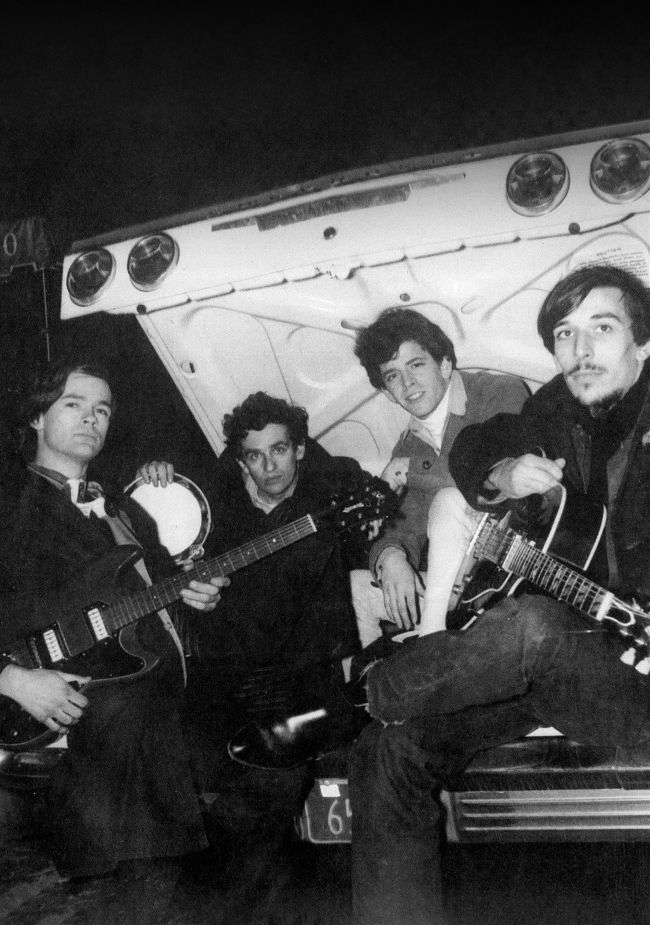
Trunk rockers: The Primitives (from left) Tony Conrad, Walter De Maria, Lou Reed and John Cale, 1965.
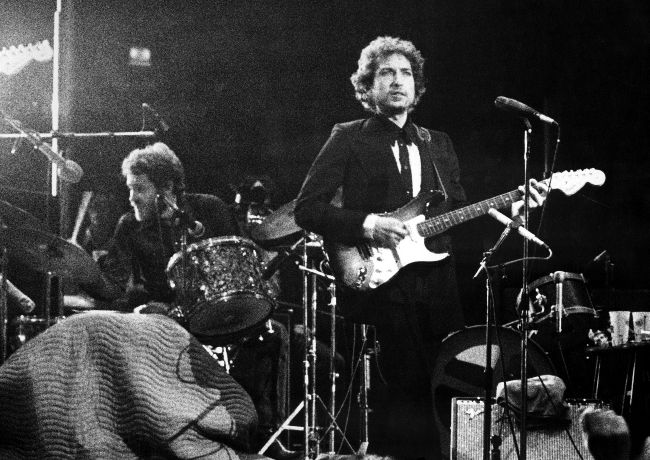
Live and kicking: Levon Helm and Bob Dylan open a window into the future, Madison Square Garden, New York, January 30,
Bob Dylan & The Band ★★★★
The 1974 Live Recordings
COLUMBIA LEGACY/THIRD MAN. CD/DL/LP
IN THE IMMEDIATE wake of Bob Dylan’s 1974 return to stage 50 years ago, it seemed inevitable to label his wild romp through North America alongside The Band a cash-grab. He had not performed in a substantive way for the better part of a decade, and, at least until David Geffen and Bill Graham conspired together to create one of the biggest rock spectacles of all time, he had not recorded with The Band in nearly that long, too. The tickets produced mail-order pandemonium, and the album, Planet Waves, topped the charts – a rarity for Dylan, always – despite being almost no one’s idea of definitive Dylan. That summer’s subsequent release of Before The Flood, which collected 21 tracks from the Los Angeles and New York sets, suggested someone tickling the tip jar. Given that Blood On The Tracks and Desire soon followed sans Band, that financial rationale has remained the standard tale. Even if that is true, The 1974 Live Recordings – a soundboard dump of 431 tracks spread across 27 CDs, almost all of which have never been heard – repeatedly insists that this reunion was much more than some get-richer-quick scheme. On the precipice of reconsidering his marriage, his back catalogue, and his backing band, Dylan is a righteous bundle of nerves for many of these 29 hours, hurling these songs at full arenas and stadiums as if he wants to watch them explode in the aisles. Punk was properly a few years around the corner. But pairing his relentless sneer and high-volume angularity to The Band’s elemental force that strips so-called Americana down to its components, these shows often feel like a break in the firmament, a shift in the energy, a window into the future. How else can one explain the Chicago opener, a kicking-and-screaming, stumblingand-howling rendition of Hero Blues, a tirade from Dylan’s acoustic salad days? Or the surreal gothic swagger of Ballad Of A Thin Man in Philadelphia, with carousel keyboards and sidewinding guitars pulling against Dylan’s voice like they’re waiting for The Fall to arrive? Or the fast, vindictive versions of Ballad Of Hollis Brown, where The Band pushed the pace and Robbie Robertson wrenched the riff until the whole affair rightly felt like a panic attack? Dylan was in a transitional point, sure, but so was rock’n’roll. These recordings verify Dylan and The Band were there.