REAL GONE
Contort Yourself
James Chance, no wave provocateur, left us on June 18.
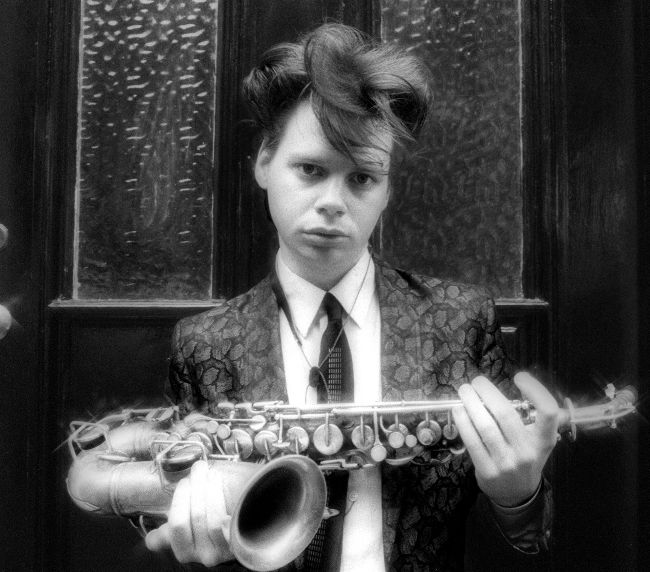
Sax maniac: punk-funk pioneer and “true maverick” James Chance in London, 1981.
Justin Thomas
“I GOT
A big kick out of provoking people,” reflected James Chance. A
charismatic, sax-toting, conservatory-schooled jazz aggressor, he pioneered the deconstructed punk ethos of NY’s no wave movement like a quiff-topped combination of Alan Vega, Albert Ayler and James Brown. Layering screaming vocals and free jazz sax over the Contortions’ taut, nervy funk, Chance attacked cultural divides by injecting black music styles into post-punk. On a mission to melt New York’s notorious hauteur, he also found notoriety by physically accosting audiences.
Born James Siegfried in Milwaukee on April 20, 1953, he grew up in Wisconsin and learned piano rudiments at Catholic school before attending the state’s Conservatory of Music. Extra-curricular activities included joining proto-punk band Death and discovering jazz after hearing John Coltrane. Moving to New York in late 1975, Chance flitted between downtown’s self-isolated jazz and post-punk scenes, forming Teenage Jesus And The Jerks with teenage runaway Lydia Lunch after clicking at a Suicide gig. “Suicide were a big influence,” Chance told this writer. “New York was like a perverse playground where you felt free to do virtually anything you wanted.”
“People in New York had this studied cool… I felt it necessary to attack them.”
JAMES CHANCE
In September 1977, he later told MOJO, “Lydia Lunch kind of kicked me out.” Chance duly formed the Contortions with organist Adele Bertei, recruiting guitarists Pat Place and Jody Harris, bassist George Scott and drummer Don Christensen. Chance mixed free jazz, funk and disco, drilling the band’s dissonant grooves with soul revue precision. “People in New York had this kind of studied cool,” he reflected on his tendency to take provocation to violent extremes. “It was so hard to get a physical reaction I felt it necessary to attack them.”
Though their black musical forms and danceability were largely disdained at CBGB, the Contortions’ onslaughts were essential elements of the no wave moment. The movement’s May ’78 coming out at downtown’s Artists Space gallery persuaded a rapt Brian Eno to produce No New York’s four-band showcase for Island, featuring the Contortions on incandescent form, plus DNA, Mars and Teenage Jesus. As first signings to ‘mutant disco’ imprint ZE Records, the Contortions released Buy, though Chance admitted he regretted “blowing up” and causing George Scott to leave during its recording. He then accepted $10,000 from label boss Michael Zilkha to record a disco album. The audacious and defiant Off White came courtesy of James White And The Blacks, aided by his dynamic manager and partner Anya Phillips, before internal conflicts split the band by late ’79.