Freight prospers while passenger numbers struggle to recover
The latest figures from the Office of Rail and Road show freight traffic is now above pre-Covid levels, but passenger traffic is still more than a third down overall.
By ‘Industry Update’
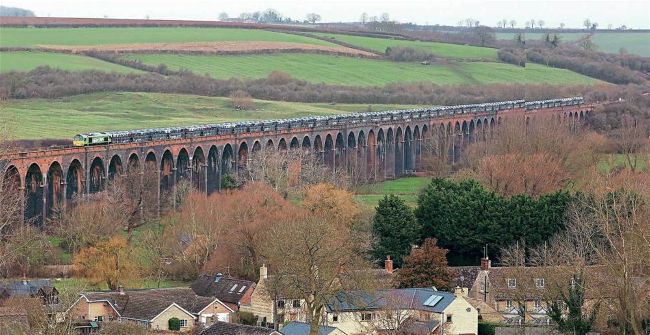
Network Rail investment to allow longer freights has made it more competitive against road. On February 23, No. 66004 crosses Harringworth Viaduct, on the Oakham to Kettering line, with the lengthy 06.58 Toton to Dollands Moor Toyota car train.
JOHN HILLIER
THE trend away from fixed employment locations to flexible working at home and elsewhere, made possible by digital technology, was evident before any Covid-19 travel restrictions were put in place, but the pandemic has accelerated the pace of change and caused a growing reduction in the use of season tickets.
Figures are now available for rail travel during the three months up to the end of 2021, a period that was again impacted by advice to work from home if possible as the Omicron variant of the virus took hold.
A total of 285 million journeys were made in this time, which was more than double the 139 million recorded for the same period a year earlier at the height of the pandemic, but far below the 461 million trips of 2019 before Covid-19 struck.
Regional variations
The latest statistics put passenger volume overall at 62% prepandemic, but within this there is a wide divergence in the rate of recovery.
Longer-distance operators are showing the highest return of passengers, with 68.2% of previous journey levels being recorded. LNER had the best result at 83.6% of its prepandemic volume, with Hull Trains achieving 83.2%, and East Midlands Railway 77.3%. At the other end of this league is CrossCountry, which recorded 58.5%.