ADVICE
FishKeeping Answers
Got a fishkeeping question? PFK’s crack team of aquatics experts are on hand to answer whatever you need to know…questions@practicalfishkeeping.co.uk
KEV BAGSHAW, VIA EMAIL
Win
The Question of the Month gets a Tetra goodie box!
THE EXPERTS
DR PETER BURGESS
Peter is our disease expert. Send questions his way if you have pathogen problems.
BOB MEHEN
Bob is a master of fishkeeping general knowledge and community tanks.
JEREMY GAY
Jeremy is more than adept when it comes to cichlids, goldfish and marine species.
NATHAN HILL
Nathan is the go-to for compatibility queries and aquatic ethical conundrums.
MAX PEDLEY
Max is like a living, breathing search engine. Cichlids are his speciality.
NEALE MONKS
Neale is the man for your technical queries. He loves brackish fish, too.
DAVE HULSE
Dave is a consultant for the Tetra Advisory Board and a research fellow at Keele University.
MARINE
How small can a reef tank go?
What’s the smallest size of tank that would be feasible to run as a simple reef set-up? There would be no fish, just coral frags to grow on and maybe some reef hermits. What equipment would be necessary? Please can you also recommend some easy corals for a small set-up?
JEREMY SAYS: With no fish, a tank for frags could be as small as 15-25 l, and it would only need a 25W heater, a 5W marine spectrum LED light and a pump to circulate the water. You would manage the water chemistry by doing frequent partial water changes, perhaps even daily. Small hermits would be fine in a tank that size too. But it wouldn’t hold many frags and the instability would make it more suitable for zoanthids or Xenia frags than SPS.
Up from that, I would consider a Fluval Evo at around 50 l. This comes with a light, pump and filter, but again that light is better suited to soft coral frags and LPS than SPS. You would also need phosphate remover and an auto top off.
Moving up from that, I'd consider the Max Nano from Red Sea which comes with a good light that’s capable of growing SPS, has decent flow and a protein skimmer, which will help to raise oxygen levels and manage nutrients. It has a top-off unit built-in and you could add small fish as well as it has a volume of 75 l.
But you don’t really need a protein skimmer on a frag tank with no fish, as it will just remove coral food from the water, so consider a bare tank like the Waterbox Cube or Peninsula. You could equip this with an AI Prime 16 HD Reef light, a small 2000 lph wavemaker, a heater, auto top off, and a phosphate reactor or algae refugium to manage nutrients. The Waterbox tanks range from 37-94 l. As it’s just for frags, surface area is more important than depth, as you just need somewhere to space them out, so they all receive enough light and flow. You could leave the tank base bare and use a three-tier acrylic frag rack to place the frags on.
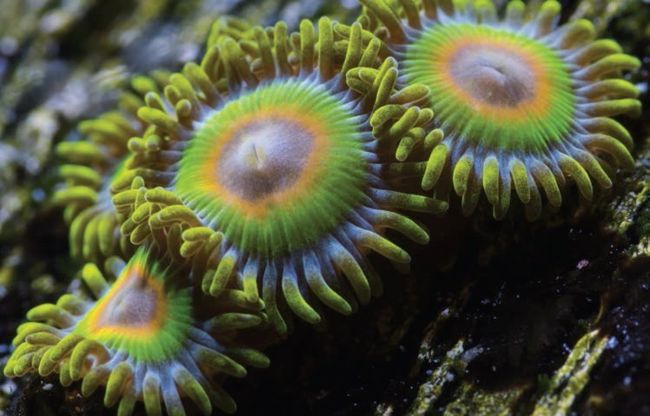
Zoanthids are fine for nano tanks.
SHUTTERSTOCK
TROPICAL
Why are my test kits results so different?
I have been battling high nitrates in my 180 l fish tank. On advice I have put C3 resin pouches into the external filter. However, after being told to try another water test kit I am getting very different and confusing results.
The API kit that I usually use gives a nitrate reading of 80+ppm whereas the NT Labs nitrate test is showing as 20ppm. Both results remain consistent. Both kits are new and within their sell by dates. Which test kit result do I trust and why such a large discrepancy between the two? Although the nitrates do still need reducing, there is a big difference between both results.
JULIE SMITH, VIA EMAIL
NEALE REPLIES: Using chemical exchange media to remove nitrate from an aquarium is usually expensive and unlikely to be effective in a typical community tank. While such media can work, fish crank out ammonia all the time, the end result being nitrate, and sooner or later the medium used becomes saturated. Unless you’re happy to be constantly replacing the stuff, this is almost never the most cost effective way to handle nitrate, particularly if your tapwater has high nitrates from the get-go.