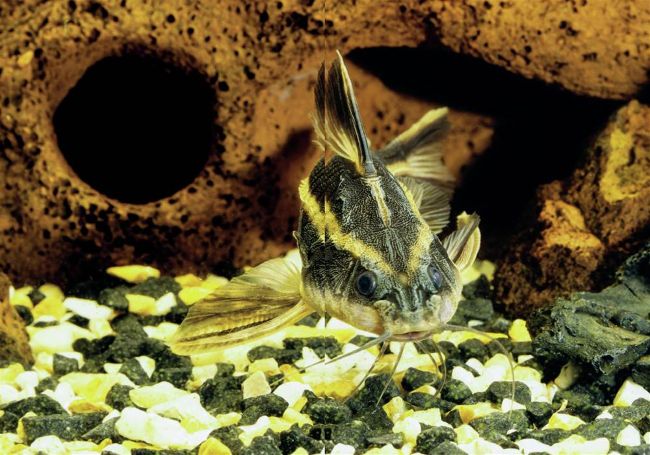
SPECIES SHOWCASE Platydoras armatulus
Sweet humbugs
Catfish fans are a patient crowd when it comes to viewing their pets. Tai Strietman makes a case for a species that might spend its whole life out of sight.
ALAMY
TAI STRIETMAN
Tai is a freshwater habitat specialist currently working on a new book project. Biotope aquaria are his passion.
I LIKE TETRAS more than catfish. There, I said it. I can sense the jaws clenching around the world, like some global Mexican-wave of indignation. Friends of mine like Luiz Tencatt, Heriberto Gimenes Junior and Steven Baker will be reaching for heavy objects, and I may need to start wearing a metaphorical bullet-proof vest as I move through fishy circles, but it is what it is.
That doesn’t mean I don’t value catfish, find them fascinating or sometimes spend good money on them (a nice group of dwarf Corydoras will always find their way into my wallet) but I just… I like things that actively shoal I suppose.
My first fish were all small tetras, and they’re the group of fishes with which I have the most experience both in the field, in the lab and in my work as an aquarist for the aquarium industry and at London Zoo.
‘But catfish are so diverse, so adaptable, so varied in their life strategies!’ you might cry.
‘True,’ I would say, ‘but did you watch the footage of Splash tetras spawning by leaping onto a leaf outside of the water on The Mating Game on BBC1 last Sunday? I didn’t see Attenborough narrating the life of a Hoplo catfish, did you?’ But this is not the point. The point is that all fish families are, to my mind, amazing and that they and each of their member species has an appeal that someone, somewhere, will value.
Of course, my passion for fish as a whole has wiggle room for catfish, so much so that I forget the number of times I have suffered mild injury from excitedly handling sharp-spined Pimelodids in the wild (something they do not take kindly to), stalking Rineloricaria whiptail catfish oversand-beds, and almost bursting my lungs while diving down to try prising a Loricariid out of its refuge in a submerged log.
The first time I stumbled into a shoal of hundreds of tiny Corydoras hastatus (one of the smallest species and highly active), barely visible in the gloom of the river as they swarmed over a bed of Hornwort, I was quite emotional; it was something of a privilege to encounter this little gem in the wild. While at London Zoo, I developed a real affection for the trio of hefty Ripsaw catfish, Oxydoras niger, which I cared for and who enjoyed having their heads rubbed as they were fed. I also happily played Tug of War with the gang of chunky Hoplosternum catfish we had, where I held onto one end of an earth worm for as long as I could before they slurped it up like spaghetti.