GB
  
You are currently viewing the United Kingdom version of the site.
Would you like to switch to your local site?
13 MIN READ TIME

Horsfield’s tortoise

These remarkable tortoises occur further north than any other species, and have evolved to combat climatic extremes. David Alderton discusses their natural history, and how this should impact on their care.
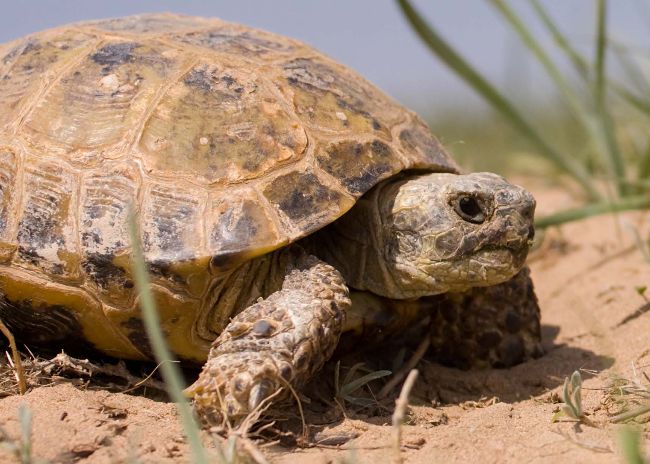
A Horsfield’s tortoise in its natural habitat.

The first thing to say is that although Horsfield’s tortoise may look rather similar to both Hermann’s and the Mediterranean spur-thighed species, it is a very different animal. This has now been recognised by zoologists as well. Up until 1998, all three species were grouped in the genus Testudo, but then Horsfield’s was transferred to a separate genus on its own, giving it the scientific name of Agrionemys horsfieldii. This is now in dispute again though, as these tortoises have hybridised with Hermann’s, and provides a reason as to why they should not be kept together.
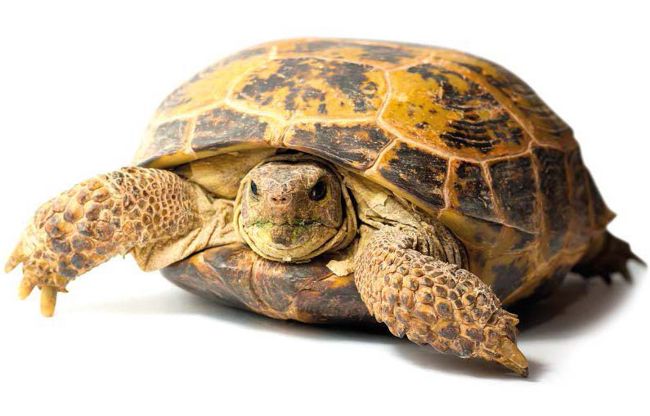
The flat top to the shell is very evident here.

Although there may be some overlap in colouration with Hermann’s tortoise especially, comparing the overall profile of these tortoises allows Horsfield’s to be distinguished easily. It has a more rounded, less elongated body shape as well as a flatter shell.

Horsfield’s ranks as a relative small species of tortoise too, with males being noticeably smaller than females, which average somewhere between 20-25cm (8-10in) when mature. Males in contrast are about 5cm (2in) smaller overall.

In addition to being known as Horsfield’s tortoise, this species is also recognised under several other common names. The best-known of these is probably the Russian tortoise, although this is not an entirely accurate summary of its range. It is also sometimes described as the steppe tortoise too, reflecting the type of environment where it is to be found in the wild. It may even be called the four-toed tortoise, having four toes on each foot, and may also be referred to as the Afghan tortoise.

Did you know?

Horsfield’s tortoise is named not its discoverer, but after an American doctor and naturalist Thomas Horsfield, who lived from 1773 until 1859. He became an important figure in natural history circles in London, being a founder of the Royal Entomological Society and the first assistant secretary of the Zoological Society of London in 1824, but was never involved with the tortoise that bears his name. It was named after him as an honour.

Range and lifestyle

Read the complete article and many more in this issue of Practical Reptile Keeping
Purchase options below
If you own the issue, Login to read the full article now.
Single Digital Issue Issue 124
 
£3.99 / issue
This issue and other back issues are not included in a new subscription. Subscriptions include the latest regular issue and new issues released during your subscription. Practical Reptile Keeping
Annual Digital Subscription £32.99 billed annually
Save
31%
£2.75 / issue
6 Month Digital Subscription £17.99 billed twice a year
Save
25%
£3.00 / issue
PRINT SUBSCRIPTION? Available at magazine.co.uk, the best magazine subscription offers online.
 

This article is from...


View Issues
Practical Reptile Keeping
Issue 124
VIEW IN STORE

Other Articles in this Issue


In This Issue
Welcome
It’s very obvious that we’re currently living through incredibly strange
Features
Shedding in beardies
Scientifically known as ecdysis, shedding is in fact a natural
Resplendent rainbows
The rainbow boa occurs over a wide area in the
Yellow-headed and elongated too!
The elongated tortoise (Indotestudo elongata) can be found across much
Ball python pairings
The aim of this article is to start by providing
Regulars
First record of a toad mimicking a venomous snake
A study of a toad has revealed that it enhances
The curious case of the disappearing snakes
The loss of any species is devastating, but the decline
Living on the edge
Ninety percent of the world’s coastal freshwater turtle species are
Mating behaviour of female loggerheads
Male sea turtles will mate with suitable female, but when
Record-breaking cave salamander
Researchers from the University of Tennessee (UT) at Knoxville have
Scorpions fluoresce as protection against parasites
Most scorpions glow a blue-green color when illuminated by ultraviolet
Damselflies make deadly hunters
What species of insect help to control the numbers of
Lizard breathes in an unusual way
Take a deep breath in. Slowly let it out. You
REPTILE FOCUS
In the wild, corn snakes seek out areas where there
Monitor lighting
Q&A Please give me your thoughts about whether I should
Housing scorpions
When considering keeping scorpions, thought must be given to the
Puzzle Corner
Find the solutions to these puzzles by following the clues,
A CLOSE ENCOUNTER OF THE MEGA-ARACHNID KIND! PART 2
I ended the first article by quoting a section from
YOU & YOUR Reptiles
If you have a favourite photograph of one of your
Chat
X
Pocketmags Support