Housing scorpions
Scorpions can be fascinating to keep, relatively easy to accommodate, although some species can be quite in terms of their care needs. Many require specific habitats, temperatures precise humidity requirements, with juveniles tending to be more to cater for than adults.
Housing
When considering keeping scorpions, thought must be given to the requirements of the individual in terms of its natural environment. It is important that these conditions be recreated as accurately as possible in terrarium surroundings. For example, burrowing species should have the ability to use the substrate for this purpose, while flat rock scorpions (Hadogenes species) must be able to retreat into crevices where the microclimate mirrors that of their natural environment.
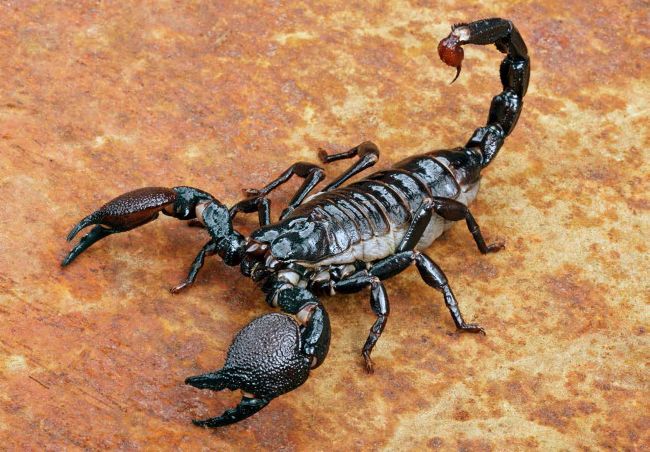
An emperor scorpion (Pandanus imperator) is a rainforest species occurring in West Africa.
Environmental concerns
Always bear in mind that by far the greatest killers of scorpions are extreme fluctuations in temperature and humidity within their quarters. Even desert species can be surprisingly intolerant to environmental changes. So suspending a 100 Watt light bulb over a barren layer of sand where the scorpion cannot seek out a cooler spot is definitely not the way to proceed, in terms of their care.
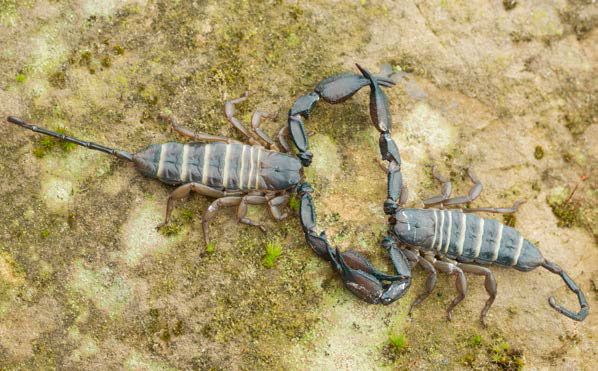
Hadogenes is a genus of large African scorpions (growing up to 20cm (8in) long) whose range extends from South Africa up to Tanzania.
Photo courtesy Milan Zygmunt/
www.shutterstock.com In their natural environment, desert scorpions thermoregulate by migrating into the coolness offered by rocky crevices, or sheltering in deep burrows or beneath rocks in order to find sanctuary away from the oppressive heat. Burrows also provide the scorpions with the necessary humidity which they require in order to breathe. Should the conditions be too dry, their book lungs can dry out and lead to the individual’s demise.
Unfortunately, a suitable depth of substrate is seldom provided in order for the scorpion to achieve this balance. The upper layer in their quarters needs to be dry and then becomes progressively damper the deeper you go. However, it is equally important that these lower layers are not kept so wet that they will ultimately turn black and start to smell.
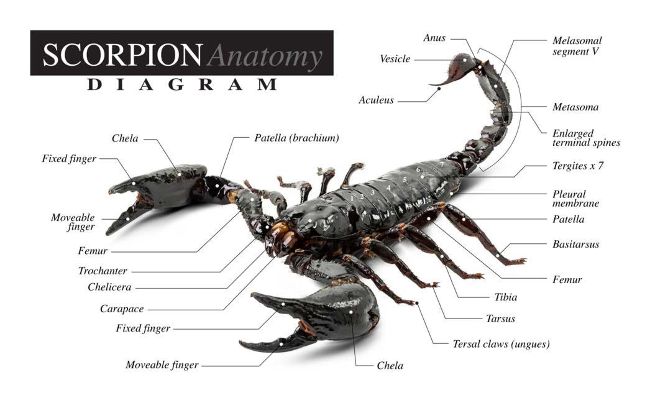
A Pandinus scorpion - these scorpions can be kept together in suitable surroundings. Here you can see the names given to various parts of a scorpion’s body.
No matter what the species, bear in mind that the temperature, humidity and the amount of space that you provide your scorpion will be the major contributing factors determining as to how well it will thrive - or not. Do not be mislead by the fact that just because a species is found in a dry barren region, this is how you should keep it at home. As you will quickly learn, this approach will not work. The particular habitat that it has sought out will have been quite specific to its needs.