Resplendent rainbows
Despite working with, and keeping many species of reptiles over the years, the Brazilian Rainbow Boa (‘BRB’) had me captivated from the moment I first saw one. Striking colouration, gorgeous markings and an iridescence closely resembling oil on water; I was instantly drawn into the world of these snakes. Gemma Plater proclaims her obsession!
Gemma Plater
The rainbow boa occurs over a wide area in the wild, with its range extending from Costa Rica and Panama in Central America southwards. The species occurs to the east of the Andes across much of South America, down as far as northern Argentina, being found in rainforest and wetland areas. Depending as to which source you prefer, there are nine to eleven recognised subspecies. These are distinguishable by pattern, scale count and locality, although the validity of some is still being debated.
Iridescence and colour change
The rainbow boa is renowned for its spectacular sheen, which is at its most visually stunning in sunlight. The spectrum of rainbow colours displayed down the length of the snake shines so brightly that it almost disguises the appearance of the lateral rings and spots as the angle of viewing is changed; much in the same way that the colours seen in oil on water, or on the surface of a bubble change with every movement.
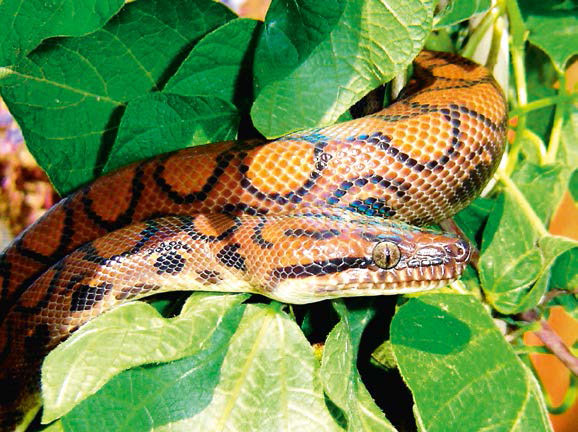
A young female in natural sunlight.
© Gemma Plater
This iridescence is caused by evenly-spaced microscopic ridges along each and every scale, refracting light and acting like a prism - literally creating a miniature rainbow on every scale. As amazing as this is in its own right, this appearance is thought to have a significant practical purpose. The microscopic ridges are believed to reduce friction and aid the shedding of dirt in moist environments. This allows the animal to remain clean in its damp habitat, avoiding the build-up of dirt which could inhibit mobility, and might predispose to infections as well.
The scale structure of the rainbow boa is also thought to aid the repulsion of water. As a result, although many species would suffer scale rot and other moisture-related problems, these boas thrive under conditions where the humidity is high. There is also the suggestion that the air spaces between these ridges facilitate heat absorption, although as yet, the research in this area is still ongoing.
At night, these reptiles look equally amazing, as they are capable of ‘metachrosis’, which means they can change colour by the expansion of pigment cells. This is the same basic technique as commonly displayed by chameleons when they change colour. The oranges, reds and browns seen during the day are transformed to pale slate grey/white down their sides at night with the back being darkened. It is said that metachrosis is triggered by both temperature and light levels, but despite researching this theory, I found there is little information as to exactly why this occurs.