GB
  
You are currently viewing the United Kingdom version of the site.
Would you like to switch to your local site?
16 MIN READ TIME

HERPETOLOGICAL MYSTERIES

The shamir and the stone worms

Ancient Judaic sources, medieval accounts, and most recently, a new species from the Philippines. Dr Karl Shuker investigates the links and considers an intriguing possibility regarding a strange invertebrate that is said to be capable of destroying and eating rock.

A reconstruction of King Solomon’s  Temple. 
Artwork courtesy Johnreve/PD.

The portrayal of the shamir in the Rosslyn Missal. 
Source PD.

The mysterious shamir

There are a number of mysterious and controversial biblical creatures with potential relevance to cryptozoology, which is the study of species unrecognised by science, of which the most famous examples are undoubtedly Leviathan and Behemoth. Much less famous but no less remarkable, however, is the small yet highly intriguing subject of this article -the shamir.

Also spelled 'samir' or 'schamir', the shamir is the Hebrew name given to a tiny worm-like creature referred to in certain Jewish holy books, including the Midrashim and the Talmud, and particularly the Gemara. The latter is the component of the Talmud that consists of rabbinical analysis of, and commentary upon an earlier work known as the Mishnah. (There is also a notable shamir illustration in the Rosslyn Missal, which is an Irish manuscript dating from the late 13th or early 14th century.)

According to Jewish tradition contained within the abovementioned Judaic sources and others, the shamir was one of ten miraculous items created by God at twilight upon the Sixth Day of the Hexameron (the Six days of Creation). Although it was only the size of a single grain of barley corn, the shamir was so incredibly powerful that merely its gaze was sufficient to cut through any material with ease, even through diamond itself, which is the hardest substance on Earth.

Such a wondrous creature needed to be safeguarded, so God entrusted the shamir to the hoopoe (Upupa epops), the Eurasian woodcock (Scolopax rusticola) or to the common moorhen (Gallinula chloropus), depending upon which version of the legend is consulted, commanding the bird to protect the shamir from all harm.
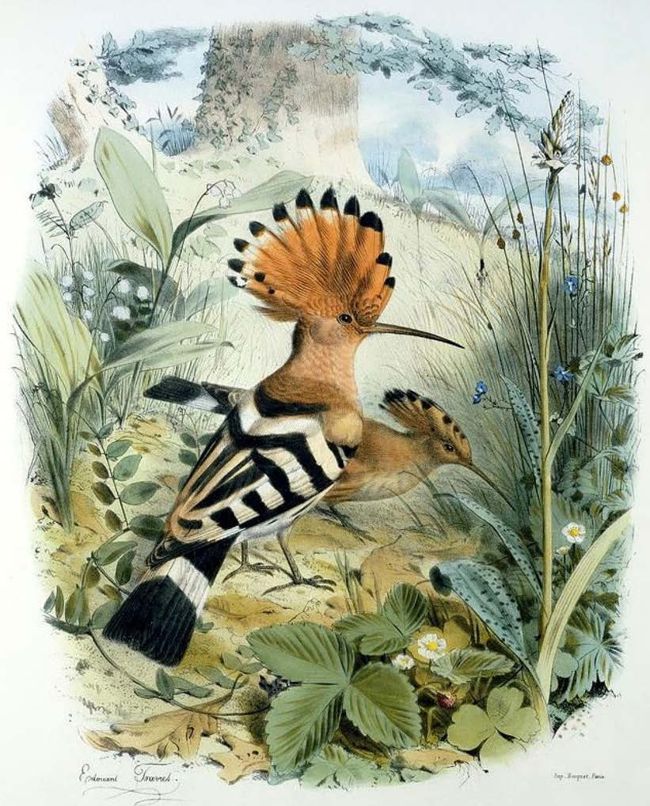
The hoopoe was one of three species of bird which were reputed to protect the shamir. This painting of a pair is by Edouard Travies and was created in the 1800s. 
Source PD.

King Solomon reputedly called on the rock-cutting ability of the shamir. This painting of the king is by Pedro Berruguete, and was made much later, as it dates back to the early 1500s. 
Source PD.

In order to contain this mighty if minuscule worm, the hoopoe placed it among a quantity of barley corns, then wrapped them all up together in a woollen cloth, which in turn was placed inside a box fashioned from lead – the only material strong enough to contain the shamir effectively but without disintegrating from the intensity of its laser-like gaze. So here, safely and comfortably ensconced within its leaden enclosure, it passed through all the ages that followed, being kept by the hoopoe in the Garden of Eden.

How it reputedly lived

Only twice did the shamir emerge. The first occasion occurred during the time of Aaron and Moses, when God commanded the hoopoe to lend this worm to Him for the etching of the names of the 12 tribes of Israel upon the precious stones on 12 special priestly breastplates (the Hoshen); one breastplate for each of the tribes and each breastplate composed of a different stone. The task was a very difficult one, but when these stones were shown to the shamir, this astonishing creature accomplished it so expertly that not a single atom of precious stone was lost or destroyed.

Read the complete article and many more in this issue of Practical Reptile Keeping
Purchase options below
If you own the issue, Login to read the full article now.
Single Digital Issue Issue 132
 
£3.99 / issue
This issue and other back issues are not included in a new subscription. Subscriptions include the latest regular issue and new issues released during your subscription. Practical Reptile Keeping
Annual Digital Subscription £32.99 billed annually
Save
31%
£2.75 / issue
6 Month Digital Subscription £17.99 billed twice a year
Save
25%
£3.00 / issue
PRINT SUBSCRIPTION? Available at magazine.co.uk, the best magazine subscription offers online.
 

This article is from...


View Issues
Practical Reptile Keeping
Issue 132
VIEW IN STORE

Other Articles in this Issue


Welcome
Welcome
Main cover image of a strawberry poison-dart frog
Regulars
Alligators gain new tails
Featuring  stories about the way that some amphibians are
Why are some amphibians so noisy?
This month, Paul Donovan investigates the calls of amphibians, and explains why some species prove to be much noisier than others
Lighting advice for dart frogs
D O YOU NEED A HELPING HAND OR ADVICE?
INVERTEBRATE FOCUS
Photo courtesy Dr Morley Read/www.shutterstock.com There are a
YOU & YOUR Reptiles
I f you have a favourite photograph of
New turtle foraging area discovered
A green turtle returns to the sea after
On the edge of extinction
The island of Nihoa, a slice of jagged
The rise of iguanas
The rise of iguanas
The discovery of the first known fossil iguana
Bees learn how to defend themselves
What’s the best way to ward off giant
How amphibians benefit from beavers
The recovery of beavers may have beneficial consequences
WHY INSECTS GAVE UP FLIGHT
Most insects can fly, yet scores of species
WHY AMPHIBIANS MATTER
The iconic red-eyed tree frog (Agalychnis callidryas) lies
New species of mosasaur found
A new species of an ancient marine reptile
Features
Insights into the leopard gecko
In the third and concluding part of his series of articles on advances in the care of leopard geckos, John Courteney-Smith MRSB of Arcadia Reptile explains how using the latest knowledge and equipment enables you to see more of the natural behaviour of these popular and fascinating lizards
Snakes with unusua al dietary tastes
It is easy to assume that all snakes are relatively unfussy about food, with the vast majority being offered rodents or chicks in vivarium surroundings. But as Paul Donovan reveals, some species have developed very specific and even bizarre dietary tastes
Grow your own reptile food
Although it is possible to buy salad packs and other vegetables from supermarkets, it is much better to grow your own food for tortoises and other herbivorous reptiles, and you can do this easily, even if you don’t have a garden, as David Alderton explains
The fascinating world of Tarantulas
For many people, much of the appeal of keeping reptiles and amphibians as pets stems from a deep fascination with these animals and a genuine appreciation of all aspects of their natural biology, writes Hannah Salisbury, MSc BSc (Hons) AnSci. It’s no great surprise then that enthusiastic keepers who start out with just one type of exotic pet will often go on to develop a keen interest in other varieties -and particularly those that can be housed easily in the home
HOW TO GET AWAY The anti-predator behaviour of lizards
Lizards have developed surprisingly varied means of escaping from predators, even communicating directly with them in some cases. Dr Julia Mueller-Paul investigates how they survive, and explains the implications for those keeping lizards
The approach of winter
& My lizard has really slowed down over
SUBSCRIBE ONLINE TODAY!
SUBSCRIBE ONLINE TODAY!
ALSO EVERY  BACK ISSUE AVAILABLE
Chat
X
Pocketmags Support