The Assassings’ Guild
In 1983, Marillion began work on their “difficult” second album. Their debut, Script For A Jester’s Tear, had set them on the road to success but Fugazi proved there were still many obstacles in the way. Prog looks back on a tale of writer’s block, challenging crowds and the search for the perfect drummer that led to the band’s first Top 5 album and the line-up that would be their saviour.
Assassing: Dave Everley Illustration: Mark Wilkinson
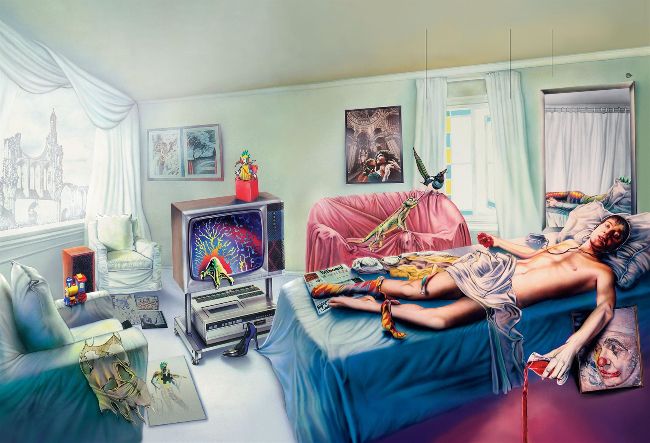
Mark Wilkinson’s stunning Fugazi artwork.
It was when the guy burst into the studio holding a machete that Mark Kelly knew things had got silly.
Marillion’s keyboard player was holed up in London’s Odyssey Studios, racing against the clock to get his band’s second album, Fugazi, finished. Kelly, producer Nick Tauber and engineer Simon Hanhart had been working through the night in an attempt to mix the last few songs, but they still weren’t quite there. The only snag was that the studio had been booked by another producer, who was currently waiting outside and becoming increasingly annoyed.
“He was there to record a session with an orchestra,” says Kelly. “Basically, there were 40 people waiting for us to finish.”
The Marillion team were acutely aware that they were biting into someone else’s time. But they were even more aware that their deadline to finish the album was hurtling towards them at an alarming speed, and they needed to get these mixes nailed.
“We basically paid this guy a thousand quid to hold off and give us another few hours,” says Kelly. “And then eventually we ran past that point.”
That’s when the stonewalled producer’s patience finally snapped. He stepped into the studio lounge and announced that he had served in Vietnam, and that he had a machete in his bag and he was willing to use it.
Ian Mosley
“That was it,” says Kelly, laughing at the memory. “We basically had to go, ‘Right, that’s it, we’re leaving then. Bye.’”
An aggrieved man making threats with a machete pretty much sums up the fraught, wired and occasionally unhinged process of recording Fugazi. A record that cost £120,000 to make and should have anointed Marillion as one of the biggest new British rock bands of the era instead turned out to be a disappointment to the band and their label. Its title couldn’t have been more appropriate: ‘Fugazi’ was US army slang for ‘Fucked Up’.
“It was a strange time,” says Fish, Marillion’s original singer and lyricist. “We were riding on the back of [debut album] Script For A Jester’s Tear, we’d done our first American tour, it was all wonderful. And then we hit Fugazi.”
In the summer of 1983, Marillion had every reason to be confident. Script… had reached No.7 in the UK Albums Chart when was it released that March, turning the Aylesbury band into unlikely pop stars. Its success inevitably sparked off a surge of interest in like-minded bands.
“Record companies would go, ‘Bloody hell, that seems successful, let’s sign another band’, so suddenly all the majors are looking for their version of Marillion,” says Kelly of this unlikely prog revival. “Bands like Pendragon and Pallas were getting record deals, where previously they wouldn’t have been able to.”
Marillion weren’t wholly comfortable in the role of figureheads for this ‘neoprog’ movement. In fairness, many of the other bands felt the same way.
“We didn’t want to be lumped in with the likes of IQ and Pendragon,” says Kelly. “I remember when we played the Marquee once, a couple of IQ were down the front heckling us. They resented the fact we were having success and they weren’t, even though they’d been around longer than us.”
Marillion’s peers weren’t the only ones who wanted to see them brought down a peg or two. The gatekeepers of cool within the British music press were also willing them to fail.
“With the exception of one or two people, there wasn’t a huge amount of love for Marillion in the mainstream press,” says bassist Pete Trewavas. “There was a general feeling of, ‘These guys don’t deserve to be successful in the early 80s.’ They definitely had the knives out for us.”
For all the opprobrium heaped on them from certain quarters, Marillion looked to be in a good position as they readied themselves to work on the follow-up to Script…. There was just one problem: aside from a handful of ideas, they didn’t have any material.
“We used up all the material we had on Script… and the Market Square Heroes EP. We needed to come up with an album’s worth of material and we pretty much had to start from scratch.”
Mark Kelly
In time-honoured rock’n’roll tradition, Marillion had written the songs that made up their debut album over a period of two or three years. But now the cupboard was bare. “We used up all the material we had on Script… and the Market Square Heroes EP,” says Kelly. “We needed to come up with an album’s worth of material and we pretty much had to start from scratch.”
Not completely from scratch. Fish had been stockpiling ideas for months, and even years. Early versions of the lyrics for songs that would become Jigsaw, Punch & Judy, Emerald Lies and Incubus were all kicking around in various states of completion. “I had a lot more lyrics than there were musical ideas,” the singer says now.
The prospect of writing a new album may have been hanging over their heads, but there was a more pressing matter at hand. Kelly, Trewavas, Fish and guitarist Steve Rothery had fired founding drummer Mick Pointer in April 1983 following a prestigious two-night stand at Hammersmith Odeon at the end of the UK leg of the Script tour, unhappy with his technical abilities. With a series of summer festival dates in the pipeline – not to mention the impending prospect of recording a second album – they needed to find a replacement pronto. Although Marillion’s concept of ‘pronto’ was different to most other people’s definition of the word.
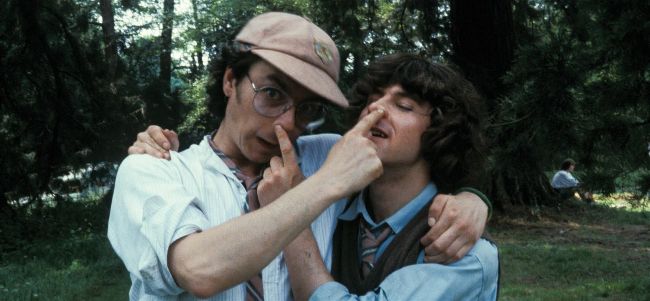
Move over Angus Young! Andy Ward’s first job in Marillion was to play the part of a schoolboy in the GardenParty video.
STEVE ROTHERY/POSTCARDS FROM THE ROAD BOOK PAUL SLATTERY/CAMERA PRESS