Take One: Action!
It was the album that was never supposed to be, and now Rush’s Moving Pictures has been given a 40th anniversary reissue. Geddy Lee and Alex Lifeson recall angry mobs, out-of-control aeroplanes and Superman in the story behind the hugely successful record that gave us Tom Sawyer and defined the sound of rock music in the early 80s.
Words: Philip Wilding Extra interviews: Jo Kendall
“Moving Pictures is the cute, sweet, happy offspring [of Permanent Waves]! We learned a lot about writing and how we work best to accomplish our goals.”
Alex Lifeson
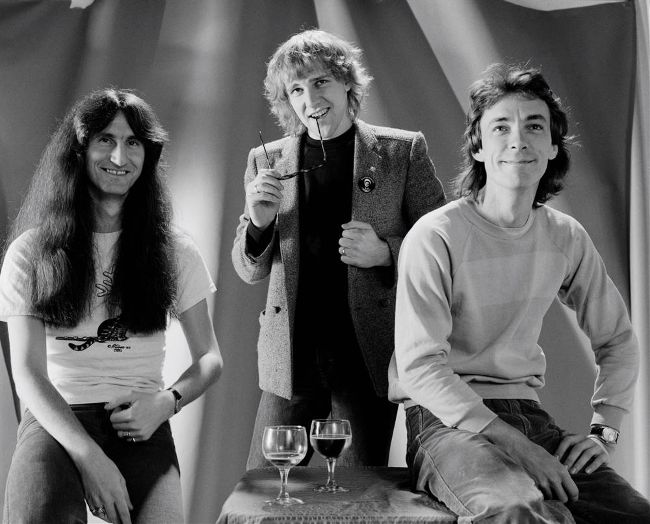
Rush in 1980. L-R: Geddy Lee, Alex Lifeson and Neil Peart.
FIN COSTELLO/REDFERNS/GETTY IMAGES
I
t’squietout here. Or it was. Canadian country singer Ronnie Hawkins’ estate looks out on to Stoney Lake, a geographical idyll central Ontario. The surface of the lake is glassy and dark and so flat it looks like you could step out onto the water and walk to the furthest shore. The day’s a liquid blue, the clouds like pale abstractions or opaque afterthoughts dotted towards the horizon.
The dark wooden barn sits back on the property, away from the main house with its bay window looking out towards the serr ated edges of fir trees that sit jaggedly against the sky. The barn rattles and hums all hours of the day and sometim es night. The frenetic writing sessions taking place inside fizz and fade as the orange burns out of the August afternoons. Although the keening guitars, rumbling bass and impossible drum parts aren’t the cause of consternation among the wood s this afternoon: it’s the strange, relen tless engine hum overhead, a darting blur of propellor blades and a small engine that sounds like it might choke, stutter and disappear out of sight at any moment.
“Oh,” says Geddy Lee. “Alex [Lifeson] was in the heat of his ‘model aeroplane period’ at that point.” He makes inverted commas in the air with both fingers, faux-exasperated eyebrows arching upwards. “Even Broon [producer Terry Brown] had the stupidest aeroplane you’ve ever seen in your life.”
Lifeson: “I like to have a hobby when we’re working.”
Alex Lifeson is grinning like he’s still got that model aeroplane tucked under one arm and is heading to a vantage point to send it into the sky.
“I had a radio-controlled plane that I built there and crashed into the top of a truck. Might have been Broon’s truck? Bang, right into the top of the cab, put a hole in the roof,” he recalls. “But you should have seen the plane that Terry had. It was on these lines, and you flew it in circles, I guess. And the engine on it was probably 12,000 horsepower, and it went, like, 900 miles an hour. But in a circle.”
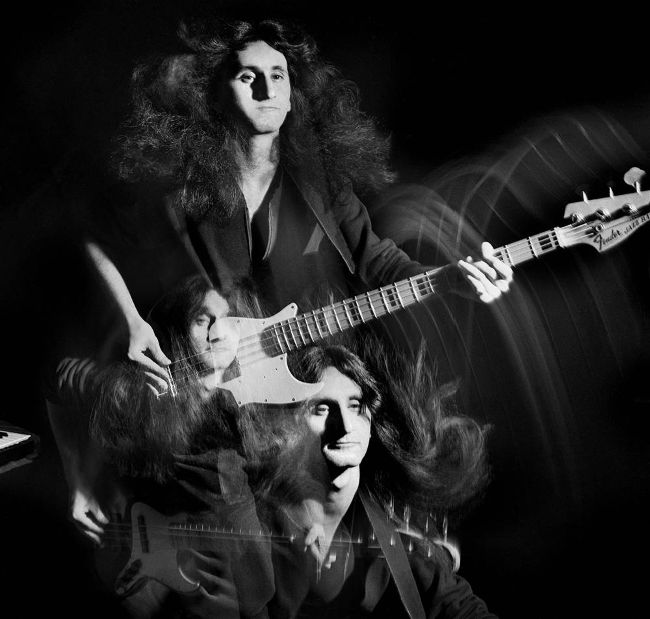
Geddy Lee: he has the wind in his hair…
DEBORAH SAMUEL
Lee: “It was going around and around, getting faster and faster and Terry was holding on to it and getting dizzier and dizzier…” Lifeson: “And he had to let go of it.
He was going around and around, and I was laughing so much that I had to lay down in the grass. There were literally tears in my eyes.”
Lee: “I was standing not too far from him. And when the thing took off, I had to hit the deck! This plane whizzing around overhead tethered to Broon –I mean, it had to come down eventually. He could barely stay upright. It was great. They were fun writing sessions, a good headspace.”
Lifeson: “As long as you weren’t being hit in the head, by, you know, Broon’s or my plane…”
Welcome to the writing sessions for an album that would help define not only Rush, but also rock music in the early 80s: Moving Pictures.
“[Red Barchetta] was one of those songs where it might have been
built on a more conventional sense of timekeeping, and we would listen back to it and think, ‘Well, that can be more interesting.’”
Geddy Lee
It’s early 2022 and Alex Lifeson and Geddy Lee are sat in their respective homes in Toronto, the town where they both met as gawky kids with ambitions of being in a band. Lee is in his living room, Lifeson in his home studio, the wall behind him hung with guitars. Even on a Zoom call, the sparky energy that kept them as friends and bandmates for over 40 years is still self-evident. They are, at turns, reflective, forgetful, deeply focused or simply goofy when it comes to recalling the summer writing stints – and autumn and winter recording sessions – that led to them making a record that would help propel them to platinum rock star status, and go on to dominate their live set until the band finally retired in 2015.
It’ll give readers some idea of the hectic writing, recording and touring schedule that the band were all undergoing at that point in their career that it was straight after they’d finished writing for Moving Pictures that they packed up their equipment, rescued Lifeson’s plane from a tree and set out to play some shows before heading to Morin-Heights to begin making Moving Pictures.
If you were lucky enough to see Rush play those dates in September 1980 – 16 scant shows – you’d have seen the trio showcase two brand-new songs too: Tom Sawyer and Limelight.
“We played them live on those shows?” asks Lifeson. “Did we?”
“To warm them up,” says Lee.
Lifeson: “Then how come Tom Sawyer was the hardest song to capture in the studio?”
Welcome to Le Studio. Now synonymous with the Rush name, they’d go on to record seven albums there, starting with Permanent Waves in 1980 and ending with 1993’s Counterparts. Set on Lake Perry and in the foothills of the spectacular Laurentian Mountains, you can see why a band might be drawn there, as Lee puts it: “It was truly a part of the great Canadian landscape.”
“A magical place,” remembers Lifeson, “but practical too; you could drive home within five hours. And the house and the view… We had a volleyball court outside – it was right on the lake. We had barbecues in the summer. Every time we went there, we went back to what we liked to think of as ‘our rooms’. It had that warm familiarity.”
In the summer: barbecues, or setting out onto the lake in a paddle boat or canoe. In the winter: snowshoeing, or taking to your skis.
“And before Le Studio,” says Lee, “you have to remember that we had been recording in Europe before we went there to make Permanent Waves, and all of a sudden, we’re in this really beautiful studio room and it has these giant picture windows and this insane view. The lake, the mountains and you’re banging away at Freewill, or whatever it might be. Le Studio was a revelation in the way we worked as a band; it was such a charming spot.”