Heat Of The Moment
In 1982, Asia released their self-titled debut album and embarked on an unprecedented journey that took them to the top of the charts and halfway across the globe. With the release of the box set Asia In Asia, the original line-up look back over the creation of a chart-topping supergroup whose career reached unexpected heights in the 80s.
Words: Dave Ling
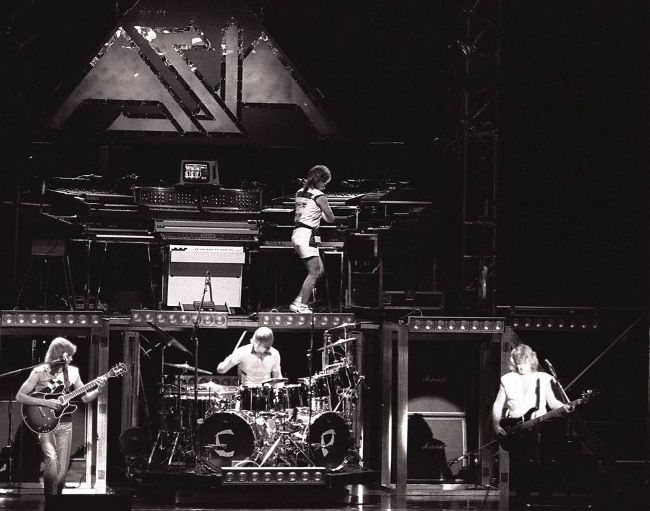
Wildest dream: Asia rock Germany in 1982.
ELLEN POPPINGA -K & K/REDFERNS/GETTY IMAGES
“Asia led the way. We didn’t see ourselves as rivals to Yes for two reasons: firstly they had disbanded, and secondly because we didn’t damn well want to be like Yes.”
Steve Howe
The game-changing, self-titled debut album from a brand-new group named Asia was released on March 8, 1982. Though the band responsible was a fresh entity, its four members could not have been any more familiar. Guitarist Steve Howe and keyboard player Geoff Downes both came from Yes (before that, Downes had been one half of the chart-topping pop duo The Buggles). Carl Palmer boasted a lengthy resume that included The Crazy World Of Arthur Brown, Atomic Rooster and, most recently, Emerson, Lake & Palmer. Last but by no means least, on bass and vocals was John Wetton, formerly of Family, King Crimson, Roxy Music, UK and Wishbone Ash, among others.
A little over two months later, Asia had sailed past platinum-selling status to leapfrog Chariots Of Fire by Vangelis and land proudly atop the US Billboard album chart. Though it was displaced for three weeks by Paul McCartney’s Tug Of War, the album bounced back for a further seven weeks, spending a total of nine at the pinnacle. Come the year’s end, Asia was acknowledged as America’s best-selling record of 1982. At the last count it had accumulated sales of more than 10 million copies.
Disregarding the reputations of the participants, to outsiders the astonishing response to Asia might have seemed like an overnight success, but their achievements culminated in more than a year of planning, scrapping those intentions and returning again to the drawing board. Trevor Rabin, later a driving force of 90125-era Yes, was briefly a member. Incredibly, for a nanosecond The Move/Wizzard star Roy Wood had also been considered for the line-up. But in the end, Asia got the formula right, the four men deploying MTV to tap into America’s heartland.
Nevertheless, more than four decades later, progressive purists still pooh-pooh their efforts. Asia wasn’t pure prog rock though it was symphonic-enhanced rock music at its most sophisticated and classy. Thirteen years ago, speaking in the very first issue of Prog, Carl Palmer claimed that, with radio having turning its back on them, ELP simply “could not have carried on”. He added: “America had gone very, very corporate. So it was a case of repainting the armour.” What Palmer meant was that although a gleaming new chassis was fitted, beneath the bonnet the same reliable old engine remained.