The Musical Box
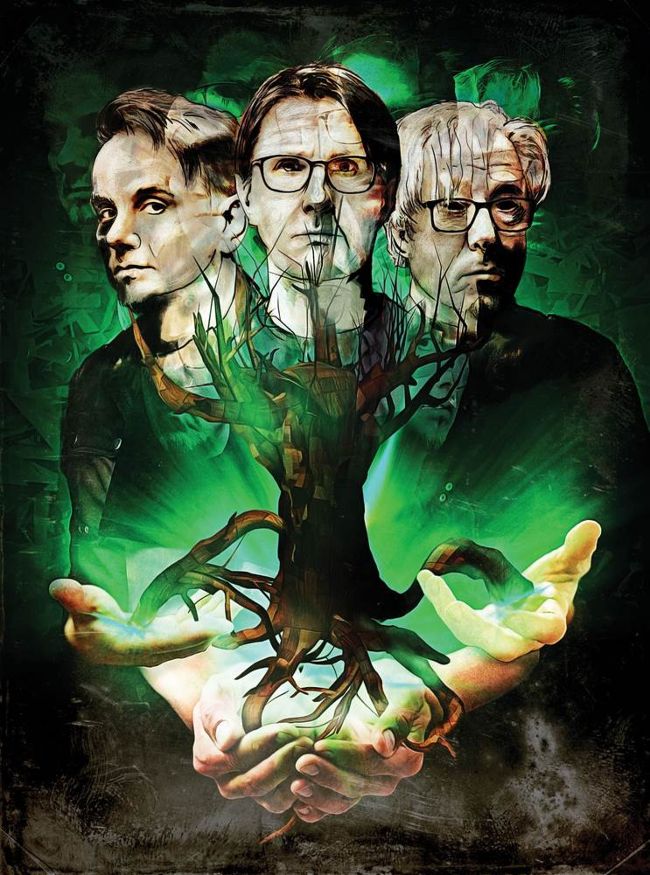
PORCUPINE TREE
New spins…
Friends reunited: modern prog icons make the decade’s most unexpected comeback, sounding the same… but different.
Words: Grant Moon
Illustration: Mark Leary
Edited by Dave Everley prog.reviews@futurenet.com
In aparallel universe, Steven Wilson’s tour for his UK Top 5 album The Future Bites went ahead as planned and his fruitful solo career continued as per the script, which didn’t feature a new Porcupine Tree album. That band ostensibly shut shop in 2010 after touring their 10th album The Incident. But it turns out that Wilson, arch synth texturalist Richard Barbieri and drummer Gavin Harrison (but notably not original bassist Colin Edwin) had been quietly chipping away at new music in the intervening years. When the pandemic struck and the script changed, there was a window to finally finish Porcupine Tree’s 11th studio record.
With three such bright, seeking artists involved, Closure/Continuation was never going to be a retread of Deadwing or In Absentia. The musical DNA behind those classic PT records is here of course, but so is a renewed sense of refinement and nuance, earned by all three in the interim. Wilson’s genre-fluid catalogue speaks for itself, as do Barbieri’s own classy, thinking albums; Harrison has excelled within the resurgent King Crimson. All these experiences are in the creative mix here and, crucially, the trio have co-written more than ever before.
Opener Harridan is a case in point. A tough bass introduces the song’s main, 5/4 groove, which Harrison – simply peerless – then nails; spooky electric piano chords come in and Barbieri adds swirls of dark atmospherics. Wilson’s on impassioned form on the dour verse’s crescendo (‘You can only save yourself’) and the powerful refrain (‘When we bite the dust, We will hide our cuts from the world’). The soft breakdown and ensuing metallic riff are pure PT, but more exploratory passages flirt with the fusion of Wilson’s The Raven That Refused To Sing (And Other Stories). Right down to its enigmatic final chord, Harridan’s an adventure in sound, and Porcupine Tree are back – the same, but different.
Closure/Continuation
MUSIC FOR NATIONS
"The DNA of their classic records is here, but so is a renewed refinement.''
The beautiful, fragile ballad Of The New Day is a flex of that Lazarus/Trains muscle. Set against Harrison’s subtle rhythm changes, the conventional chord progression is brought to life with some cheeky tonal diversions. Again (and importantly), Wilson’s in fine, consoling voice (‘Breathe the autumn, shame to be down in the thrall of the new day’), and then we’re taken on a crunchy detour through many different keys and time signatures, before being returned to the comfort of the verse.
Barbieri and Wilson’s Dignity is a masterful, evocative character piece/short story. The sounds of kids playing in a schoolyard echo, a jangly, riff comes in and then, to strummed acoustic, this scene-setting line: ‘Lost boy with the shreds of your shoes on your feet, and the schoolgirls called you a freak.’ Cue some spicy chords, retro synths and lyrical guitar work on an inspired piece brimming with loneliness and pathos.
And the brains come with some Crimsonstyle brawn. With its jagged metallic riff and subtle references to Holst’s Mars, Bringer Of War, Rats Return is a now-prescient look at the spiritual bankruptcy of tyrants and warmongers. They name names – ‘Genghis K, Pinochet, Mao Tse Tung, Kim Il-Sung’ – and given current events there’s bound to be another face on the video screens on tour this year. Herd Culling’s fiddly, prog-blues riff isn’t far from that of The Incident’s The Blind House. Tight guitar and drums are joined by fizzy electronic stabs before things get rocky (but never prog metal); Wilson’s falsetto, harmonies, throaty vocal and frantic electric guitar solo sell the drama. Written by the whole trio, this one’s controlled, beautifully balanced and oddly catchy. Predictably, the sound quality on this record is astounding.
And it wouldn’t be the Tree without some misery and alienation. Walk The Plank comes with eerie keyboard clusters, a bleak bass hook, Psycho-creepy ascending strings and claustrophobic lyrics: ‘This ship is now underwater and the rats will never find their way back again/And my span it gets shorter, And I don’t appear to fit my skin anymore.’ The album’s knotty closer, Chimera’s Wreck, opens with a gorgeous, acoustic guitar arpeggio – part John Carpenter, part Pink Floyd’s Hey You. ‘A coat of arms is all we are,’ rues Wilson, ‘The slow decay, a dying star, a sinkhole for the crawling of the hours.’ (Cheers, Steve.) Harrison’s brushed, bone-dry snare sets the pulse, Barbieri adds a cinematic wash to the salty, folky – and later Iron Maiden-heavy – mood on a tune that’s sure to tick all the boxes for diehard PT fans.
There are more of those now. Porcupine Tree’s reputation, and audience, has bloomed in their absence. Whether Closure/Continuation is the last hurrah or the start of a new era remains to be seen, but either way, the three remaining members have brought all their accrued music smarts to the table, and have made another exceptional record.
TIM BOWNESS
Butterfly Mind INSIDEOUT
Gold standard art-pop.
It took a long time for the two members of No-Man (established 1986) to receive widespread recognition.Steven Wilson, of course, has become an art-rock household name in the past decade for his much-loved mixes for the prog hierarchy, a series of scintillating albums and now his frequently touching autobiography.
The time must surely be right for former bandmate/current podcast co-host Tim Bowness to bask in similar mainstream admiration. Supported by a rhythm section consisting of bassist Nick Beggs and drummer Richard Jupp (the latter in his first major appearance since leaving Elbow), the richly detailed Butterfly Mind is another perceptive instalment in Bowness’ lengthy solo career.
Although Bowness’ voice – pure and clear – is front and centre throughout, as ever, it acts as part of the whole, balancing emotion, pathos and (passive) aggression perfectly. It seems fitting that Jupp is currently playing with Bowness as Guy Garvey is clearly no stranger to the latter’s beautifully written ballads. Even though he uses far fewer words than many of his contemporaries, each is painstakingly considered, yet open to interpretation. Butterfly Mind could be about many things: ageing, divorce, pandemics, Brexit, paranoia, the butterfly mind that so many experience in this 21st century ‘always on’ culture. About The Light That Hits The Forest Floor is a touching reflection on passing love, yet like the rest of the album it’s neither splashy nor overwrought.
As with the best of his work, Bowness only ever uses what he needs. This delicious spareness can be heard to greatest effect on Dark Nevada Dream, the album’s standout track. The only song that significantly nudges over the four-minute mark, it blooms softly, pulsing with languid guitar figures, the sensuous Hammond of Dave Formula (ex-Magazine) and a Van Morrison at-his-peak lightness of touch.
Keeping up the tradition of recent albums, guest players contribute with appropriate understatement, aside perhaps for Peter Hammill, who contributes a startling ‘Hendrix of the voice’ cameo at the end of Say Your Goodbyes Pt1, and still-sounds-if-he-only-recently-picked-it-up guitar on We Feel. Adding to the guestlist, that song also features some impeccable Ian Anderson flute work.
With its reprises and repeated lyrical refrains, plus pristine production by Bowness and long-term collaborator Brian Hulse, and a final mix by Steven Wilson, Butterfly Mind is big and bold enough for mainstream crossover. However it’s received, it stands as a career high point for Tim Bowness, full of invention, scope and ambition.
DARYL EASLEA
ASIA
Asia In Asia: Live At The Budokan, Tokyo, 1983 BMG
Made in Japan, with help from Greg Lake.
Asia in Asia. What could
possibly go wrong? On
paper quite a lot, actually.The acrimonious departure of frontman John Wetton saw 11th hour stand-in Greg Lake use a teleprompter onstage as an aide-mémoire, while the Budokan show’s live broadcast to MTV USA via satellite meant the heat was most certainly on.
This deluxe box set, with a 40-page book, testifies to Asia’s fortitude and adaptability. Reunited with his ELP bandmate Carl Palmer, Lake is predictably solid, while Steve Howe and Geoff Downes seem energised by Lake’s arrival. With MTV’s Mark Goodman compering and the Japanese fans going uncharacteristically apeshit when Palmer’s drum solo segues into Heat Of The Moment, Asia In Asia is a reminder of an era when prog’s poppier exploits rose high in the singles charts – and men versed in 9/8 time signatures wore mullets and cap-sleeve T-shirts. The timing of this December 6, 1983 show is interesting, too. Yes’ Owner Of A Lonely Heart had reached No.1 in the US weeks earlier, and rivals Asia sought greater US traction for 1983’s Alpha, the disappointing followup to their phenomenally successful, self-titled debut. JMN
THE BARDIC DEPTHS
Promises Of Hope GRAVITY DREAM
Melodic, intelligent and convincing concept album from beefed-up collective.
The Bardic Depths, led by writer and multiinstrumentalist Dave Bandana and conceptualist and lyricist Brad Birzer, came together through the Big Big Train Facebook community. Their self-titled 2020 debut was based on the literary friendship between JRR Tolkien and CS Lewis against the backdrop of World War II.
Three of the guests from that album – guitarist Gareth Cole, vocalist/sax player Peter Jones and drummer Tim Gehrt – have since joined Bandana and Birzer to form a stable line-up.
Co-produced by Cosmograf’s Robin Armstrong, Promises Of Hope finds the band developing their blend of wraith-like soundscapes and multilayered rock, conceptually exploring the horror of suicide and the possibility of redemption.
Employing a palette that ranges from whistles and fiddles to the church organ it all unfolds leisurely.
There are elegant similarities to Pink Floyd on The Burning Flame and Returned has a whiff of Peter Gabriel’s fourth album, but these influences are used creatively. Performed with tremendous conviction, Promises Of Hope is for those who relish their music intelligent and ambitious, full of melodies and hooks. DE
MS AMY BIRKS
In Our Souls
MSAMYBIRKS.BANDCAMP.COM
Second set full of elegantly rustic odes.
The follow-up to 2020’s All That I Am & All That I Was upholds Ms Amy Birks’ penchant for lusciously classical timbres and poignant lyrics. Layered vocals, marching drums, and remorseful piano chords collide to make introductory piece In Our Souls a radiant adaptation of Charlotte Bronte’s poem of the same name. Sister Emily’s work is given a sparser and lighter treatment via A Death Scene, whereas their sibling Anne’s The Dream is transformed into a slightly quirkier singer-songwriter composition punctuated by ethereal chants, woodwind and percussion.
Birks’ original lyrical material is equally gorgeous. Folk narrative Elsa’s nuanced instrumentation is a highlight, as are the symphonic and progressive pop elegies Brothers and The Woman In White. Goodnight For Now incorporates acoustic strums and strings for maximum calmness, and Cannot Contain recalls the vibrant arrangements of Tori Amos, Ben Folds and Kate Bush. Even the less intriguing Hold On and The One That Got Away are likeable, so there’s really nothing that prevents In Our Souls from being a consistently beautiful journey. JMB
ARCHIE CAINE
Tommy And The Angels
ARCHIECAINE.BANDCAMP.COM
A symphony of voices on theatrical debut.
Musical theatre meets symphonic metal in the debut release from British singer Archie Caine.The record tells the story of an unhappy wee lad called Tommy whose desire to escape his loveless home brings him into contact with an angel. Caine is joined by Arena’s Damian Wilson as the Narrator and Dianne van Giersbergen as the Angel, while Adrian Benegas, of Paraguan symphonic metal band TRAGUL, plays keys.
Musically, Caine and his co-writers, Bo Wilde and Holly Nichol, have an ear for poppy melodies that come to the fore in the upbeat Faster and Losing The Game, while the propensity for bombast and the melodrama of the story recall Jim Steinman. Van Giersbergen hits the loftiest of high notes in Meeting The Angel and Eden, and Caine shows his falsetto in the showpiece ballad Tommy’s Lament, although he has a fuller tone lower in his range. Losing The Game is a stronger showcase for the vocalist in a duet with Wilson.
The pronounced musical theatre influence can threaten to take the album into the realm of camp at times, not least when singing about monsters under the bed, but this a solid first effort from Caine.
DW
JOHN CARPENTER, CODY CARPENTER AND DANIEL DAVIES
Firestarter OST SACRED BONES
Horror master continues to burn.
Now that John Carpenter has effectively given up making films, music seems to be taking up more and more of his life. Last year saw the third volume in his Lost Themes series, in conjunction with son Cody and godson Daniel Davies, alongside the score for Halloween Kills, the latest in the ongoing slasher franchise.
The trio have wasted no time in getting back to it, shaping the soundtrack to a new film version of Stephen King’s pyrokinetic sci-fi horror Firestarter. Carpenter’s signature moves are in evidence here: jarring synth lines, recurring motifs, sudden spasms of ruptured noise, a pervading sense of imminent peril. It carries echoes of previous scores, particularly Halloween, Escape From New York and Assault On Precinct 13. But Firestarter feels like a full narrative experience, from opening gambits Mother’s Love and Lot 6 (Main Titles) to the sinister drone’n’beats of Rainbird Fights Vicky (which sounds like something being dragged across a floor). Even the ambient interludes are loaded with meaning. A masterclass in emotional dread and suspense. RH