JEAN-MICHEL JARRE
Progressive electronic pop doyen goes on a binaural odyssey by way of a trip back to Paris and 1968.
Words: Jeremy Allen Illustration: Mark Leary Edited by Dave Everley prog.reviews@futurenet.com
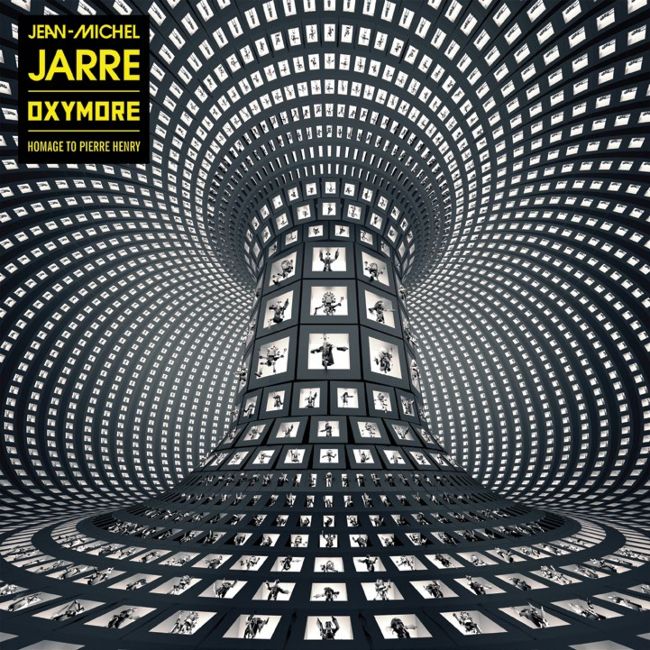
Oxymore: Homage To Pierre Henry
SONY MUSIC
Jean-Michel Jarre achieved global recognition with his 1976 album Oxygène, selling 12 million albums at a time when progressive music was supposedly in retreat. Forty-six years later, he brings us Oxymore, which suggests we’re in for more of the same – or at the very least, we’ll be treated to some motifs from across the decades. The title turns out to be a red herring. It’s a play on ‘oxymoron’ rather than a declaration of more Oxygène, an obvious semantic correlation that Jarre claims he didn’t notice initially.
If Oxymore has an antecedent then it’s 1984’s Zoolook, a record that used the Fairlight CMI to build sonic worlds, festooned with manipulated voices spouting 25 different languages. But the listener needs to go back further still to 1968 to identify the true inspiration for Oxymore, to the Groupe de Recherches Musicales (GRM), where Jarre studied under musique concrète pioneers Pierre Schaeffer and Pierre Henry. Schaeffer would come to renounce his sonic experiments towards the end of his life in 1995, but the other Pierre was still composing with found sounds well into the 21st century.
Henry’s voice is present on the introductory track, Agora, and it recurs intermittently throughout. On Agora (Greek for ‘gathering place’), the listener first detects what sounds like typing on a page, followed by dripping water that fulminates in a gush, then sporadic voices and whispering, chopped up and moving from speaker to speaker over some radio static. Then comes Henry, the daring Paris-born composer, talking about the process of making compositions using the fabric of sound, all in French of course.
Agora sets things up nicely for the title track, a dramatic and ominous example of where we’ll go, a kind of primordial dawn of recorded sound built from the fragments of objets trouvés, mixed in a state-of-the-art studio. The Oxymore oxymoron refers to the contrasts of collage, exploring the possibilities of cutting-up fragments with cutting-edge technology, 110 years after Picasso and Braque were slipping bits of newspaper into their painted canvases at the height of Cubism. Montage is no longer a radical artform these days, though the way Jarre melds electroacoustic sounds with his ultra-modern studio creates a fascinating tension.
"His desire to shape the future leaves little room for nostalgia."
Jarre had hoped to work with Henry when he recorded more than 30 collaborations for his Electronica project – released in two volumes in 2015 and 2016. Sadly, his sonic guru was too ill to contribute, but before Henry died, he made a series of recordings that were bequeathed to Jarre via his wife, Isabelle Warnier. The stems full of concrète sounds, as well as the composer talking about processes and textures, form the basis of Jarre’s 22nd studio album.
Oxymore is perhaps most interesting thanks to Jarre’s willingness to return to the GRM with the same mindset he would have had in 1968. He eschews melody in favour of strange textures and disembodied, sometimes coquettish voices, like on Sex In The Machine and Synthy Sisters. Definable, ear-catching tunes are sacrificed to the gods of experimentation, but the unifying dance grooves he presents make for a cogent and cohesive experience.
When JMJ became famous in the mid-tolate 70s, it was partly thanks to his decision to take his avant-garde training and marry it to accessible, catchy melodies like on the hit single Oxygène (Part IV); moreover, his music tapped into a general optimism engendered by space travel, and a naïve assumption of progress. Here we get the brutality of Brutalism, or the Poe-like horror of Animal Genesis, and that positivity has evaporated, with more of a sense that we’re stuck in an awesome dystopian machine from which it’s impossible to escape. If it’s punishing at times, it also illustrates why Jarre is an artist who has, for the most part, remained in touch with what’s going on. His music oozes with the now, and it always has.
The titular oxymoron, then, where future meets past, also extends to the way we listen. Recorded sound has come on in leaps and bounds since Schaeffer founded the Studio d’Essai in 1941, and then later the GRM, although we’ve been living with stereophonic sound since the late 60s and there’s been little in the way of progress in the way we consume music since then. Jarre made a case for 5.1 surround sound around the release of his compilation, AERO, in 2004, and while 5.1 didn’t catch on other than in cinemas, he goes in to bat for binaural sound this time around. The enhanced binaural mix isn’t available as we go to press, though listening, it’s easy to imagine how it might work. Ever the innovator, Jean-Michel Jarre’s desire to shape the future leaves little room for nostalgia.
BANCO DEL MUTUO SOCCORSO
Orlando: Le Forme Dell’Amore INSIDEOUT
talian veterans hit their half-century with inventive poetic adaptation.
K
ey progenitors of the Rock Progressivo Italiano movement, Banco Del Mutuo Soccorso mark their 50th anniversary with an album that distils a vast 16th century Italian poem into a single concept album.
With keyboard maestro
I
Vittorio Nocenzi the only
remaining founder member, Orlando… kicks off with the gentle piano and synth woodwind of the scene-setting
Proemio introducing the world of chivalry, conflict and extremes of romantic love about to be explored. Conventional structures are largely secondary to storytelling; while there are great hooks, themes and leitmotifs
– the jazzy passages in La Pianura Rossa, the call-and-response between guitar and keys in Cadere O Volare, vocalist Tony D’Alessio’s passionate exhortations in Cosa Vuol Dire Per Sempre – song development can seem counter-intuitive.
With terrific performances from everyone involved, especially Nocenzi and guitarists Nicola Di Già and Filippo
Marcheggiani, Orlando: Le Forme
Dell’Amore is a delight for the band’s aficionados and acts as a superb snapshot of the rich, sometimes idiosyncratic and deeply expressive world of Italian prog.
GMM
DANIEL BIRO
Synthrospections 7: Earthly Reflections SARGASSO
Another one-take wonder from the worldly synth artist.
S
ynth player and composer Daniel Biro studied piano at Monaco’s Jazz Conservatory and got his music degree from Nice University before settling in London in the 80s. In 2021 he started his ‘Synthrospections’ – improvised, one-man keyboard concerts livestreamed to listeners across the world. The seventh of these was recorded in June this year – Biro gave a talk on one of his heroes, the late Vangelis, and then played this 40-minute synth work, in just one take.
That takes some nerve and a great deal of skill, but Biro’s confidence in his abilities is borne out by the results.
Earthly Reflections isn’t an especially adventurous melodic experiment, but in terms of mood and sonics it’s an captivating piece. Inevitably, Biro pays due tribute to Vangelis: the central section is a blend of lyrical, sweeping melodies and machine-like rhythmic pulses. Biro has assimilated the work of other pioneers too. The opening 10 minutes – aone-note bass vamp underpinning some jazzy improv – evokes Richard Wright’s more languorous moments on Pink Floyd’s mid-70s output, while the ghost of Klaus Schulze is another presence on this richly atmospheric achievement.
GRM
CAN
Live In Cuxhaven 1976 MUTE/SPOON
Krautrock pioneers get laid-back and funky on latest live release.
T
he third instalment in
Can’s ongoing series of archival live albums finds the band in a looser mood compared to some of the more intense jams featured on the previous two. Recorded in January 1976 in the town of Cuxhaven on Germany’s North Sea coast, there’s a fittingly aquatic vibe to much of the music here, gently surging in fluid waves and eddies.
This spacier take on Can’s sound is evident on Eins, its scuttering beat and bass throb subtly adorned with Irmin Schmidt’s keening organ and spare, funky soloing from Michael Karoli. In fact, while rhythmically more
ambitious, it’s not a million miles from pre-Dark Side Of The Moon Pink Floyd, whose influence on the krautrock scene can’t be overstated. Zwei continues the laid-back vibe – the way it ebbs and flows is just wonderful, the dynamics masterfully controlled by Jaki Liebezeit’s patiently evolving percussion.
Drei nods towards Dizzy Dizzy, before entering that zone of uncertainty where avant-rock starts to morph into free jazz. But Vier is Can once again as playful jam band, responding to an appreciative audience by kicking back and having some fun.
JB
CELESTIAL SON
Planeteria PRIME COLLECTIVE
Danish synth proggers enlist big-name help on third album.
C
openhagen’s Celestial
Son have only released one EP and two studio albums since their 2003 formation. But this first long player in seven years proves the effectiveness of taking your time.
While Rasmus Sjogren’s songs are shot through with an epic widescreen ambition in keeping with an intrinsically prog mindset, he’s obviously absorbed plenty of more diverse influences. Rise Of A Cosmic
Dragon blends grinding industrial techno motifs with a sparkling, cascading synth riff, before echoing Japan (band more than country) in its use of Eastern instrumental sounds
and coolly crooning vocals.
Elsewhere, Lord Of Karma and Reen employ Depeche Mode-ish stylings before the latter is lifted by anguished vocal howls and insistent, krautrock-echoing marching beats.
The way Avian Heart’s stinging, angular guitar motif softens into a romantic sweep of a chorus is reminiscent of some of Porcupine Tree’s more wistful moments – perhaps no coincidence given Gavin Harrison adds polyrhythmic percussion to this and several other tracks. Exalted company to be keeping, but Celestial Son sound well-deserving of being in the same room.
JS
SARO COSENTINO
The Road To Now CAT SOUNDS
Atmospheric collection from Italian composer and multi-instrumentalist.
S
aro Cosentino has a background in pop production and TV/film work, and he’s applied sumptuous orchestrations and glossy sheen to each of the eight tunes here. The sound and feel here is reminiscent of his 1997 album, Ones And Zeros, and like that previous release, The Road To
Now features guest vocals from Peter Hammill, Tim Bowness and Karen Eden, plus instrumental contributions from members of King Crimson and Peter Gabriel’s band.
Impeccably produced, with the exception of one instrumental track featuring Trey Gunn’s sinuous touch
guitar, the rest of the album is in thrall to slow and medium-paced melancholic ballads musing upon love, life, and loss. The best of these is Hammill’s Time To Go and When Your Parents
Danced, each imbued with a poignant depth.
However, taking the album as a whole it lacks any significant contrasts in tone or dynamic gear shifts with Cosentino’s unfailingly empathetic arrangements carefully positioning everything in a pervasive soft focus haze. Though beautifully rendered, the cumulative result becomes indistinct and worryingly interchangeable.
SS
BRIAN ENO
Foreverandevernomore UMC
Ambient innovator voices concerns over humanity’s future.
B
rian Eno’s campaigning on humanitarian issues has been running for almost as long as his work in the realms of ambient music and electronic exploration. For his 29th solo studio album, the venerable pioneer and producer brings together his concerns for the ecology with his ever expanding musical vernacular.
What’s immediately apparent is that, while welcoming him behind the microphone, Eno’s lyrical concerns move in tandem with the ethereal music that he creates. This is less to do with hectoring and more in line with subtle persuasion. The sublime Icarus Or
Blériot is a case in point wherein Eno explores the dichotomy at the heart of scientific exploration: the benefit to the wider community versus the cost and profit for the few.
The lachrymose There Were Bells is tempered by soothing and comforting sweeps that sweeten the lyrical pill. Indeed, the soundscapes and grand strokes are easy to escape into for this is an album that undulates, ebbs and flows like a gentle river through a quiet and glorious countryside. But through it all runs Eno’s plangent voice, which is as much a part of the instrumentation as it is a vessel for his message.
JM
DEVIN TOWNSEND
Lightwork HEVYDEVY RECORDS/INSIDEOUT
Canadian maverick swaps heavy riffs for synths and strings.
Born from material that Devin Townsend wrote during the pandemic, Lightwork finds him in a reflective, optimistic mood. Unusually, the one-man prog powerhouse brought in a co-producer for the album in the form of GGGarth Richardson, whose credits include Rage Against The Machine, Melvins and Biffy Clyro. The result of their collaboration isn’t what might be expected given Richardson’s extensive background in heavy rock. Lightwork builds on the direction Townsend pointed towards on Empath, with less emphasis on mammoth guitar riffs and venturing into the territory of progressive pop.
Sonically, Townsend maintains his trademark wall of sound, like a proggy version of Phil Spector minus the evil undercurrent. It’s a huge, deep mix, with instruments layered upon each other measured in fathoms, big, punchy drums, and vast swathes of strings and synthesisers. The opening Moonpeople establishes the vibe, with Townsend touching on falsetto with his vocals, a cheerfully catchy chorus hook, and lyrics that introduce the album’s themes about self-discovery and coming out of the darkness, metaphorically addressing all the uncertainties of the pandemic.
Lightworker has hints of the musical theatre of Why? from Empath, with a monster chorus and production expertly designed to bowl the listener over. It feels guaranteed to be an absolute behemoth live. There are several moments when the album brings to mind the style of Tears For Fears and in tracks like Equinox and Call Of The Void, Townsend even sounds like Curt Smith, although some distorted singing serves to underline his metal roots. If not for the occasional screamed vocals, Equinox could fit on The Seeds Of Love, the songwriting is that strong and the production suitably lavish. Call Of The Void is reassuringly hopeful, Townsend, urging the listener not to freak out: ‘Because when you feel the world’s insane, relax!’ Vacation is a mellow slice of sunshine as Townsend opines about longing to get away from it all.
Dimensions adds an industrial edge to the album with its NIN-style pulsing synths and machine-like drumbeat and the album closes with the expansive Children Of God, which brings back the prog pop aesthetic. Lightwork may be the closest that Townsend has come to a conventional set of songs, and it’s almost a shock to hear the mind behind Ziltoid The Omniscient offering the world a musical hug, but being unanticipated doesn’t make it any less enjoyable. The final sound on the album is a lighthouse’s lonesome foghorn, calling the listener home, guiding them out of the dark and into the light. Glorious.
DAVID WEST