Once In A Lifetime
By the early 80s, much of the British music press had turned their backs on prog, dismissing it as old-fashioned and out of touch with the youth of the day. But in the UK’s shires a grassroots scene was beginning to grow, spearheaded by Marillion, whose successful debut album Script For A Jester’s Tear paved the way for a sound inspired by the 70s classics but infused with modern pop hooks and poetic lyrics. Members of Pendragon, Pallas, IQ, Solstice and more share the story behind the rise (and fall) of a movement that would set prog on a new path.
Words: Dave Everley
Portrait: Simon Fowler
TICKET FLYERS THROUGHOUT ARTICLE TRILOGY AND PENDRAGON ARCHIVES
“In the early days, we used to wear these stupid kaftans with a big eye on it. We’d walk down the street in them before the show, publicising the gig. Whatever it took.”
Mick Pointer (ex-Marillion)
ll things must pass, and prog’s imperial early-to-mid-70s phase was no exception. By the end of that decade, many of its chief protagonists were either seemingly spent as creative forces (ELP, Yes), about to undergo radical transformations (Genesis, Yes again) or absent (King Crimson, albeit temporarily). The upstarts of punk may have been commercial minnows in comparison, but their jibes about ‘dinosaurs’ hit where it hurt.
Yet as the 80s got underway, something unexpected was happening. Across the United Kingdom, a wave of grassroots bands set about reviving this seemingly moribund genre. A scene was emerging, largely away from the bright lights and music industry back-slapping of London. It was centred around the likes of Aylesbury’s Marillion (née Silmarillion) and space cadets Solstice, Twelfth Night (who began life as an instrumental band at Reading University), Pallas from Aberdeen, Pendragon (originally Zeus Pendragon) from Stroud and Portsmouth’s IQ (formed from the ashes of The Lens). Their ranks were swollen by countless other like-minded outfits: Chemical Alice (whose keyboard player Mark Kelly would join Marillion, and other members would go on to form Tamarisk), Trilogy, Haze, Airbridge, Liaison, Citizen Cain and others.
As the decade progressed, these bands would channel the DIY spirit of punk to create a vibrant homegrown scene, populated by a handful of larger-than-life characters and soundtracked by albums that wore their love of a thenunfashionable musical style openly. One band –Marillion –would go on to much bigger things, but others would have their own individual and collective successes, not least in keeping the progressive rock flame flickering.
Unlike earlier scenes that had been centred around specific locales, the new prog bands initially operated in isolation in towns and cities across the country, largely unaware of each other.
Mick Pointer: “Silmarillion played our one and only show at a pub in Southall [west London] called The Hamborough Tavern. We had a big fallout with the guitarist and keyboard player over a fucking Mellotron, would you believe? We started gigging as Marillion pretty bloody quickly afterwards. You have to get yourself out there in front of a whole lot of people.”
Nick Barrett: “We played Redditch College and the agricultural college in Cirencester. We got booed off at most places. At one gig, the rugby team tried to drive a car into the venue and then got onstage and started hassling us.”
Andy Glass: “I’d played with Mick Pointer in a band called Electric Gypsy. As soon as Marillion started getting gigs, they were like, ‘Do you want to come and play with us?’”
Brian Devoil: “There were a couple of pubs in Bicester where we played, a couple of places in Oxford, and the Target in Reading, which was our local pub.”
Mike Holmes: “When we started IQ in Southampton, we wanted to do any kind of music we wanted to. We had a funk track, a reggae track, but it became really obvious very early on that what we were really good at was prog.”
Paul McMahon: “We were basically a school band when we started out [in 1978]. The ambition was to do original music. We’d no idea that prog music was going to have any kind of resurgence.”
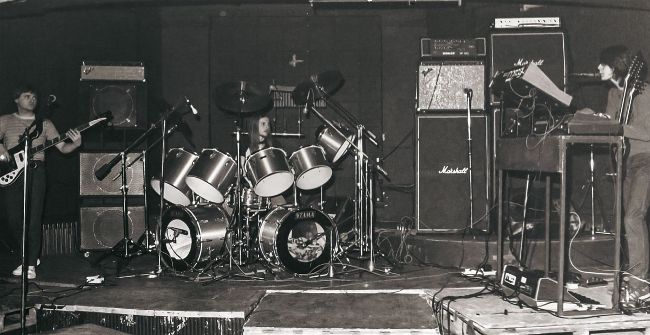
Trilogy’s first Ruskin Arms gig, November 1981. No kimonos yet, though…
PRESS/TRILOGY ARCHIVES
Dramatis Personae (in order of appearance)
MICK POINTER Marillion co-founder and drummer 1979-83
NICK BARRETT Pendragon founder and guitarist/singer
ANDY GLASS Solstice founder and guitarist
BRIAN DEVOIL Twelfth Night founder and drummer
MIKE HOLMES IQ guitarist
PAUL MCMAHON Haze founder, guitarist and vocalist
GRAEME MURRAY Pallas founder and bassist
NIK SZYMANEK Trilogy drummer
ED PERCIVAL Airbridge guitarist, keyboardist and vocalist
ANDY GRANT Chemical Alice/Tamarisk
FISH Former Marillion singer and solo artist
ROGER MORGAN Afterglow fanzine co-editor
KEITH TURNER Quasar founder and bassist
NIGEL HUTCHINGS General manager/ booking manager, The Marquee
STEPHANIE BRADLEY Prog fan/Marquee attendee
PETE HINTON Elusive Records A&R manager
STU NICHOLSON Galahad singer
“We played The Ruskin Arms in east London, which is where Iron Maiden played a lot. We used to wear kimonos onstage. Was it a rip-off of Rush? Yeah, of course it was.”
Nik Szymanek (Trilogy)
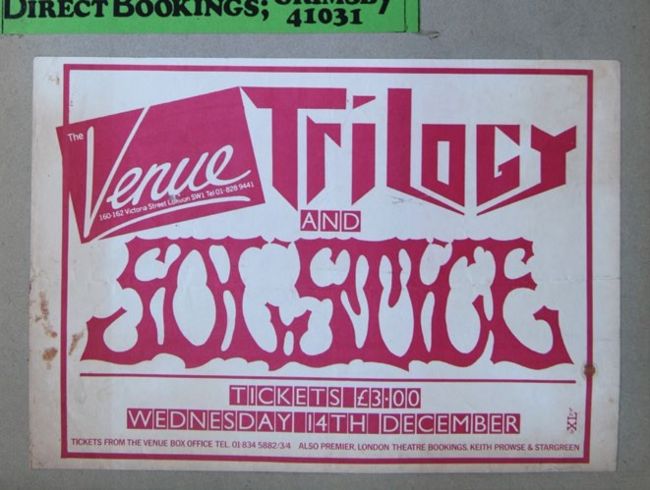
The bands did joint tours to spread the word of prog.
Graeme Murray: “Glasgow really seemed to take to the whole prog thing. There was a venue on Sauchiehall Street; we used to play there on a Saturday, a lunchtime show, an evening show and a late show, and the place would be packed out the door.”
Nik Szymanek: “We played The Ruskin Arms in east London, which is where Iron Maiden played a lot. We used to wear kimonos onstage. Was it a rip-off of Rush? Yeah, of course it was.”
Ed Percival: “These days, you can do a tribute band. Back then, it wasn’t a thing you did. You wrote your own songs, because that’s what music was all about. It was about you creating something new.”
Andy Grant: “With Chemical Alice, we were so young. The only ambition was to play live and try and get a recording, just to see if we could get people to come and look at us.”
There was excitement in the air, both musically and visually. Marillion, Pallas and Twelfth Night imbued their musical experiments with an electric 80s energy, complementing it with visuals that drew on the grand theatrical tradition of Peter Gabriel and Peter Hammill.
Mick Pointer: “The early Marillion stuff was going down more of a hippie route. It needed a kick up the arse. Then Derek Dick [aka Fish, who joined in January 1981] turned up with a book of lyrics and started looking at the material we had. That’s when things started taking shape.”
Andy Glass: “Fish was incredibly charismatic. Who doesn’t love a showman?”
Mick Pointer: “In the early days, we used to wear these fucking stupid kaftans with a big eye on it. We’d walk down the street in them before the show, publicising the gig. Whatever it took.”