THE PROG INTERVIEW
BRIAN AUGER
Every month we get inside the mind of one of the biggest names in music. This issue it’s pianist and master of the Hammond organ Brian Auger. Although probably best known for Julie Driscoll, Brian Auger And The Trinity’s 1968 hit This Wheel’s On Fire, away from the pop world he’s highly regarded as a pioneer jazzer who sought to “develop this idea of a bridge between jazz and different musical worlds”. Before that one-off hit, he had the band The Steampacket with vocalists Driscoll, Rod Stewart and Long John Baldry, and after The Trinity formed Brian Auger’s Oblivion Express. In his long and storied musical journey, Auger has also worked with Jimi Hendrix, John McLaughlin, Tony Williams, Sonny Boy Williamson and Eric Burdon, among many other big names from across the musical spectrum. Brian Auger’s Oblivion Express’s Complete Oblivion box set was released in 2023.
Words: Rob Hughes
It’s the day before Brian Auger’s 84th birthday, and the legendary Hammond maestro is in fine spirits. Seated in his practice space at home in Los Angeles, he explains that he’s getting together with his family to toast the occasion. That means a visit from his grandkids and children, three of whom –son Karma and daughters Ali and Savannah –have at one time or another played in Auger’s ground-breaking jazz-fusion ensemble Oblivion Express.
MICHAEL PUTLAND/GETTY IMAGES
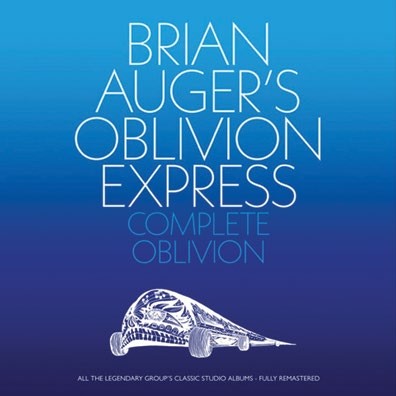
Out now: Brian Auger’s Oblivion Express Complete Oblivion box set.
There’s also cause for a celebration of the musical kind: the recent release of Complete Oblivion, a lavish box set of the band’s essential run of studio albums from 1970-75, a period that saw Auger move from progressive jazz rock to deep jazz funk and beyond, driven by his love of experimentation and dynamic rhythms. It’s the latest and most lustrous in a spate of recent remasters that have sought to place Auger’s formidable output in some kind of context, from his early days in British R&B band The Steampacket, which also featured vocalists Rod Stewart, Long John Baldry and Julie Driscoll, to solo works and late-60s combo The Trinity.
“Revisiting this stuff has been quite a revelation to me,” he marvels, “because there’s been a lot of music that I’d not listened to for a while. But those old records are coming at me and I’m going, ‘Wow! Did I really do that?’ I think it’s just the fact that I was so fired up. I became a professional musician in 1963, and now I’m at that point where I’m looking back.
I often think to myself that the universe has smiled on me many times.” Auger started out as a pianist in London’s vibrant jazz scene of the early 60s. Galvanised by Jimmy Smith’s funky organ sound, he’d switched to Hammond B3 by 1965, by which time he’d co-founded The Steampacket with singer Long John Baldry, alongside a young Rod Stewart and 18-year-old newcomer Julie Driscoll. The band weren’t built to last, but he wasted little time in forming Brian Auger And The Trinity, taking the redoubtable Driscoll with him as lead singer.