Long Distance Voyager
In 1971, 20-year-old Steve Hackett made his debut with Genesis.
His imaginative guitar work became a key feature of their 70s sound,
but when Peter Gabriel departed, Hackett’s future with the band came
into question. Two years after the release of his debut solo album,
Voyage Of The Acolyte, he also left to hone his craft as not only a solo
artist but also a bandleader. As he prepares for his upcoming Best Of
Genesis & Solo Gems Tour, we look back on how one of prog’s great
guitarists turned what could have been a death knell into his strength
Words: Mike Barnes
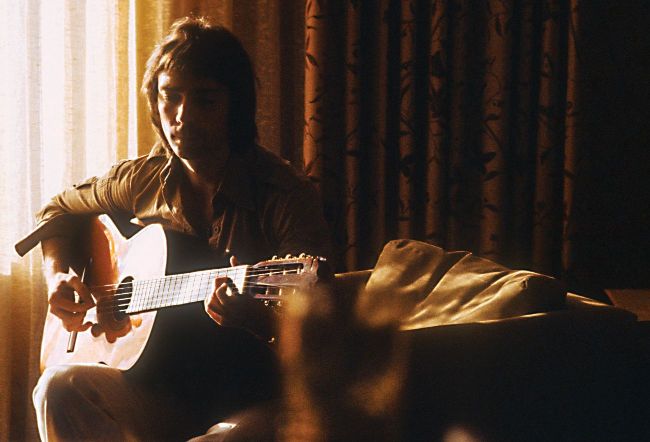
Steve Hackett, a man in motion.
Portrait: Armando Gallo
“I think all too often, ‘progressive’ means, for some people, impenetrable time signatures and it’s difficult and long, and all of that. Whereas I think progressive music ought to be inclusive and no kind of music should be off limits.”
In September 1975 Peter Gabriel made
a public announcement that he was
leaving Genesis. The move had been
rumoured a few weeks before in
weekly music mag Melody Maker, but
it was now official, and to fans it felt
like an act of abdication. Unbeknown
to them, Gabriel had taken time out
from the group the previous year,
during the rehearsals for The Lamb Lies
Down On Broadway, when his newborn
daughter Anna-Marie was unwell. This
hadn’t gone down well with factions
within the band, and their reaction had
not gone down well with Gabriel. He
returned to record and tour the album,
knowing that he’d soon be going for
good, but delayed his announcement
until they found a replacement singer.
Guitarist Steve Hackett remembers feeling that Genesis were on very shaky ground.
“I didn’t know if the band was going to continue without Pete,” he tells Prog. “The Lamb Lies Down On Broadway was a very good album. It’s something we all wrote, but Pete was working almost like a solo act within the band. We were like the pit orchestra to his Nijinsky or Nureyev; he was very much the star of the show.
“I also felt that the band was losing its sense of romance and magic. The Britishness and the European-ness that we had that was part of our appeal.”
In a lengthy statement for the music press titled ‘Out, Angels Out – an investigation’, Gabriel revealed that, musically, the roots of his unhappiness lay in Genesis’s collective approach to songwriting – which gave the compositional credit “All Titles Done By All” on the record label. On the surface this seemed suitably progressive and inclusive, an attempt to rectify the disparities in composing royalties that had perennially caused problems within groups. But it created its own set of issues.
Gabriel wrote, “The vehicle we had built as a co-op to serve our songwriting became our master and had cooped us up inside the success we had wanted. It affected the attitudes and the spirit of the whole band.” He needed to be able to explore musical and visual ideas in a way that this “pseudo-democratic committee system could not provide”.
Hackett had also had some of his ideas turned down by this committee system and had been writing new material during the lengthy The Lamb… Tour. And so, “hot on the heels of Pete’s departure from Genesis” at the tour’s conclusion in May 1975, he took the opportunity to record his first solo album, Voyage Of The Acolyte, at Kingsway Studios, London, in June.
“It was my attempt to do something outside the auspices of the band,” he explains. “Pete was surely going to make a huge success of what he was doing, but I went into the studio thinking, ‘I’ve written loads of stuff, but am I going to come out with a whole album, or will it end up on the cutting room floor?’ I didn’t have the level of confidence that you really needed to become a successful solo act.”
Hackett’s interest in the tarot deck helped focus his compositional ideas.
“Here’s the Ace Of Wands. It means the beginning of a new venture. ‘Aha!’ I thought. ‘This could be the first track.’ A Tower Struck Down, that had to be a really aggressive track. My brother John came up with a marvellous riff, which was dissonant but engaging.”
His first marriage had failed, so Hackett moved back in with his parents in central London. At that time, John Hackett, his younger brother, had quit his languages course at Cambridge University and was also at home, applying for a music degree. “Once again, we were little boys sharing a bedroom,” says Steve. “But instead of wrestling and beating each other up as young boys do, we were being constructive, making music together. John’s input was invaluable.” musician, and it never ceases to John had started playing music as a guitarist, but then he and Steve saw King Crimson live in 1969. Inspired by their formidably talented wind player and multi-instrumentalist Ian McDonald, the brothers co-purchased a flute.