China s Outback
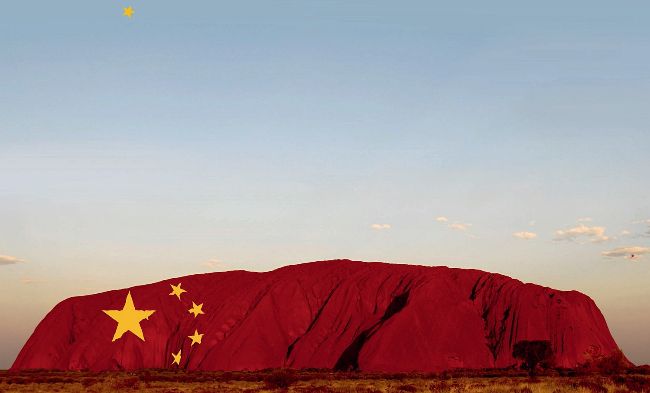
Australia is uneasily perched on the frontier of a new world order—based in Beijing
KERRY BROWN
© BERND LEITNER/IMAGEBROKER/REX/SHUTTERSTOCK
I started learning Mandarin in earnest a quarter of a century ago, just after moving to Melbourne. Recognised as the world’s best preserved Victorian city, it also has a vibrant, long-established Chinatown. My wanderings there during lunch breaks whetted my appetite. In the evenings, I memorised characters and learned the pinyin system used to transliterate Chinese characters. For a novice, Melbourne was a Mandarin learner’s paradise.
But travelling on the Great Ocean Road to Adelaide on holiday exposed a less positive side of the story. A monument halfway along this route records the murder of Chinese prospectors who came to find their fortune in the newly opened goldfields of 19th-century Victoria. On my arrival at the nearest town, one inhabitant ranted to me about how the country was being overtaken by “Asians from the north.” The real story of the land that used to call itself the lucky country is not one of unalloyed cordial contentment with China and the Chinese.
The ambiguity in Australian attitudes to Asia in general, and China in particular, has long bubbled under the surface of Australian politics. More progressive politicians such as Paul Keating in the 1990s, and even arguably Gough Whitlam back in the 1970s, have seen openness to Asia as a way to move on from the colonial past. But there has always been resistance from Australian traditionalists too.
Tensions, however, are now boiling over. Just before Christmas a crucial by-election was held in Bennelong in New South Wales. A Liberal MP was defending a seat on which the Coalition government’s tiny majority depended. The campaign was dominated by a leaked letter of mysterious provenance, urging the local Chinese community to vote against the “anti-Chinese” government in Canberra. The letter was taken as conveying the views of the Beijing authorities to the Chinese diaspora. The perception of outside interference produced a backlash, and the Liberal candidate was able to cling on despite a strong swing to the Australian Labor Party.
The reason why the topic of China is now electric in Australian politics is not hard to fathom. Geography and economics are forcing Australia to begin a disruptive and painful adjustment that all western nations may eventually have to make—to a world order with Beijing at its centre. Whatever happens in global geopolitics, Australia cannot afford to anguish about whether it is Asian or not. China became its largest trading partner in 2010. Australia is becoming an Asian economy whether it likes it or not.
But nor can the country escape from the shadow of a single momentous and disruptive fact: for the first time in its history, its greatest economic ally is a country that holds profoundly different values, and in which the Communist Party holds a monopoly on power. No wonder Australians, who sit at the frontier of engagement with China, are nervous. But people in other democracies should pay heed to these dilemmas, for they may not escape them for long. And despite its more distant location, they could arise in Brexit Britain earlier than most, because an isolated country outside its own regional club will feel particular pressure to hold the new superpower close. For Britain, Australia is the canary in the Chinese-built coal mine.