They think it’s ALL OVER
The World Cup in Russia this summer could be a disaster. Football’s showpiece event may not recover
JONATHAN LIEW
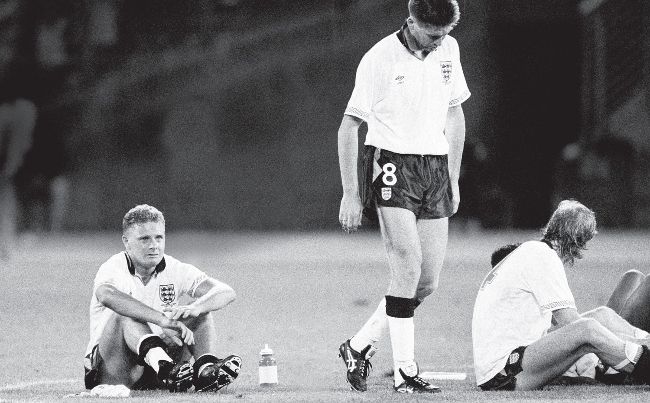
Paul Gascoigne cries and Chris Waddle slumps after England lose to West Gemany on penalties in the 1990 World Cup
© CHRIS SMITH/POPPERFOTO/GETTY IMAGES
Stray dogs have roamed the streets of Russian cities for as long as anyone can remember. Following the fall of Communism in the 1990s, as prices rose and the economy collapsed, the animals began to proliferate: more people were throwing their pets out onto the street. Then, when the economy bounced back, capitalism began to generate plenty of waste for them to scavenge. Today, some estimates put the number of stray dogs in Russia as high as two million.
For a country about to throw its doors open to the multitudes attending this summer’s World Cup, this is presenting a big problem. Vitaly Mutko, the deputy prime minister, ordered host cities to install temporary dog shelters. But given the chronic scarcity of funds and the sheer scale of the problem, municipal authorities have a strong incentive to cut corners. With the tournament already rife with talk of corruption and fears of racism in the stands, this is where canine death squads come in
According to animal rights campaigners, cities are issuing tenders for companies to remove dogs from the streets before the first batch of World Cup tourists arrive. The methods are many and varied, but the most popular involve poison or else shooting the dogs with tranquiliser darts and then taking them to a shelter, where they often end up being put down.
Like so many of the scare stories emerging from post-truth Russia, the tale of the World Cup strays is probably a blend of grim reality and macabre western wish fulfilment about this distinctive country. And yet it also fits into a wider ugly narrative about the supposed greatest stage of the beautiful game. The whole way we perceive the World Cup has become warped, bearing no resemblance to the way its creators imagined it.
When an idealistic French administrator called Jules Rimet first proposed a World Cup in the 1920s, he envisaged an event where barriers would come down, where nations would unite, where an entire planet could be captivated by a single sporting spectacle. A celebration of humanity; a celebration of football, in its purest and most refined form. It’s a fair bet that he wouldn’t have foreseen the catalogue of crooked deals and backhanders, nor the ongoing FBI corruption probes into football’s governing body, Fifa. Over the last several years, the combined effect of these has exposed to the world the squalid business that international football has become. Rimet probably wouldn’t have foreseen canine death squads with tranquiliser guns either.