STICKY WICKETS
A SPORTING CHANCE
Cricket has a class problem. As state schools continue to suffer the effects of austerity, it’s only going to get worse
by PAUL HAYWARD
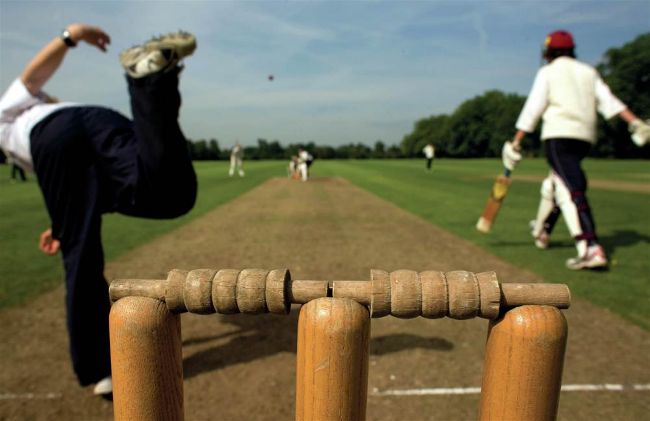
An expression of English life? Playing cricket at Eton College
© CHRISTOPHER FURLONG/GETTY IMAGES
In February, the Marylebone Cricket Club (MCC) wrote to its 23,000 members with a grave bulletin. The MCC’s chief executive, Guy Lavender, had “been in direct contact with the Head Masters of both Eton and Harrow and the respective representatives of Oxford and Cambridge University Cricket Clubs.” The sombre news he imparted to the wearers of the famous “egg and bacon” striped tie was that Lord’s, the north London cricket ground that is the home of the MCC, could no longer accommodate the annual Eton-Harrow and Oxbridge fixtures.
This break with centuries of tradition came about, the MCC claimed, because it needed to protect the Lord’s pitch by restricting the number of matches and promoting wider playing opportunities for junior and “female cricket.” (The need to make space for lucrative professional matches was surely also relevant.) Lavender assured his fellow members: “this decision did not arise as a result of any ‘anxiety to kowtow to the woke police’ as recently reported in the media.”
The Eton-Harrow match has a rich history. As Derek Birley wrote in A Social History of English Cricket, in the late 18th century, fierce rivalries developed between England’s top private schools. “By 1804 Eton versus Harrow was sufficiently big box office for the boys to hire Lord’s as a venue,” Birley wrote. “Among those impresarios was Lord Byron. Afterwards both teams got drunk and, according to Byron, headed to the Haymarket Theatre, where they ‘kicked up a row, as you may suppose, when so many Harrovians and Etonians were in one place.’”
Viewed in isolation, Lord’s dropping Eton vs Harrow might seem a further example of cricket’s pursuit of money over tradition—its faintly desperate commercialism. But it was also a rare setback for England’s private school system.
The vast expansion of wealth and influence by private schools over the last 20 years can be accurately measured by the state of cricket. A 2019 study commissioned by the Sutton Trust found that the men’s professional game was in the top 10 professions dominated by the privately educated—tied with the news media on 43 per cent. Senior judges were top of the table with 65 per cent.
In their book Crickonomics, to be published this year, Stefan Szymanski and Tim Wigmore trace the tradition of Gentlemen vs Players—upper classes vs workers—that broadly ran from 1806 to 1962, but whose after-effects are with us today. Since 1965, 32 per cent of professional cricketers in England have been privately educated, against 7 per cent in society.
Unlike many sectors of Britain, where privilege remains undisturbed, cricket’s inequalities have been thrust into the sulphurous light of an inquest, on the back of events in the southern hemisphere.
This winter’s mortifying 4-0 Ashes defeat for the England men’s team in Australia stoked the dread that red-ball cricket—chiefly Test matches, the most sacred form of the game—is being destroyed by the shorter, snazzier white-ball competitions like The Hundred. The Hundred, launched by the ECB in the summer of 2021, is a kind of digital cricket, which miniaturises the sport (and the attention span) to a century of deliveries for each team. It is a boiling down of Twenty20, or 20-over cricket, previously thought to be the end of the line for brevity. The new competition also hopes to promote women’s cricket and attract a new, younger audience to the game.
For the first time after an Ashes defeat, a postmortem focused not only on the England team’s technical and tactical flaws, but the very soil in which the game is rooted: its inaccessibility to ethnic minorities, the struggle for the equality of the women’s game, regional imbalances and the growing domination of fee-paying schools in producing players.