COVER STORY
DOOM SPIRAL
The far right thrived in 2024 but the erosion of liberal democracy is the stor y of the centur y so far, writes Cas Mudde. It didn’t have to be this way

© SHUTTERSTOCK/ALAMY IMAGES
“We have big plans for the future!” tweeted Viktor Orbán, the prime minister of Hungary, after his first phone call with Donald Trump, just hours after the United States presidential election was called. Other far-right politicians were equally ecstatic, from Argentina and Israel to the United Kingdom. Italy’s Giorgia Meloni heralded the “unshakable alliance, common values and historic friendship” between her country and the US.
In fact, leaders of all stripes stumbled over themselves to congratulate Trump and stress their country’s close ties. “I look forward to our close cooperation on the shared interests between the USA and the Netherlands,” said Dick Schoof, leader of the far-right-dominated Dutch coalition. “As the closest of allies, we stand shoulder to shoulder in defence of our shared values of freedom, democracy and enterprise,” chimed in Keir Starmer.
There is little doubt that 2024 was a great year for the far right, a terrible year for incumbents and a troublesome year for democracy around the world. Still, it will not be as impactful as the “annus horribilis” of 2016, which brought Brexit and the first Trump victory. The reason is as simple as it is depressing: as I argued in my 2019 book The Far Right Today, the far right began a process of mainstreaming and normalisation long ago. This past year was not one of political transformation, but rather a product of the political transformation that started at the beginning of the century. You just haven’t been paying attention.
It was trailed as being the “year of elections”. Some 70 countries with a combined electorates of around two billion held elections in 2024; not all of these elections were free and fair, however. In many of the biggest elections, such as those in the European Union, India and the US, the far right did well. Media around the globe bleakly asked whether democracy could survive.
In a surprisingly optimistic assessment, admittedly before the US election, the Economist concluded: “Democracy has proved to be reasonably resilient in some 42 countries whose elections were free, with solid voter turnout, limited election manipulation and violence, and evidence of incumbent governments being tamed.” To be fair, the magazine followed this assessment, clearly foreshadowing the US elections, with the warning: “Yet there are signs of fresh dangers, including the rise of anew generation of innovative tech-savvy autocrats, voter fragmentation and departing leaders trying to rule from beyond the political grave.”
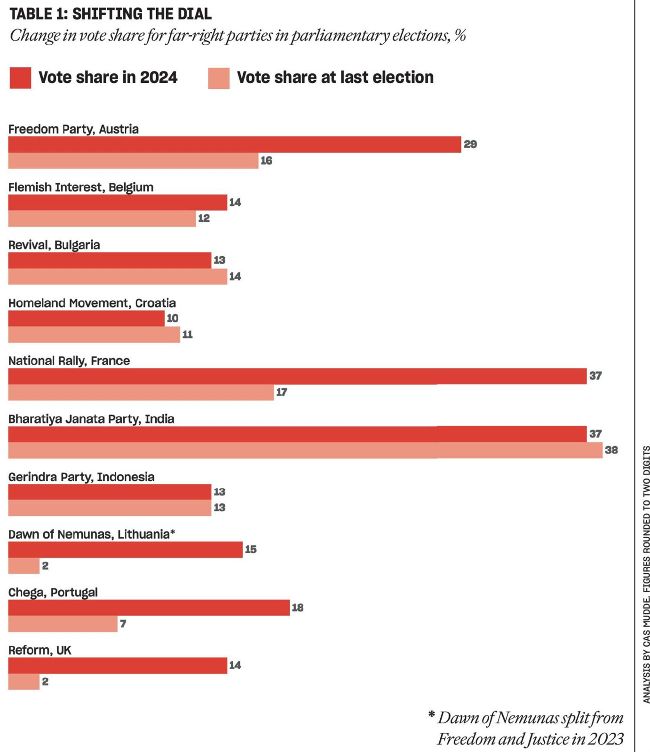
ANALYSIS BY CAS MUDDE. FIGURES ROUNDED TO TWO DIGITS
There are many different understandings of the left-right distinction, but I define right-wing ideologies as those that consider social inequalities as good or natural and believe that states should not try to create more egalitarian societies. Within this broad group, the “mainstream” right supports both the core institutions and values of liberal democracy. The far right does not. At its core is nativism, a xenophobic form of nationalism, and authoritarianism, afundamental belief in order and discipline.
Within the far right, the extreme right rejects democracy—the idea that people elect their own leader by majority (one can think of historical fascism)—whilse the radical right only opposes elements of liberal democracy, notably minority rights and separation of powers. In recent years, however, part of this group has radicalised, for example by undermining the democratic system (like Orbán) or by rejecting election results (like Trump), without openly defending a non-democratic system. These hybrid extreme-radical right parties are best referred to as far right.
If we focus exclusively on the results of far-right parties in parliamentary elections, we see not only that almost all have won in 2024, but also that most have won big. There are two main exceptions. The Bulgarian party Revival contested two parliamentar y elections in 2024 and gained almost identical results. More importantly, and surprisingly, India’s ruling Bharatiya Janata Party (BJP), which was widely expected to trounce opponents in free and unfair elections it had organised itself, slipped back—but remained in power. Beyond these, there were three small increases for the far right (under 2 per cent) and five big ones (more than 10 per cent), including in France and the UK.