PEOPLE
Theodor Meron
Clear conscience
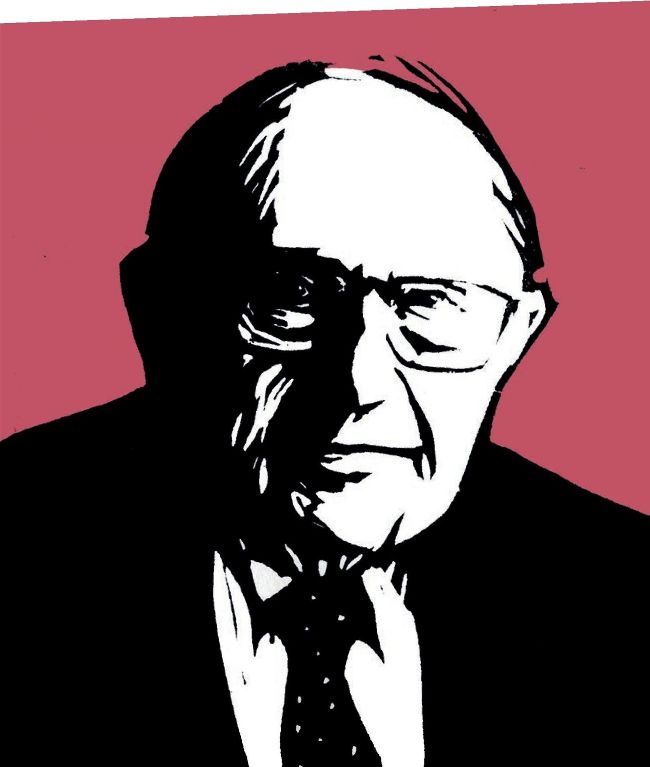
ILLUSTRATIONS BY JOHN WATSON
In May 2024, International Criminal Court (ICC) prosecutor Karim Khan sought arrest warrants for two Israeli and three Hamas leaders on charges of war crimes and crimes against humanity during the Israel-Gaza war.
Before he did so, he consulted a panel of six experts, including Amal Clooney and Baroness Helena Kennedy. Also on the panel was someone with a lower public profile, but who is one of the world’s foremost experts on the laws of war. Theodor Meron, 94, helped to establish the foundations for international criminal tribunals and oversaw the world’s first genocide trials. He is also a Holocaust survivor and former Israeli official who, in the first decades of Israel’s existence, advised on legal arguments against what have become some of the country’s most controversial policies, including on West Bank settlements. Foreign Policy magazine dubbed him “the man who tried to save Israel from itself ”.
I meet Meron in Oxford— where he’s still working as a professor—on a cold November morning. Ted, as he goes by, is waiting for me at Trinity College when I arrive. He gives me a tour, greeting students we pass and telling me about the architecture before we sit down to talk.
He has always been driven, he says, by a desire to work towards “a world with no Holocausts.”
Born to a Polish Jewish family in 1930, Meron’s childhood was cut short by the outbreak of war and he spent several years in a Nazi labour camp. By the time Allied victory came, he had lost most of his family and emigrated alone to Mandate Palestine, where he had some relatives. He was there when, in May 1948, Israel was declared an independent nation.
Meron went on to spend 20 years in the Israeli foreign service. Despite his lost years of education, he later held professorships at Harvard, New York and Berkeley, specialising in international humanitarian and criminal law.
At the age of 71, he began a new career, serving as a judge and president of the international criminal tribunals for the former Yugoslavia and Rwanda. He presided over dozens of war crimes trials, including the one that judicially recognised what happened in Srebrenica as a genocide for the first time.
I felt that ethically and morally I had to say yes
Meron is no longer a citizen of Israel, having moved to the US in the 1970s. Even so, his connection to the country gave him pause when he was asked to join Khan’s panel.
“I have to live by my principles, even when I would not have chosen to have that assignment,” he tells me. “I felt that ethically and morally I had to say yes.”
The experts unanimously agreed that there were reasonable legal grounds to pursue the warrants. In November those warrants were finally approved by a panel of ICC judges, but it’s too late for some. Two of the Hamas leaders named on the application—Yahya Sinwar and Ismail Haniyeh—are dead. The third, Mohammed Deif, likely is too. Only Israel’s former defence minister Yoav Gallant and prime minister Benjamin Netanyahu remain standing.