Our critics
Art
A mother’s work
Charlotte Johnson Wahl did her best art in hospitals, away from the screaming demands of family life. Yet she’d always return to that family—to us
by Rachel Johnson
“Nothing is wasted,” my mother would tell me if I ever complained about a job, a man, duty, drudgery. And if the wheels were ever really coming off, she’d say, “You are stronger than you think.” “Nothing is wasted,”
She said and did lots of things, of course. She never stopped outputting from the age of about five. After she died, aged 79, on 13th September 2021, we (and when I say “we”, Imean her four children) collected her aphorisms and more in an “Alphabet of Mama”. But this little Festschrift is nothing compared with the vast archive of prolific writing, notebooks, diaries and even an unpublished novel that she bequeathed to posterity, on top of her immense and remarkable body of artistic work, including the selection of unforgettable Maudsley paintings currently on display at the Bethlem Museum of the Mind in south London.
But it was these two go-to sayings that stood her, and her four children who loved her with passionate intensity, in the greatest stead throughout her extraordinary but not always easy life.
My mother was born, Charlotte Fawcett, in 1942, in the middle of the war. She was a Pears soap cutie with bubble curls and a gap-toothed smile. Like so many war babies, she had a memory of a strange man in uniform turning up one day at the house—in her case, in Park Town, a gracious crescent in north Oxford—and being told that this was her father. She was three.
In 1946, she had a baby brother, Edmund. “I hated him,” she would say. She didn’t hate him—she adored him, but “wanted to be the only one who did”, which explained jealousy to me from an early age.
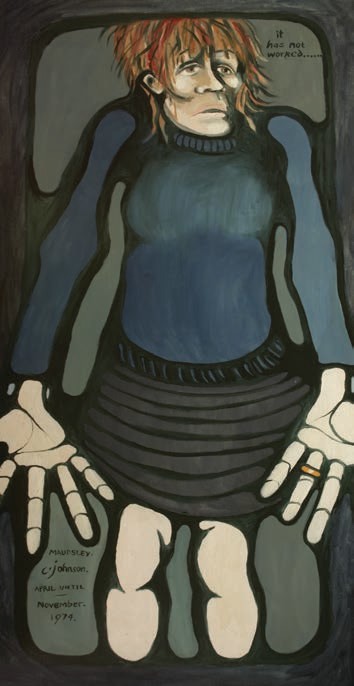
© BETHLEM MUSEUM OF THE MIND / © ESTATE OF CHARLOTTE JOHNSON WAHL. ALL RIGHTS RESERVED 2024 / BRIDGEMAN IMAGES
Edmund was followed by Philippa, a little sister whom Mama also adored, then after a long gap, Sophia.
Charlotte wasn’t a boy, and she wasn’t musical in a house where her father, James Fawcett, played piano to concert level and never travelled without a dummy keyboard to drum Rachmaninoff or Brahms in departure lounges.
She couldn’t read until she was seven in a house where her father was a war hero, a prize fellow of All Souls and later aQC and the founding president of the Commission on Human Rights, and who wrote books on international law and outer space, was knighted by the Queen and could not drive past a lamppost on a motorway without counting it.
She felt plump, spotty and hairy in a large family of competitive thinness, musical ability and cleverness.