UKRAINE
UNBREAKABLE
Bombarded by Russia, close to the frontline, Kharkivites anointed one building as the symbol of their resistance. Jen Stout goes to see it
Only in Kharkiv, ever-changing city of industr y and ideas and shifting identities, could the words REINFORCED CONCRETE become a rallying cry for fortitude, resilience and wild hope.
Of course, Ukrainian makes the phrase sound uniquely beautiful, condensed into one word: zalizobeton. Five lyrical syllables. It just doesn’t translate well— the English words bring to mind drab grey boxes, decaying post-war estates. Zalizobeton, though, is the beating soul of Kharkiv, Ukraine’s second-biggest city, which has the misfortune to be located less than 20 miles from Russia. Under near-constant bombardment since the start of the full-scale invasion, Kharkivites found a building to rally around—the improbable, staggering Derzhprom.
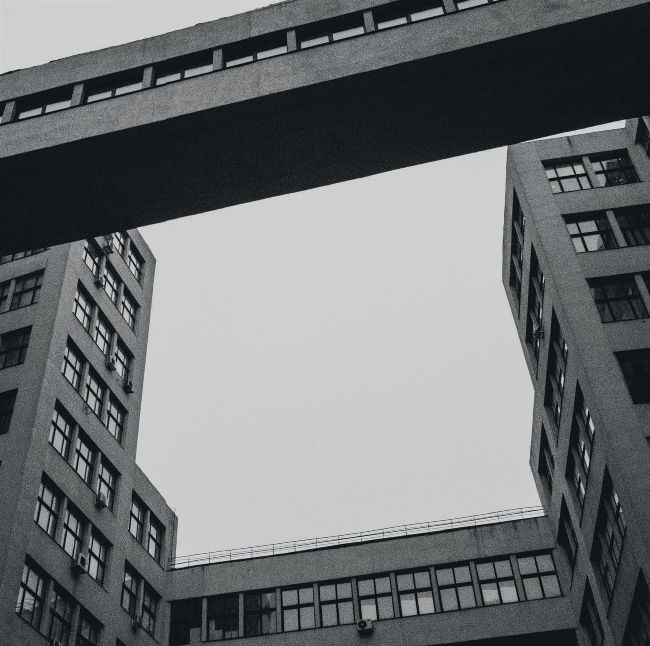
You’d know all about this constructivist masterpiece—the House of State Industry, the first skyscraper complex in Europe—if it was in a great world capital. But Kharkiv didn’t get a lot of western tourists, even before the full-scale invasion of 2022 made it a terrifying and sometimes deadly place to visit. It got me, though, in 2018, wide-eyed and absurdly excited to finally be in the city I’d read so much about. I made straight for the vast Freedom Square and, at its far end, the bright, stark geometry of the Derzhprom building.
There’s a photo from that day: I’m a tiny, elated figure, arms outstretched, under a walkway in the sky that links one tower to another. I couldn’t believe this city, its layers of history, the almost crazed mixture of architectural styles around every corner. But Derzhprom crowned ever ything, soaring 63m tall, with a TV tower on top; the three H-shaped sections curving gracefully and joining together at various levels. It was hard to take it all in, the impression being of something both pleasingly symmetrical and totally perplexing, in a way that made me think of the printmaker MC Escher.
© JEN STOUT
The person who took that photo was an actor; we had spent the afternoon walking through cobbled streets and gardens in the November snow, then played table football in a pub and talked into the wee hours. The city felt very free, to me; a place of constant movement and change.
Now, that actor is serving on the frontlines, and his city is torn apart by nearly three years of bombing, three years of grief. Hundreds of thousands fled, but many I knew stayed to fight—whether that meant baking bread to distribute in the shelters and hospitals, or staging underground concerts to raise money for the cash-strapped army units that were holding off the Russian advance. Or picking up a gun.
Kharkiv was nearly encircled in the beginning, in March 2022, and the courage it takes to stay put in that situation is hard to fathom. Symbolism matters at a time like that: having something to believe in, a uniting idea. And a young graphic designer named Patrick Cassanelli found it. Using the futuristic outline of Derzhprom, he created a stark, heroic image, the building like a computer-game fortress, a Ukrainian flag flying above, and the words KHARKIV ZALIZOBETON in big, stylised letters.
It was a chevron at first, a patch for soldiers’ uniforms. Then quickly the design appeared on T-shirts, caps, hoodies, stickers—with the proceeds going to army units. Kharkiv band Papa Carlo used the word as a song title, and shot the music video on the roof of Derzhprom. The building had always loomed large in the city’s iconography, but in 2022 it gained an almost spiritual significance, an emotional anchor for a million and more people trying daily to defy fear.