WEIRD SCIENCE
Discover the strange scientific studies that answer the questions you didn’t know needed answering
WORDS SCOTT DUTFIELD
DID YOU KNOW?
A half-pint glass of beer produces up to 2 million bubbles, twice as many as Champagne
WALKING LIKE A DINOSAUR
How do you figure out how dinosaurs walked? For a group ofresearchers at the University of Chile and the University of Illinois, the answer came from artificially changing the anatomy of a distant living cousin: the chicken. Birds are the descendants of giant bipedal dinosaurs called theropods that roamed Earth millions of years ago. Some of the closest living avian relatives to the T. rex are chickens. But the two don’t have quite the same anatomy, such as a chicken’s lack of a heavy tail. It was thought that moving a living bird’s centre of mass would recreate the posture of extinct dinosaurs, so a plunger-like tail was added to chicken test subjects to redistribute their centre of mass in a similar way to the T. rex.
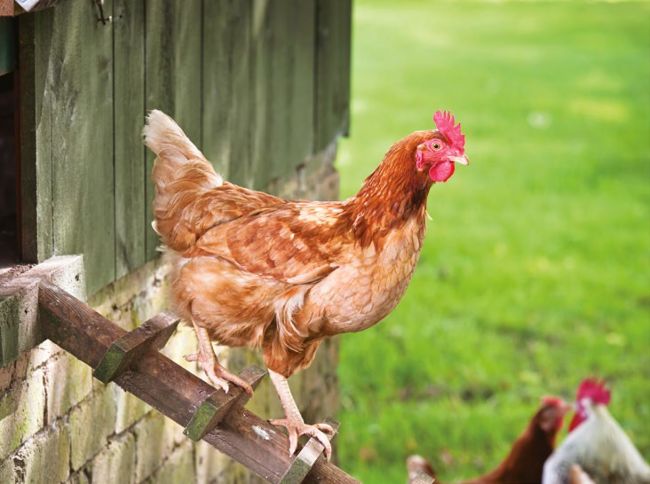
Given the right anatomy, chickens will walk like dinosaurs
In this study, researchers raised 12 domestic chicks for 12 weeks, split into three groups of four. One group of chickens was left alone as the control group, the second was given a weight to carry around on their backs and the third group was fitted with an experimental tail that weighed around 15 per cent of the chicken’s overall mass. Over the 12-week period, the tail-wearing chickens had a more posteriorly located centre of mass than the other chickens, along with a more vertically orientated femur and elongated gait. The new chicken strut resembled that of a velociraptor walking through Jurassic Park.
Did you know?
A T. rex could run at around 12 miles per hour
RECREATING THE DINOSAUR WALK
How
a
chicken’s
body
changes
when
you
give
it
a
tail
1 UNADAPTED CHICKENS
One group of chickens was reared without modifications as a control group.
2 WEIGHTED CHICKEN
A group was reared with extra back weight but no tail to see if weight over the pelvis alone changed their posture.
3 NEW TAIL
The experimental tail was made from wooden sticks inserted into a solid modelling clay base.
4 CENTRE
In chickens equipped with a new tail, the centre of mass moved from in front of the hindlimbs to the base of the tail.
5 POSTURE
Among the tail-enhanced chickens, the orientation of the femur became more vertical and the knee joint was more extended.