Learning through story
NON-FICTION
Leanne Betasamosake Simpson invites readers to rethink relationships with nature and our world BY JENNY FERGUSON
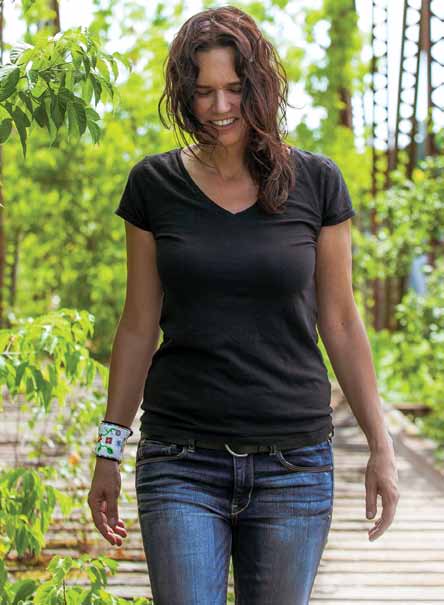
▲ Leanne Betasamosake Simpson
LEANNE BETASAMOSAKE SIMPSON: NADYA KWANDIBENS
H A Short History of the Blockade: Giant Beavers, Diplomacy, and Regeneration in Nishnaabewin
University of Alberta Press
Leanne Betasamosake Simpson
SCHOLAR, WRITER, AND ARTIST Leanne Betasamosake Simpson (Michi Saagiig Nishnaabeg of Alderville First Nation) offers her distinctive Nishnaabeg storytelling in this year’s instalment of the Kreisel Lecture Series, entitled A Short History of the Blockade. In the print version of the lecture, readers experience story as a mode to learn, to listen, to think through a topic – here, it is Indigenous blockades – and, in this process, live through how worlds are built together. At once imminently current, with discussions of the Wet’suwet’en Unist’ot’en Camp, and historical, Simpson’s lecture works to deconstruct the colonial Canadian position that blockades are somehow outside the realm of “legitimate” or “moral” forms of protest.
To do this, Simpson frames her ancestors as makers: “They worked collectively to produce, reproduce, replicate, amplify, and share Nishnaabeg life, because if they did not, Nishnaabeg worlds would not exist.” This kind of making, however, is not the work of colonial projects. Instead of “the kind of work where you outsource the labour of living so you can do something more important,” Nishnaabeg work “values above all else the way one lives.” In order to follow Simpson’s storytelling, and her implicit argument about blockades, the reader must understand this fundamental difference in how Indigenous work/living is known. When one’s “infrastructure for life [are] relationships” rather than institutions, there is a shift in not only world view but the worlds which are created, are lived in, are loved in.
Story is the engine for world-building and world-making. In colonial machinations, story becomes distorted as propaganda. For Indigenous Peoples, “telling stories is a foundational practice.” However, the telling of stories and the listening to stories must be active and engaged: “Stories not only fill our worlds, they make our worlds, but only if you have the skills to find meaning in oral literature. But only if the story lives and breathes inside of you. But only if you wrap stories around you like a blanket and take them out to consider from time to time.” Simpson centres the multiplicity of stories. Story results not in one meaning but “a diversity of meanings.” Story is an active, collaborative process, “a practice of deep rationality, not a looking at, but a looking with or a looking through or a thinking through together.”
Simpson’s key reference is the beaver, which, under Indigenous practices of relationality, is a relative, not a product to be exploited by colonial institutions. For Simpson, the beaver, or amik, and the Indigenous blockade are “an amplification and centring of Indigenous political economies – Indigenous forms of governance, economy, production, and exchange.” By examining the work that our non-human relative amik does, Simpson’s storytelling reveals life behind the barricade: “[Y]ou’ll find parents with children. You’ll find Elders. You’ll encounter ceremony, sacred fires, and language learning. Art making. Singing. Drumming. Storytelling.” When the beaver dam is reduced to a feat of engineering translated in colonial practices to manufactured dams – something to be controlled, something to monetize, something to be valued above life – it becomes impossible to see the story that amik is telling.