PRACTICE & PERFORMANCE
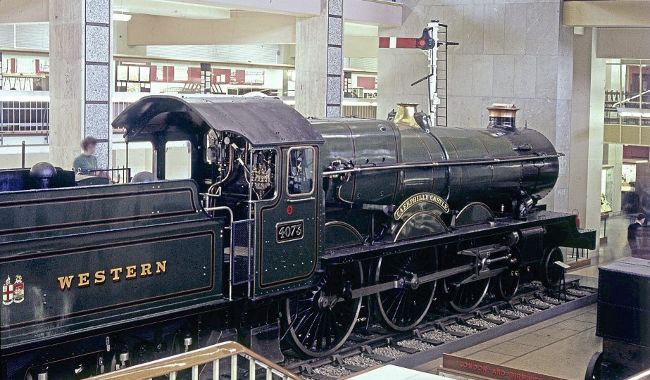
‘CASTLE’ CENTENARY
John Heaton
FCILT analyses some ‘Castle’ Class performances from the past 100 years.
DARKNESS fell on the face of the earth as an intense thunderstorm enveloped the battling pair of Great Western Railway Collett ‘Castle’ 4-6-0s heading into the eye of the deluge. But the rain was too little too late. Three weeks of hot, dry weather had resulted in the last-minute addition of a ‘fire risk’ two-tone green Class 47 No. 47773 (D1755) to the rear of the train. Whereas diesels acting as insurance against breakdowns usually do as little as possible, fire risk minimisation permits no laxity on the uphill stretches. On the level, approaching Ashchurch, pace suddenly slackened, accompanied by an announcement that Network Rail had instituted a post-Carmont precautionary 40mph temporary speed restriction as far as Stoke Works Junction, some 2.2 miles before reaching the 1-in-37¾ uphill gradient of the Lickey Incline.
This Vintage Trains ‘Castle Centenarian’ railtour had been re-routed to avoid the nowfixed Nuneham Viaduct repair at Oxford, and taken the date vacated by the cancelled ‘Morning and Afternoon Lickey’ runs. On Saturday, June 10, 2023, the ‘Centenarian’ was still booked to run from Birmingham to Shrewsbury, then via the Welsh Marches, but to miss out the originally planned route through the Severn Tunnel, Oxford and up Hatton bank – instead, following the River Severn through Chepstow and onwards to the final challenge of Lickey.
Wet fields (and drenched photographers) signalled the opportunity for Nos. 5043 Earl of Mount Edgcumbe and 7029 Clun Castle to be allowed their head and take their ‘11-coach+Class 47’ load of around 522 tonnes up the famous incline unaided. If the weight of the two ‘Castles’ is included, the cavalcade probably grossed out at around 775 tonnes. Perhaps the diesel helped accelerate the train from the 40mph adverse weather restriction to almost 60mph by the new Bromsgrove station (although No. 7029 by itself managed a similar performance with ‘load 6’ on the morning Lickey special in 2021), but the remainder of the duo’s steep climb was certainly down to steam power. In terms of pure speed, the locos were losing about 5mph per quarter-mile and were down to 18mph before easing of the gradient facilitated the rear of the train to pass the famous Blackwell 53¼ milepost at 22mph.
Lickey climbs
Table 1 shows the run alongside the 2021 Lickey ‘Castle morning run’ timed by Sean Emmett, which appeared in TRM’s January 2022 issue. To say the equivalent drawbar horsepower (edhp) of the two ‘Castles’ hauling their caravan was 2500hp is more of a shot estimate than a calculation, whereas the previously quoted 1850hp for the single ‘Castle’ is more reliable. It should be borne in mind that the edhp figures credit the engine moving itself uphill, so two engines gain extra credit. In what is only an apparent paradox, three locos at the same speed with the same trailing load on the same section of line would be higher again.
The double ‘Castle’ load was the equivalent of only one extra Mk.1 coach for each loco compared with the single engine load, but the speed was only half as high and the single ‘Castle’ managed three-quarters of the combined locos’ edhp. Historically, such a proportion is not unusual, as it is rarely necessary for both locos of a double-header to be thrashed.
Looking at the climbs on the Up Marches section, it is clear that diesel assistance was being provided at the start of the three steepest sections: Dorrington towards Church Stretton, six miles from MP 5.85 (average gradient 1-in-133, steepest 1-in-90); Rotherwas Junction to 3m 510yds (average 1-in-127, steepest 1-in 92); and finally MP 12¼ (between the two River Monnow underbridges south of Pontrilas) to Llanvihangel Summit at MP 18¾ (average 1-in-138, steepest 1-in-99). It seems that the Class 47 withdrew its services at around 45mph on the first two gradients and subsequently on the 1-in-80 and 1-in-104 climbs to Nantyderry and then Pontypool Road.