AMAZING AMAZONITE
The Misconstrued Feldspar That’s Not a Mistake to Own
STORY BY MARK LEATHERMAN
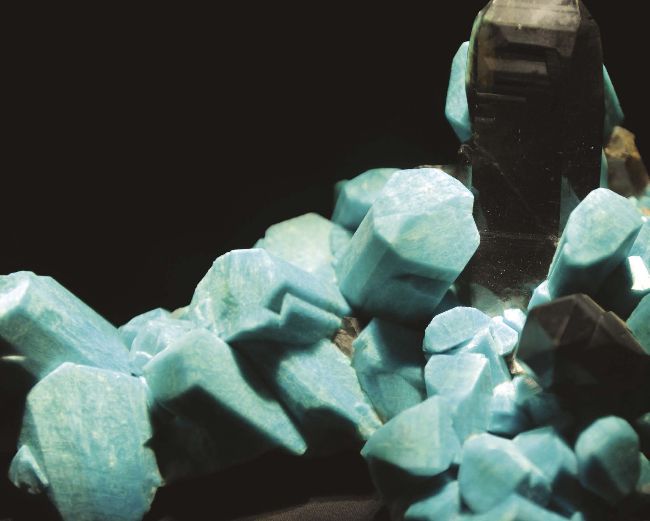
Euhedral amazonite crystals with smoky quartz, from Colorado, represent some of the most sought-after specimens in the entire worldwide rockhounding community due to their striking color contrast and low odds of finding and extraction.
WIKIMEDIA COMMONS
Like the elements of the Periodic Table, nearly all minerals derive their namesakes from words of many languages, people who discovered them, or possibly after the location of discovery. If one is new to the mineral amazonite, a common first guess is that it was initially identified in the Amazon rainforest of South America. As logical as this inference is, there has never been any amazonite reported from the namesake river region. A strong possibility is that early Spanish explorers confused amazonite with another similarly colored mineral they found in the area. Still, it was an attractive stone to them, so much so the thought focused on use in costume jewelry. Despite this inference, the mineral is indeed found in Brazil but found significantly far from the famed river within the famous pegmatites in the state of Minas Gerais.
AMAZONITE’S ORIGINS
Amazonite is a legendary stone used by many early civilizations. The stone is believed and highly likely that it was the third stone in the breastplate of Moses. The ancient Egyptians prominently used the mineral for making amulets, as well as making beads. Such jewelry has even been found in King Tut’s tomb, as well as on the boy king’s golden mask. Also, The Judgment of Osiris, part of the fabled Book of the Dead, includes the mineral cut into slabs. To see amazonite used in ancient Egyptian jewelry, the Field Museum in Chicago has some pieces on display.
Traveling to the immediate south of the locality of origin, the Sudanese reportedly utilized the stone during Neolithic times for necklaces and other ornamentations commemorating the dead. In 2018, a geochemical and anthropological study published in the academic journal, Antiquity, revealed that Sudanese amazonite was originally sourced from southern Ethiopia to the southeast (more on this wonderful occurrence later!). Lastly, the stone appeared in Assyrian civilization in connection with one of their chief gods, Belus. Oddly enough, the stone had seemingly dropped from all usage during medieval times. The stone received official recognition in 1701 with Nicolas Venette’s (1633-1698) Traite des Pierre (French for Treatise on Stones) dubbing it Pierre des Amazones (Stone of the Amazon). The name changed to amazonite in 1847, at the direction of Johann Breithaupt (1791-1873), after the later-disproven Amazon River locality.