Amber Rush
NORTHERN EUROPE’S SOARING PRICES AMIDST A MINING BOOM
STORY BY STEVE VOYNICK
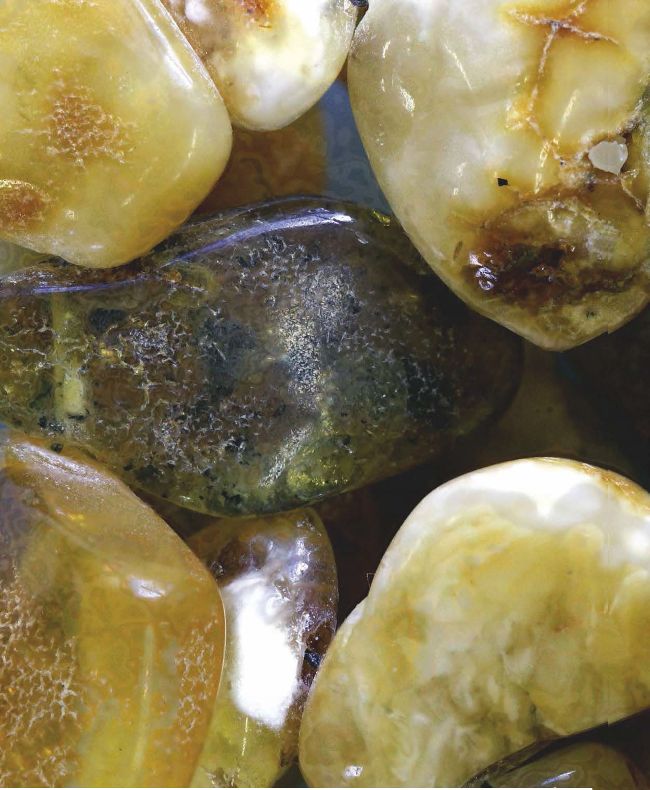
These small pieces of beach amber have been semi-polished by sand abrasion.
In northern Europe, amber is known as “sunstone” and “solar stone” for its golden, sun-like glow. It is also known as “Baltic gold” for its huge economic impact. The latter term is especially fitting, since northern Europe, notably the Baltic Sea coast at Kaliningrad, Russia, and adjoining Poland and Lithuania, has produced most of the world’s amber.
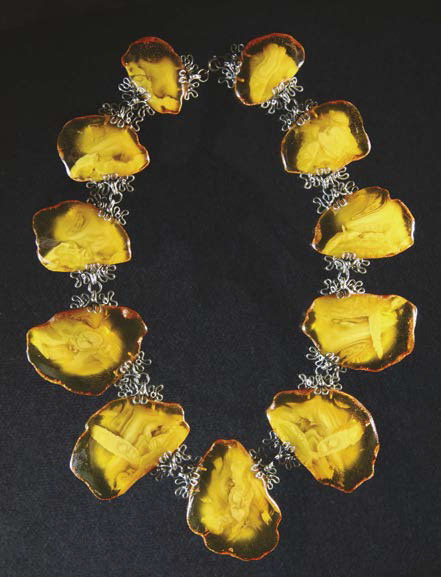
Craftsmen at the Kaliningrad Amber Combine fashioned this elaborate necklace of Baltic amber.
Today, tens of thousands of people work in the regional amber industry. Amber is the area’s iconic souvenir, and museums that showcase amber are significant tourist attractions. With the recent emergence of Ukraine as a major source of amber, northern Europe’s amber output is soaring. Average grades of amber now sell for several hundred dollars per pound, and regional production is estimated at 1,000 tons per year—a historic high.
But there are two sides to amber mining in northern Europe. With few alternative employment opportunities and lured by record amber prices, some 20,000 Kaliningrad Russians and Ukrainians now work as independent amber miners. And virtually all are unlicensed and unregulated. While amber mining provides a living for thousands and has boosted production to record levels, it has also brought environmental devastation, economic chaos, corruption, violence, protection racketeering, black-marketeering, and rampant smuggling.
The complex origin of northern Europe’s amber rush is rooted in the geology, occurrence, and history of amber and the centuries-old reverence for amber. In recent years, regional economics and politics are among the drivers of the amber rush.
Amber is a fossilized tree resin — a valid definition — if the meaning of the word “fossilized” is expanded. While most fossils are created through such physical processes as mineral replacement and sedimentary impression, amber formation is an entirely different molecular polymerization process.
FOCUSED ON FOSSIIZED TREE RESIN
Due to the lack of a crystal structure and definite composition, amber is classified as an organic non-mineral, a natural substance of origin that is neither a mineral nor a mineraloid (a noncrystalline, mineral-like material). Chemically, amber is an oxygenated hydrocarbon with a variable composition that consists roughly of 80 percent carbon, 10 percent oxygen, 9 percent hydrogen, and traces of sulfur and phosphorus.
Amber originates as the resin that various tree species exude as a defense mechanism against fungal or insect attacks. Resins are complex hydrocarbons consisting of organic acids, sugars, esters, and terpenes, the latter being the key to the formation of amber.