BEACH SPRINT DIARIES
CULTIVATING CHAMPIONSHIP MINDSET ON THE SHORES OF COSTA RICA
WORDS CARA STAWICKI
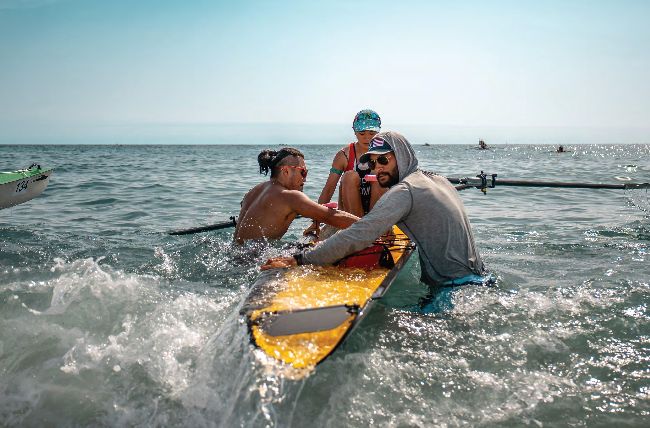
PHOTOGRAPHY BENEDICT TUFNELL
“When big waves risk cresting, crashing or dumping, you engage in what I can only describe as a type of chosen surrender.”
“Put your boats in the water.” A switch flips. I hear this and immediately lock in.
At the onset of the 2025 Americas Rowing Beach Sprint Championships in Garabito, Costa Rica, surf conditions led the World Rowing jury to require three boat handlers per boat for the duration of the event. The same was true at the 2024 World Rowing Beach Sprint Finals in Genoa, Italy, where I boat handled alongside Ben Booth and Marc Oria for Team USA, and naively thought that those were the toughest conditions I’d ever face while boat handling.
Mercilessly, the waves at Playa Mantas, CRC, proved me wrong. I am grateful, to my core, for the jury’s decision because my task, regardless of the surf, remains unchanged: read the water, know the crew (preferences, tendencies, needs) and get the boat off the line as quickly and effectively as possible. In other words, do my part to set up the athlete (or athletes in a team boat) to win.
Boat Handling in the Wave Break
In “normal” conditions, World Rowing’s Beach Sprint Regulations require two boat handlers per boat. With the addition of a third, I am positioned on the beach on the starboard side of stern, ready to grab the boat and run to the water.
As I said earlier, it’s like a switch flips. I hear the cue and grab the shell. My team and I run. We have exactly one minute before our athlete comes barreling down the beach, full-speed, high knees once they hit the water, ready to launch themselves into the boat and take off toward the buoy line.