PLOVDIV
2025 EUROPEAN ROWING CHAMPIONSHIPS PLOVDIV, BULGARIA
UKRAINE AND GREAT BRITAIN GLITTER IN GAMES CLASSES AT THE EUROPEANS
WORDS RACHEL QUARRELL
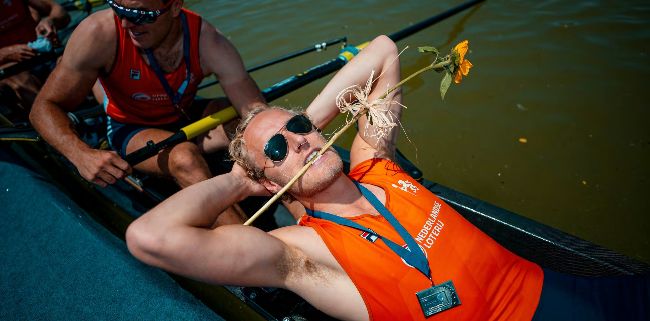
PHOTOGRAPHY BENEDICT TUFNELL
A new (Para)Olympiad and a clean sheet. A spicy four days of racing at the 2025 European Championships on Plovdiv’s Rowing Canal in Bulgaria crowned a host of fresh gold medallists and launched the next quadrennial of rowing’s elite competitions in style. Britain had a late surge to top the Olympic-class events ahead of Romania and the Netherlands, Ukraine claimed four para-rowing medals, and Germany bossed the now non-Olympic classes with three lightweight titles.
Whilst the non-European countries couldn’t join the fun, this early Europeans ahead of a compressed World Cup schedule was a sparkly introduction to the racing season, as well as a workable way to keep accommodation and travel costs down for everyone in a post-Olympic year. However, the absence of the non-European countries was barely noticed in a glut of top-class racing performances.
Course and European best times toppled like dominos, a Plovdivian habit since the Junior Worlds of 1999, which saw the Under-19s smash most of the senior world best times. The course, a man-made concrete basin aligned for a predominant tailwind, produces quick times in most warm weather and this regatta was no exception. Simultaneously the new no-repechages system and a revised medal ceremony format each had their first airings, and spectators got the first vague hints of the shape of 2km rowing in the run up LA28.
“The course, a man-made concrete basin aligned for a predominant tailwind, produces quick times in most warm weather and this regatta was no exception.”
Gun to tape
Abolishing repechages was one of the most immediately significant of several major changes to world-class rowing at the Quadrennial Congress held in March 2025. Instead, and aligning better with the majority of Olympic and Paralympic speed-based sports, a “fastest losers” system has been adopted so that repechages are not needed. The maturing of international rowing since the 1980s has led to most heat race times being very strong predictors for progression, and the impact of external issues being vanishingly rare (the one exception, high wind at the Rio Olympics, having arisen after the heats had already been raced).