Reviews
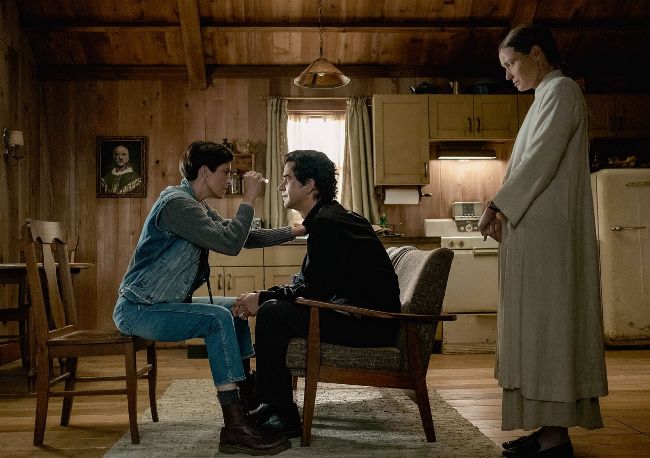
“Yep, it’s undoubtedly a nose you’ve got there.”
MIDNIGHT MASS
There Is Power In A Communion
EPISODES 1.01-1.07 There’s been a persistent Catholic strand in horror since Regan MacNeill’s head first did a 180, but Mike Flanagan’s latest series – his first not to lean on a literary source – breaks new ground. There are no exorcisms here (hallelujah).
Instead, Flanagan cleverly plays with two concepts. Firstly, that organised religion can, from a certain perspective, appear horrific. Take transubstantiation for example, the business of eating the body and drinking the blood of
Christ. The Bible is quite clear: this is not metaphorical, but literal. Secondly, that aspects of the supernatural can, from a certain perspective, appear miraculous. Combine these two notions and you create a landscape where the monstrous and the divine can merge together.
Crockett Island is the setting, a community with a tiny, dwindling population and a church whose congregation rarely hits double digits. That changes after a charismatic new priest, Father
Horror finally comes to the fore in shockingly brutal fashion
Paul Hill (Hamish Linklater) arrives to take the place of the elderly Father Pruitt. One day in mass, he beckons a girl who uses a wheelchair. She stands up and walks. It’s only the first miracle.
While Father Paul is the catalyst, the true monster of the piece is the superciliously pious Bev Keane, a calmly spoken tyrant-in-waiting as well drawn as One Flew Over The Cuckoo’s Nest’s Nurse Ratched. When the Emmys come around, Samantha Sloyan deserves consideration.
It’s a beautifully crafted series all round, replete with glorious sunrises (an apparent stylistic tic which turns out to have more significance) and hymns so harmonious even the staunchest atheist might be tempted to shell out for a soundtrack LP.
Dramatically speaking, anyone who saw The Haunting Of Hill House or The Haunting Of Bly Manor will have some idea what to expect: creepy goings-on, yes, but a focus on families, often dysfunctional. Midnight Mass is Flanagan to the max. Early on, the supernatural only makes fleeting appearances, while great swathes of screen time are devoted to meaningful conversations – often between two characters, and lasting as long as eight or nine minutes. Many of these discussions concern their views on God, the afterlife or forgiveness. Religion isn’t just a set of props here: Bible, crucifix, holy water. Faith is at the heart of the story. Faith is at the heart of the story.
In the last couple of episodes, which dramatise how that faith can be perverted, horror finally comes to the fore in shockingly brutal fashion. But along the road there’s much to admire.
Occasionally you may wish that one of the earnest walk-and-talks could be telescoped. But the dialogue is so well-written and the performances are possessed of such conviction that if you can acclimatise to Midnight Mass’s languid pacing, you’ll eventually be enraptured.
Ian Berriman
Midnight Mass was also the title of a novel written by Kate Siegel’s character in Mike Flanagan’s 2016 film Hush.
NOVA JONES Series One
Vocal Hero

And it’s only day four in the BigBrother household.
EPISODES 1.01-1.05 Forget space opera. CBBC has created a new genre: space popera. Red Dwarf meets Hannah Montana for the Beeb’s new teen sci-fi comedy Nova Jones, a show as hyperactive and sparkly as a glitterball colliding with a pick ’n’ mix.
Nova (Molly Rainford) is a sparkly-clothed intergalactic pop diva flying from gig to gig on the spaceship Jefferson (surely a reference to ’70s rockers Jefferson Starship?). She’s accompanied by her sensible sister, McLaren, who acts as her manager, while the
ship’s crew includes a Captain with an AI mechanical arm that has a mind of its own, and a goldfish-attention-spanned trainee midshipman called Sid.
In these first five episodes (another five are set to follow at a later date), a lot of the fun comes from the bizarre alien audiences Nova performs to – including a planet of sentient giant glasses filled with milk. There’s always at least one new song per episode, and a lot of them are up there with “Let It Go” in terms of earwomery. The show also takes aim at a whole load of online and social
Nova’s role as an influencer is constantly lampooned
media-related targets; Nova’s role as an influencer is constantly lampooned, as is her need to be “Liked” (with a capital L).
But while the themes are bang up to date, the comedy and production values sometimes feel like they come from the past rather than the future. In terms of
SF ideas and comedy tropes, it all feels a little over-familiar and formulaic. Then again, will a new generation of teens even care? Just turn on, tune in, and pop out.
Dave Golder
Molly Rainford came sixth in the 2012 Britain’s Got Talent final, which was won by Pudsey the dog. Where’s he now, eh?
LUCIFER Season Six
To The Devil A Daughter
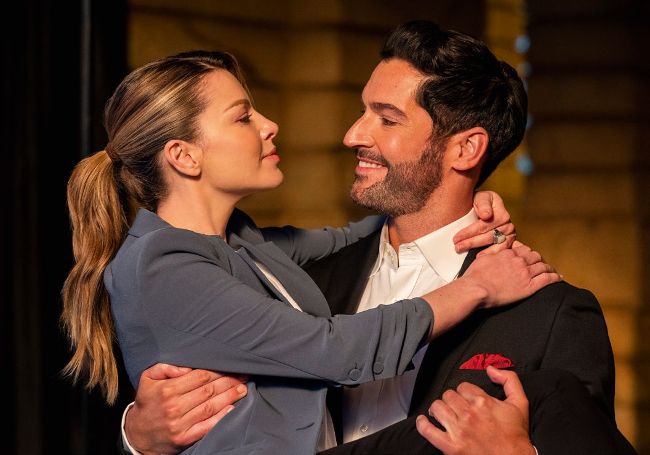
“You’re a handsome devil.” “Oh, you.”
EPISODES 6.01-6.10 Few TV shows truly go out on top, but Lucifer is a rare beast: a series that improved with each season. What started as a goofy, slightly embarrassing buddy cop show about a bored Devil-turned-nightclub-owner (with a love of Carry On smut) teaming up with an LA cop to solve crimes matured into something far more interesting as its internal mythology and character arcs took precedence.
The final season plays to the show’s strengths while mitigating its weaknesses, though the innuendo often still borders on dad humour. Even that’s justifiable, as season six introduces Lucifer’s moody, razor-winged teenage daughter, who travels from the future armed with omens a-plenty.
Time travel? Groan, right? Well, no, because it’s not just a handy plot device; it underpins a theological debate about will versus fate, cleverly tying in with Lucifer’s dilemma about assuming the role of God now that dad’s exited the universe.
Oh, and the cop, Dan, is a ghost now, an idea that works so well you wish he’d died seasons ago.
There’s satisfying closure for all the characters
There’s satisfying closure for all the characters. It’s often very sad but joyously uplifting. There’s a cartoon episode and a meta episode with hilariously skewed flashbacks that poke fun at the show’s clichés. Lauren German (Chloe) and Tom Ellis (Lucifer) are magnificent throughout, creating an epic love story that feels intensely personal. And, whether consciously or not, it’s a marvellous satire on Judeo- Christian beliefs, making you question how, say, a monotheistic deity or eternal afterlife could ever realistically operate.
Season six is unlikely to win new fans, but it’s a near-perfect parting gift to existing ones.
A key location this season is the intersection of 10th and Swanson; the tenth episode is the show’s swansong.
STAR WARS: VISIONS Season One
The East Jedi
EPISODES 1.01-1.09 A long time ago in, well, the ‘70s, there was no such thing as Star Wars canon.
This was a simpler time, when there was just a single hit movie, and writers had the freedom to riff on the themes of George Lucas’s galaxy far, far away; at one point Marvel Comics even introduced a human-sized green rabbit named Jaxxon. Animated anthology series Star Wars: Visions feels like a throwback to those early days, an era before adhering to an all-encompassing continuity became a (sonic) minefield for creatives.
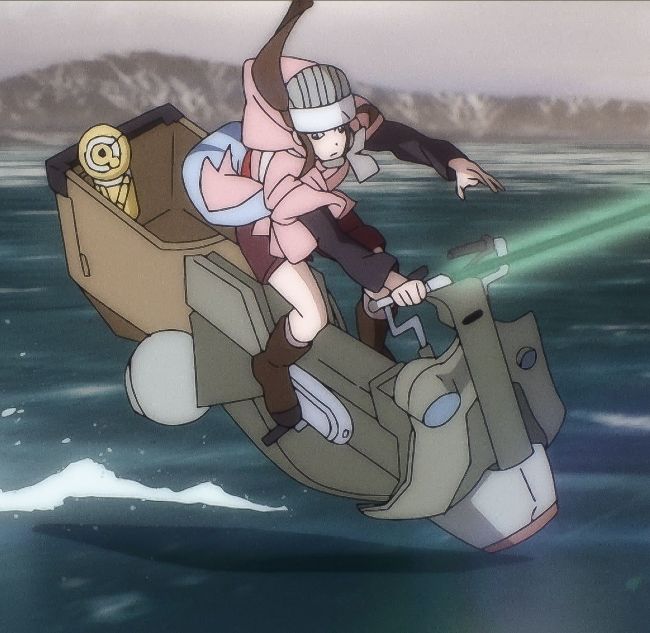
The Vespa is now called the V3-SP4. Probably.
It’s the show’s biggest strength, because while there’s something incredibly satisfying about passing the time in a vast shared universe where every event has consequences, sometimes it’s fun to throw off the shackles and do your own thing.