Terror Attacks that Never Were
Myths of Poison Gas Attacks in History and More Recently on Afghan School Girls
BY ROBERT E. BARTHOLOMEW, STEPHANIE LOCKERY, AND ABDUL FATTAH NAJM
“Of all our passions, fear weakens judgment most.” —Bertrand Russell1
FOR THE PAST EIGHT YEARS, ANNUAL REPORTS of Taliban atrocities involving the mass poisoning of Afghan schoolgirls have caused outrage around the world. In 2009, The Statesman proclaimed: “Afghan schoolgirls targeted in ‘Taliban gas attack.’”2 The next year, the International Herald Tribune reported: “Poison Gas Sickened Afghan Schoolgirls.”3 In 2012, The Hindustan Times stated: “Taliban Suspected of Poisoning 120 Afghan Schoolgirls.”4 During August 2015, the New York Daily News published the headline: “More than 100 Afghan Schoolgirls, Teachers Poisoned in Suspected Taliban Attack.”5 In May 2016, the Afghan newspaper the Pajhwok Reporter carried the story of nearly 200 students who were supposedly poisoned after smelling an unfamiliar odor in Zaranj, despite no evidence of poison and the girls rapid recovery.6
Between 2009 and 2016, several thousand casualties have been reported in dozens of schools in at least seven Afghan provinces: Balkh, Bamyan, Farah, Herat, Khost, Nimroz, and Takhar. During this period, numerous suspects have been arrested and charged with carrying out these attacks, while Afghan newspapers have called for harsh penalties for the perpetrators.7 Yet, the further one delves into these claims, the more dubious they become.
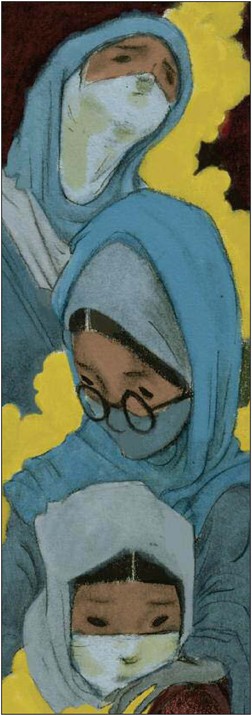
Illustration by Simone Rein
The WHO Report
In 2012, the World Health Organization (WHO) investigated reports of mass poisonings at 22 girls’ schools over the previous four years. Among the symptoms were nausea, vomiting, headaches, dizziness, fainting, and weakness. Curiously, not a single patient died and all recovered rapidly. While the domestic folk theory attributed the incidents to Taliban militants intent on preventing girls from going to school, in line with their ultra-conservative religious views, WHO concluded that these were cases of mass psychogenic illness. Episodes were typically preceded by a foul odor, which gave rise to a belief that their school was the subject of a chemical or biological attack. Some incidents were triggered by rumors that the water supply had been poisoned. Classic psychogenic indicators included the rapid spread of transient and benign symptoms, a quick recovery, poisoning rumors, high states of anxiety (feeling shaky, rapid heartbeat), the absence of environmental or biological agents, and a preponderance of female victims.8
While a one-page summary of the WHO findings was published in 2012, the full report has never been publicly released. Afghan journalist Matthieu Aikins obtained a statement from a WHO spokes-person familiar with the report, who noted that there was “No conclusive evidence of deliberate poisoning” based on blood, urine and water samples.9 In 2013, Aikins became aware of unreleased reports indicating that the United Nations, WHO and the International Security Assistance Force “had investigated the incidents for years and had never found, despite extensive laboratory tests, any evidence of toxins or poisoning—a fact that may explain ISAF’s conspicuous silence on the issue.”10
A search of over 1,300 newspapers, news websites and blogs from leading newspapers around the world, has failed to identify a single confirmed report of a mass poisoning incident at an Afghan school.11 The Global Terrorism Database operated by the Department of Homeland Security and the University of Maryland has collected 140,000 cases of terrorism since 1970. The database lists numerous reports of “mass poisonings” in Afghan schools, but has failed to document a single instance involving a fatality or serious harm.12 The first known poisoning claim associated with an Afghan school was in Khost Province in 2004 and involved three girls who became ill after eating biscuits.13,14 Curiously, while the initial report made headlines and was condemned by then Afghan president Hamid Karzai, no follow-up story ever appeared in the global media. Karzai called the alleged perpetrators “beasts” and said: “I will not call anyone an Afghan or a Muslim who poisons an eight-year-old child because she is schoolgoing.”15 Interestingly, a Taliban spokesman said he agreed with Karzai and strongly denied any responsibility.16 On numerous occasions since, Taliban officials have repeatedly and vehemently denied involvement,17 condemning such acts as un-Islamic and violations of Sharia law.18
In June 2012, the international media reported that the Afghan government had announced the arrest of 15 people including three students and a teacher for their alleged involvement in the “attacks.”19 This occurred a month after the WHO summary implicating psychogenic illness was published.20 In July 2012 it was reported that Afghanistan’s national security agency had released videotaped confessions of several suspects including two 17 year-old pupils.21 The United Nations Human Rights Unit challenged the validity of the confessions to the Afghan government.22,23