Who Invented Science?
Review of The Invention of Science: A New History of the Scientific Revolution, by David Wootton
REVIEWED BY CHRIS EDWARDS
THE TITLE OF DAVID WOOTTON’S LATEST book, The Invention of Science: A New History of the Scientific Revolution, is doubly provocative. To begin with, it defends the concept that there was in fact a series of events worthy of the title “revolution” that led to the widespread adoption of the scientific method. The title also hints at the elegant argument that is scribed on its pages: that the history of science needs to be rethought through the prism of the humanities, and rewritten in the context of global exploration and discovery during which it occurred. The humanities and the sciences split somewhere between the 1620 publication of Francis Bacon’s Novum Organum (New Organ, or New Method) and the 1717 publication of Giambattista Vico’s New Science. They have been inching closer together since Einstein made the observer part of the scientific process. The humanities and the sciences, partitioned by Bacon’s new method and Vico’s new science, have been narratively reunited by Wootton’s new history.
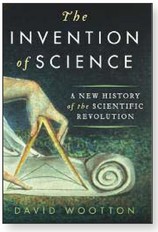
Harper, 2015. 784 pp. $35.00 ISBN 13-978-0061759529
For Wootton, the Scientific Revolution did not arrive in the West when medieval monks opened the dusty Arabic translations of Aristotle, but when Columbus sailed into the Americas. A fresh term, still sprinkled with ocean spray, animated the European language. It was “discovery.” Wootton traces the introduction of the word to a letter by Amerigo Vespucci written shortly after Columbus’s Caribbean landfall. “The invention of discovery, acting in combination with the printing press, transformed the balance between evidence and theory, tilting it away from the reinterpretation of old arguments and towards the acquisition and interpretation of new evidence” (136).
Open The Invention of Science and flip a couple of pages and you will see the cover of Bacon’s Novum Organum, pub lished in 1620. It has a ship sailing out into the ocean between the pillars of Hercules. Scientific discovery was built upon the analogy of exploratory discovery. Boats and bees (insects that leave the hive, find important things, and bring them back to make use of what they have found) were the stuff of Bacon’s imagination, so is it any wonder that his novella The New Atlantis places the perfect scientific society on an island?