Imagining No Heaven
The Rise of the Nones and the Decline of Religion
BY MICHAEL SHERMER
ARTICLE
“Imagine there’s no heaven…and at once the sky’s the limit.”—Salmon Rushdie, “Imagine No Heaven,” The Guardian, 19991
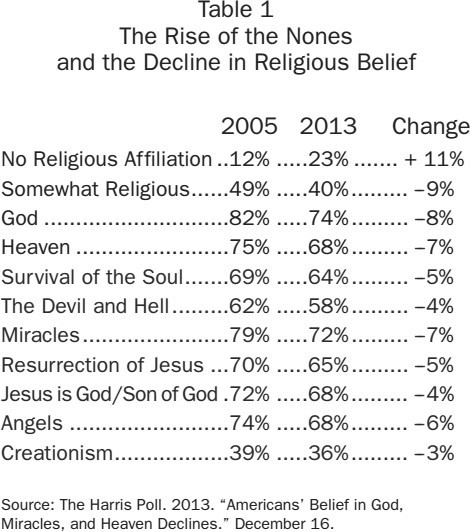
WHAT IS YOUR RELIGIOUS AFFILIATION? IF YOU DON’T have one that makes you a member of the fastest growing religious cohort in America today, the Nones, or those who check the box for “none” on surveys of religious affiliation. A 2009 study by the American Religious Identification Survey (ARIS), for example, found that between 1990 and 2008 the number of nonreligious persons in the U.S. grew by 19,838,000.2 A 2013 Harris poll on 2,250 adults found that 23 percent of all Americans and 34 percent of Millennials (those born after 1980) have forsaken religion altogether.3 Predictably, rates of belief in God, the soul, and the afterlife, along with other beliefs, are also trending downward for U.S. adults since 2005, presented in Table 1.
Reaching back even further to 2003, the Harris pollsters found an 12 percent decline in those who said they were “absolutely certain that there is a God,” from 66 percent to 54 percent, and an increase from 9 percent to 16 percent among people who said they do not believe in God (atheists), and from 12 percent to 16 percent who said they were uncertain as to God’s existence (agnostics). The raw numbers based on these percentages are staggering. With the U.S. adult population (age 18 and older) in 2013 at 240 million, 23 percent religiously unaffiliated translates into 55.2 million. Now, not all of these Nones are atheists or agnostics (many are deists, pantheists, and spiritualists of various stripes who embrace many New Age beliefs), but by the Harris poll data the 16 percent for each of these cohorts amounts to 38.4 million atheists and 38.4 million agnostics for a combined cohort of 76.8 million people. Whatever the percent overlap between the religiously unaffiliated and the combined atheists/agnostics, it still represents a powerful voting block that politicians can no longer afford to ignore.4
To those of us who are atheists, agnostics, or “spiritual but not religious,” and who prefer to keep the Constitution and the Bible in separate drawers, in 2015 the Pew Research Center released a massive representative survey of 35,000 adult Americans, confirming the 2013 Harris Poll data that the fastest growing religious group in America continues to be the Nones. According to the Pew researchers, these 56 million religiously unaffiliated adults in the U.S. are “more numerous than either Catholics or mainline Protestants,” not to mention Jews, Buddhists, Muslims, and Hindus, and “second in size only to evangelical Protestants” at 25.8 percent.5
The trend lines are as unmistakable as they are consequential. As the religious goat makes its way through the generational python, the number of nonreligious coming out the other end is growing. From the Silent Generation (born 1928-1945) at 11 percent, to Baby Boomers (born 1946-1964) at 17 percent, to Generation X (born 1965-1980) at 23 percent, to Older Millennials (born 1981-1989) at 34 percent, to Younger Millennials (born 1990-1996) at 36 percent, the decline is deep and wide. And as the sociologist of religion Phil Zuckerman pointed out to me, it is important to note that “earlier generations—that is, people who were 18-25 years old back in the 1990s, or in the 1980s, or in the 1970s, were not as irreligious, and those cohorts did not have such a high rate of unaffiliation. This point is important because people often say, ‘Well, young people are always irreligious, but they come back to the fold as they get older, get married, have kids,’ etc. And while such a trend is observable—to a degree—the fact remains that it hasn’t always been the case that 36 percent of young adults have been non-religious in decades past. So secularization is definitely happening.”6