The Last One Forgotten
Bruce Perkins and Another Terrible Tragedy of the Recovered Memory Movement
BY L KIRK HAGEN
ON OCTOBER 6, 2017, BRUCE PERKINS CELEBRATED his 73rd birthday in the Louis Powledge prison unit near Palestine, Texas. His fellow inmates at Powledge include Warren Jeffs, the convicted pedophile, former head of the Fundamentalist Church of Latter-day Saints, and Eddie Ray Routh, who was convicted in 2015 of murdering Christopher Kyle, the military sniper featured in Clint Eastwood’s film American Sniper. Unlike Jeffs and Routh, Perkins does his time in anonymity rather than in infamy, his case having been completely ignored by the press for a quartercentury. In 1993, Perkins was sentenced to four 30- year terms for aggravated sexual assault, based on testimony from what were almost certainly false memories. He is the longest-serving, and last-remaining prisoner in the U.S. whose conviction was facilitated by therapists during the moral panic of the 1990s, when the American mental health industry seemed to have lost its mind.
The panic was part of a broader aberration in clinical psychology, a discipline that in the 1980s and 1990s still lingered in a Freudian cloud. Those were also the years of alien abductions, multiple personality disorders, and satanic cults. All of those strange ideas obsessed over unconscious and repressed/recovered memories. And they all disappeared astonishingly fast. By the 2000s, extraterrestrials had stopped abducting people, devil cults had disbanded, the American Psychiatric Association had downgraded Multiple Personality Disorder (MPD) to “dissociative identity disorder,” and psychologists had quit recovered memory therapy. Bruce Perkins, on the other hand, has never quit prison. He’s a reminder that the abuse of a pseudoscience often outlives the pseudoscience itself.
Texas v. Perkins
Bruce Perkins’ ordeal began in 1990, when his daughter-in-law Trish Perkins started seeing a therapist for treatment of a mood disorder. According to Perkins’ first attorney, during her therapy Trish claimed to have recovered memories of abuse from when she was younger. She was also distressed about her children’s preoccupation with what a second therapist called “normal exploratory curiosity” with other children. Five therapists would get involved in the Perkins case before it was over.1
Eventually, Bruce’s two daughters-in-law, Trish and Patty Perkins, became convinced their children had been molested. Suspicion initially fell on the children’s playmates. At least six were singled out. The reasons why suspicions shifted to adults are unclear. Patty recalls it was Therapist #2, Carolyn Kammholz, who first insisted that an adult male was responsible. Trish, and Kammholz herself, did not remember that. Either way, the list of suspects grew. Detective Don Bynum of the Harris County Sheriff’s Office later noted that “it seems as if every male in the family must have been considered (a suspect) at one time or another.” There is no record in the trial testimony of Kammholz or Bynum having urged the parents to arrange a pediatric examination of the children.2
On October 6, 1991, Bruce’s wife Carol held a birthday party for her husband at their home in Waller, Texas, near Houston. Their sons Larin and Lann were there with their wives Trish and Patty, and Bruce’s three grandchildren. Carol remembers about 30 guests attending. Bruce and Carol’s home was spacious but not enormous; a two-story, 2,500 square foot house on about six acres. The children played inside and out, upstairs and down. The adults stayed mostly downstairs; eating, talking, and watching football. At some point, Bruce and Carol allegedly went upstairs to the master bedroom and sexually assaulted their grandchildren. Some accounts had it that seven children were abused. But it turned out that four of the seven were not even at the party. None of the adults noticed anything amiss that day or the next. Almost a year would pass before Bruce Perkins was accused.3
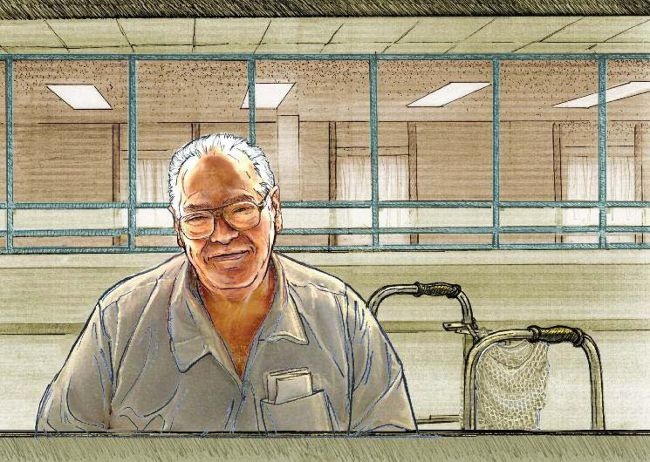
Bruce Perkins in the Louis Powledge prison unit near Palestine, Texas
In July 1992, the sons and their wives shared their suspicions of abuse with the extended family during the funeral for Carol’s father. Trish Perkins confided in Carol, who supposedly told her “I hope you don’t blame us.” When Larin confided in his father, Bruce supposedly offered the same answer, verbatim. Larin and Trish later said that Bruce and Carol soon began pressuring them to sign a release granting them access to the records of the children’s therapist. Kammholz testified she never spoke to Bruce or Carol. Larin said his parents’ behavior at the funeral “bothered him emphatically.”4