Artificial Intelligence
AI Will Not Replace Artists
It Will Devalue Them
BY KATE BRUNOTTS
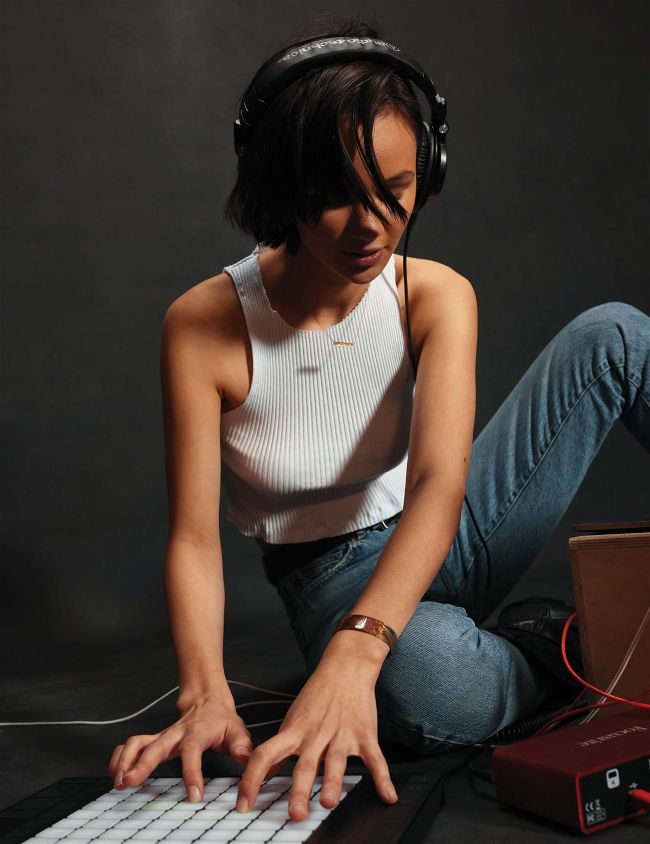
The author using an Ableton Push to build beats. Advances in technology can save musicians, artists, and writers hours of tedious grunt work, allowing them to concentrate on doing what they do best. However, without safeguards protecting artist compensation, emerging AI poses a significant threat to the livelihoods of working artists, potentially depriving them of their means to make a living.
In October of 2023, U.S. Senator Chris Coons (D), Chair of the Senate Judiciary Subcommittee on Intellectual Property, announced a draft bill entitled the No Fakes Act, or the “Nurture Originals, Foster Art, and Keep Entertainment Safe Act.”1 This bill would enable artists to sue those who use their likeness (presumably, a deep fake of their voice) without permission.
His bill is largely a reaction that traces its roots back to “Ghostwriter,” an anonymous artist who created the song Heart on My Sleeve. It utilized AI-deep fakes of vocals by two of the most popular artists in the world— The Weeknd and Drake—without their consent. It also earned a whopping 1.4 million U.S. streams before its forced removal by Universal Music Group.2
Ghostwriter is the poster child for the prediction that AI will create another stream of licensing income3 and thus revolutionize the way artists create. I hope that’s the case. But as the industry continues to extract value from music and other media with little oversight, it’s unclear who exactly is reaping the benefits.
Move Fast and Break Things
On most days, I’m making music or writing about the mechanics of doing so. It goes without saying that I have an inherent bias against the man or anything I perceive to capitalize on arts for the sole sake of profit. When ChatGPT burst into my world of self-referential music and writing, I couldn’t help but feel trepidatious.
To be clear, I’m not against utilizing certain forms of AI in my own music production process. Whether it’s using Ableton’s Magenta Studio4 to generate drum pattern ideas or playing with AI-assisted toggles in my favorite plugins, I’m no stranger to taking advantage of machine learning to feed me inklings of a great idea.
My beatmaking workflow changes from one song to the next, but for illustration purposes, I might start by writing a song on piano or guitar, and then record that into my music-making software, Ableton Live. I can then start to build the beat (drums, synthesizers, and other instrumentation) around what I’ve recorded. I might open a plugin where I can input the key and the tempo of my composition, and the plugin might suggest some samples that I can add to my song. In the case of a plugin such as Magenta Studio, with the click of a button, the AI-assisted suite can generate drum patterns, melodies, and more musical elements based on what I’ve already created In this way, I occasionally use AI technology to act as a writing partner, though it’s important to me that I resample the initial idea provided by the plugin. This could mean shifting the pitch of the sample, chopping and splicing it to make something new, or adding effects to place it within the artistic world of my song. I try to use AI as a tool to fuel and assist my creative processes, rather than as a substitute or replacement for them.