Crime and Punishment
From the Wild West to the Modern West
BY MICHAEL SHERMER
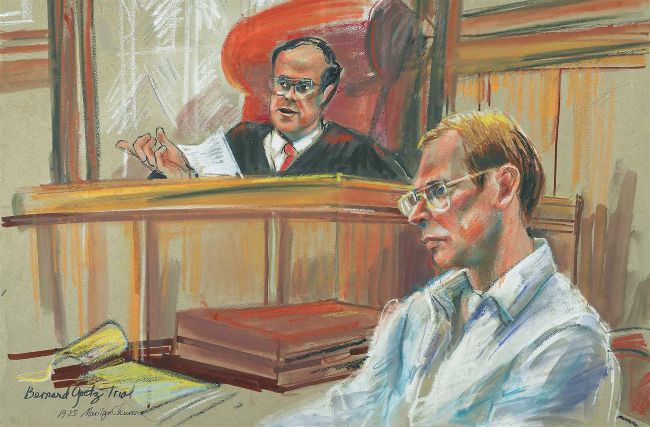
Bernhard Goetz on trial after taking the law into his own hands, igniting a national debate on crime and self-defense in 1980s New York City. (Credit: Prints and Photographs Division, Library of Congress (059.00.00) LC-DIG-ppmsca-31214 © Marilyn Church)
In the long history of civilization, self-help justice conducted by individuals has gradually been replaced with criminal justice conducted by the state. The former leads to higher rates of violence than the latter, due to the lack of an objective third party to oversee the process. Governments, despite their many and various faults, have more checks and balances than individuals. This is why Justitia—the Roman goddess of justice—is often depicted wearing a blindfold, symbolizing blind justice and impartiality; in her left hand she carries a scale on which to weigh the evidence, a symbol for a balanced outcome; and in her right hand she wields the double-edged sword of reason and justice, symbolizing her power to enforce the law.
Of course, it is not an either-or situation—non-state versus state justice systems; it is, rather, a sliding scale from small communities with no central authority or independent judicial system, to chiefdoms in which a single authority (the chief, or “big man”) resolves conflicts, to small and weak states where individuals employ self-help justice when they feel the state’s justice system has failed them, to large and strong states with relatively effective judicial systems, to totalitarian states where justice is whatever the authorities (or autocrat) say it is.
The modern West’s system of criminal justice marked a big improvement over the medieval system of torturing first and asking questions later. In the 18th century, scholars such as Jeremy Bentham and Cesare Beccaria made the case that “the punishment should fit the crime” with the overall goal of “the greatest happiness of the greatest number” being the calculus for justice.1
The goal of modern Western judicial systems is to prevent citizens from using fraud or force against one another when disputes arise. When citizens undertake self-help justice, it results in a net loss to the state since it often escalates into endless cycles of violence. Today, governments adjudicate crimes and disputes through two justice systems: criminal and civil. Criminal justice deals with crimes against the laws of the land that are punishable only by the state. Civil justice deals with disputes between individuals or groups, such as contract violations, property damage, or bodily injury, and the court’s say is final in determining liability and thereby determining appropriate compensation. Criminal justice involves mostly retribution. Civil justice involves both retribution and restoration (through assessed compensation). For both forms of justice, states claim a monopoly on the legitimate use of force, with the goal of deterring future crimes against citizens of the society.
This is why criminal cases are labeled The State v. John Doe or The People v. Jane Roe. The state (or in monarchies, “the crown”) is the injured party. My home state of California, for example, actively continues to pursue charges against the filmmaker Roman Polanski for unlawful sexual intercourse with a minor in 1977, even though she—now a woman in her 60s—has publicly forgiven him and repeatedly petitioned the state to drop the charges, and even though Polanski lives in France with no intention of ever returning to the U.S. to face arrest and incarceration.
This is also why, in areas of Western nations where citizens do not feel that the law is fair to them—for example, in parts of the United States where the police and courts are perceived to be racist—individuals often take the law into their own hands, what used to be called “frontier justice” but is now known as “self-help justice,” or plain old “vigilantism.” Consider the case of inner city violence where crime rates are much higher than elsewhere. The primary reason for this violence is gang-related illegal drug trafficking. Since drug dealers cannot turn to the state to settle disputes with other drug dealers, self-help justice is their only option. As such, criminal gangs emerge, which enforce a different sort of justice, sometimes violently.2
In such circumstances, ordinary citizens occasionally feel pressed to take the law into their own hands, as Bernhard Goetz did on December 22, 1984, when four young men approached him on a New York City subway in what he perceived to be in a threatening manner, intent on robbing him. At the time of this incident, New York City was in the throes of one of the biggest crime waves in American history, having seen its rate of violent crime skyrocket nearly fourfold from 325 to 1,100 per 100,000 people in only a decade. In fact, three years prior to this incident, three young men had robbed Goetz and then tossed him through a plate glass door. Although one of his attackers was caught, he was charged only with criminal mischief for ripping Goetz’s jacket and released from the police station even sooner than was Goetz. That criminal went on to mug again, leaving Goetz skeptical of the criminal justice system and the police’s capacity to protect him from harm. In order to protect himself, he then went out and purchased a handgun. When Goetz applied for a concealed carry permit, on the basis that he routinely carried valuable equipment and large sums of cash, his application was denied on the basis of “insufficient need,” thus increasing his frustration and decreasing his faith in the NYC judicial system.