Fighting Each Other
How U.S. Intelligence Rivalries Hampered the Battle Against Islamic Terrorism
BY GERALD POSNER
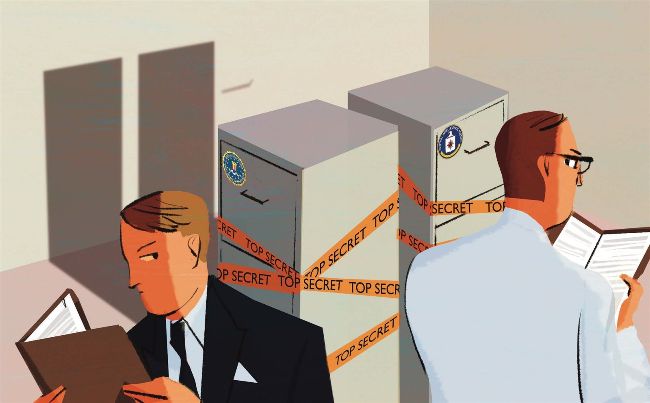
Illustration by Richard Allen
“If there is no enemy within, the enemy outside can do us no harm.”1
Ever since a Hezbollah suicide bomber in 1983 blew up a truck packed with explosives and killed 241 Marines in intelligence, security, and law enforcement agencies. However, for those of us who have followed the spiraling growth of Islamic terrorism in the 1980s and 1990s, it seemed as if the U.S was sluggishly reactive. They made little headway in extensive counterterrorism programs designed at penetrating and dismantling Islamic terror groups.2
The 9/11 attack put a spotlight on the failures of the security agencies tasked to protect the U.S. against acts of terror. How was it possible for 19 hijackers and their ambitious plot to remain off the radar of intelligence and law enforcement? The truth, as I discovered during 18 months of reporting for my book, Why America Slept: The Failure to Prevent 9/11, was not that the plot had gone undetected, but rather that the agencies responsible for monitoring and fighting terrorism had failed to share information, something that would have made it possible to connect the dots before the attack occurred.
The failures were more substantive than mere interagency rivalries between the CIA, FBI, NSA, and local law enforcement. Exclusive interviews I had with top intelligence officers and FBI officials revealed that the origins and depth of the dysfunction inside America’s counterintelligence programs was an internecine bureaucratic war that left little room for working together. Sharing information was given lip service but seldom practiced, particularly when the intelligence at stake was judged as having “high value.”
The most serious failure was the CIA’s tracking of two terrorists, Khalid al-Mihdhar and Nawaf al-Hazmi, when they moved from Saudi Arabia to California in 2000. If the CIA had alerted the State Department, the two Saudis would have been on a watch list that barred them from entering the United States. Once in California, however, the CIA could not legally monitor them domestically. The Agency not only lost track of the two Saudis but failed to let the FBI, which is specifically authorized to act within the U.S., know they were here.
In July of 2001, only two months before 9/11, an FBI memo warned the American intelligence community that some bin Laden followers might be training at U.S. flight schools in preparation for an aerial terror attack. The CIA was unaware that al-Mihdhar and al-Hazmi had taken flight training while living in the U.S.
If the CIA had shared its information about the two Saudis, al-Mihdhar might have been detained in June 2001, when he returned to Saudi Arabia and his visa had expired. Or when an Oklahoma state trooper pulled over al-Hazmi for speeding and a driver’s license check in the national database would have triggered security alerts. Sharing the CIA security concerns about the duo would have meant the Transportation Department had a red flag on them. The pair even used their own names when making reservations on American Airlines Flight 77, which was flown into the Pentagon.
“Responsibility and accountability were diffuse,” the 9/11 Commission Report concluded a year after I had published Why America Slept.3 That was a diplomatic understatement of the paralyzing dysfunction between intelligence and security agencies and policy makers. The unintended consequence of such discord was to give the advantage invariably to the terrorists.
My reporting revealed that the dearth of cooperation between the country’s top security and intelligence services was not new to 9/11. Exposing how and why the breakdowns to communicate between agencies had begun and persisted for decades explains why the world’s best law enforcement and intelligences agencies ended up fighting each other instead of combating Islamic terrorism.
“We knew that the Islamic threat was the next security problem for the U.S., and we had known it since the 1970s,” Duane “Dewey” Clarridge told me in a rare no-questions-off-limit interview in the wake of 9/11.4 Clarridge was a CIA legend. He was twenty-three when he joined the Agency in 1955 and over the next thirty years earned a reputation as one of its most accomplished covert operatives. Clarridge served in Nepal, India, and Turkey, before returning to headquarters in the 1970s. He became the chief of covert operations for the Near East Division, later ran Arab covert ops, then moved to the Latin American Division, before becoming the Rome station chief. It was during his three years in Arab operations that Clarridge became familiar with the key Islamic terrorists.