Did Prohibition Really Work?
Alcohol Prohibition as a Public Health Innovation
BY JACK S. BLOCKER
Probably few gaps between scholarly knowledge and popular conventional wisdom are as wide as the one regarding National Prohibition. “Everyone knows” that Prohibition failed because Americans did not stop drinking following ratification of the Eighteenth Amendment in 1919 and passage of its enforcement legislation, the Volstead Act. If the question arises why Americans adopted such a futile measure in the first place, the unnatural atmosphere of wartime is cited. Liquor’s illegal status furnished the soil in which organized crime flourished. The conclusive proof of Prohibition’s failure is, of course, the fact that the Eighteenth Amendment became the only constitutional amendment to be repealed.
Historians have shown, however, that National Prohibition was no fluke, but rather the fruit of a century-long series of temperance movements springing from deep roots in the American reform tradition. Furthermore, Americans were not alone during the first quarter of the 20th century in adopting prohibition on a large scale: other jurisdictions enacting similar measures included Iceland, Finland, Norway, both czarist Russia and the Soviet Union, Canadian provinces, and Canada’s federal government.1 A majority of New Zealand voters twice approved national prohibition but never got it. As a result of 100 years of temperance agitation, the American cultural climate at the time Prohibition went into effect was deeply hostile to alcohol, and this antagonism manifested itself clearly through a wave of successful referenda on statewide prohibition.
Although organized crime flourished under its sway, Prohibition was not responsible for its appearance, as organized crime’s post-Repeal persistence has demonstrated. Drinking habits underwent a drastic change during the Prohibition Era, and Prohibition’s flattening effect on per capita consumption continued long after Repeal, as did a substantial hard core of popular support for Prohibition’s return. Repeal itself became possible in 1933 primarily because of a radically altered economic context—the Great Depression. Nevertheless, the failure of National Prohibition continues to be cited without contradiction in debates over matters ranging from the proper scope of government action to specific issues such as control of other consciousness-altering drugs, smoking, and guns.
We historians collectively are partly to blame for this gap. We simply have not synthesized from disparate studies a compelling alternative to popular perception.2 Nevertheless, historians are not entirely culpable for prevalent misunderstanding; also responsible are changed cultural attitudes toward drinking, which, ironically, Prohibition itself helped to shape. Thinking of Prohibition as a public health innovation offers a potentially fruitful path toward comprehending both the story of the dry era and the reasons why it continues to be misunderstood.
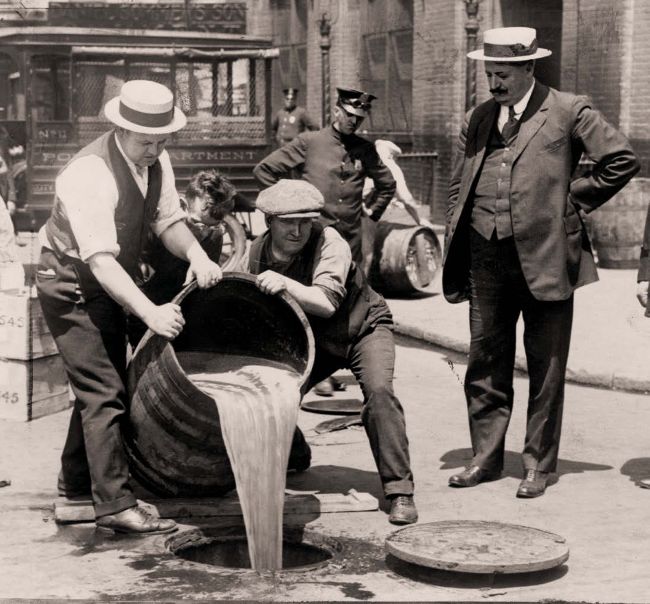
Government agents pour out barrels of illegal liquor, under the watchful eye of the NYPD, during a Prohibition-era raid. (Source: Library of Congress, Prints and Photographs Division, Washington, DC, 1921)
Temperance Thought Before National Prohibition
Although many prohibitionists were motivated by religious faith, American temperance reformers learned from an early point in their movement’s history to present their message in ways that would appeal widely to citizens of a society characterized by divergent and clashing scriptural interpretations. Temperance, its advocates promised, would energize political reform, promote community welfare, and improve public health. Prohibitionism, which was inherently political, required even more urgent pressing of such claims for societal improvement.3 Through local contests in communities across the nation, liquor control in general and Prohibition in particular became the principal stage on which Americans confronted public health issues, long before public health became a field of professional endeavor.
By the beginning of the 20th century, prohibitionists agreed that a powerful liquor industry posed the greatest threat to American society and that only Prohibition could prevent Americans from falling victim to its seductive wiles. These conclusions were neither willful nor arbitrary, as they had been reached after three quarters of a century of experience. Goals short of total abstinence from all that could intoxicate and less coercive means—such as self-help, mutual support, medical treatment, and sober recreation—had been tried and, prohibitionists agreed, had been found wanting.4
For prohibitionists, as for other progressives, the only battleground where a meaningful victory might be won was the collective: the community, the state, or the nation. The Anti-Saloon League (ASL), which won leadership of the movement after 1905, was so focused on Prohibition that it did not even require of its members a pledge of personal abstinence. Battles fought on public ground certainly heightened popular awareness of the dangers of alcohol. In the mass media before 1920, John Barleycorn found few friends. Popular fiction, theater, and the new movies rarely represented drinking in positive terms and consistently portrayed drinkers as flawed characters. Most family magazines, and even many daily newspapers, rejected liquor ads.5 New physiological and epidemiological studies published around the turn of the century portrayed alcohol as a depressant and plausibly associated its use with crime, mental illness, and disease. The American Medical Association went on record in opposition to the use of alcohol for either beverage or therapeutic purposes.6 But most public discourse on alcohol centered on its social, not individual, effects.7
The only significant exception was temperance education in the schools. By 1901, every state required that its schools incorporate “Scientific Temperance Instruction” into the curriculum, and one half of the nation’s school districts further mandated use of a textbook that portrayed liquor as invariably an addictive poison. But even as it swept through legislative chambers, the movement to indoctrinate children in temperance ideology failed to carry with it the educators on whose cooperation its success in the classrooms depended; teachers tended to regard Scientific Temperance Instruction as neither scientific nor temperate. After 1906, temperance instruction became subsumed within more general lessons on hygiene, and hygiene classes taught that the greatest threats to health were environmental, and the proper responses were correspondingly social, not individual.8